

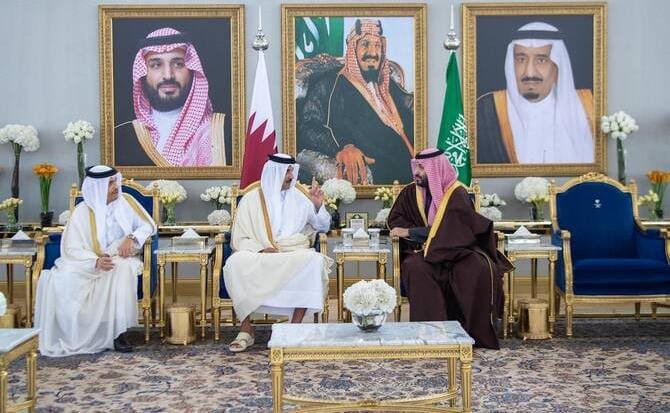
A major breakthrough in regional connectivity has taken shape in the Gulf as Saudi Arabia and Qatar have agreed to build a modern high-speed railway that will directly link their two capitals. This development marks a dramatic shift from the days of strained relations and shows how deeply the region is now moving toward economic integration, technological advancement, and long-term stability. The announcement came during high-level discussions in Riyadh, where senior leadership from both countries reviewed joint development plans and approved one of the most ambitious transport projects ever proposed between the two nations.
At the center of this initiative is a new electric rail system designed to stretch nearly eight hundred kilometers across the desert, connecting King Salman International Airport in Riyadh to Hamad International Airport in Doha. Unlike existing car or bus routes that require long road journeys, this railway aims to cut the travel time between the two cities to only two hours. The trains planned for this corridor will run at exceptionally high speeds, surpassing three hundred kilometers per hour, making the trip not only faster but also more comfortable and environmentally friendly.
The railway is expected to carry millions of passengers every year once fully operational. This includes everyday travelers, families, students, business executives, and tourists. The passenger flow will be further supported by multiple stops along the route that will serve key Saudi cities such as Hofuf and Dammam, turning the project into a regional backbone instead of a simple city-to-city connection. By linking these strategic locations, the project is set to open new economic corridors, attract new investments, and encourage greater mobility within the Gulf.
Both countries have agreed that the project should be completed within six years. Construction will unfold in stages, gradually linking districts, expanding rail stations, and integrating advanced signaling systems, smart safety controls, and cutting-edge electric technology. From the design of the tracks to the engineering of the stations, the objective is to meet the highest global standards of efficiency, speed, and durability. The system will operate entirely on electric power, which aligns with both governments’ long-term vision for reducing carbon emissions and moving towards greener energy options.
The deal is also expected to create tens of thousands of direct and indirect jobs over the coming years. Engineers, technicians, transport specialists, construction workers, and project managers will be required in large numbers. Beyond employment, the railway is projected to generate a substantial economic impact, with estimates indicating that its contribution could exceed one hundred billion riyals once the system begins operations and related commercial activities take off. This includes new hospitality projects, business districts, urban redevelopments, and logistic centers expected to emerge along the route.
One of the strongest arguments in favor of this corridor is how it will reshape regional trade. Freight transport may be added in later phases, but even in its passenger-focused stage, the line will ease business mobility and enhance commercial exchanges. Companies operating in both countries will benefit from quicker travel, reduced reliance on air connections, and increased meeting-to-meeting efficiency. For tourism authorities, the line represents a tremendous opportunity: visitors landing in either capital will be able to reach the other country within hours, expanding short-stay tourism and encouraging joint cultural events, sports gatherings, and festivals.
The symbolism behind this agreement is equally significant. Relations between Saudi Arabia and Qatar have seen major transformation in recent years. What was once a period of political distance has gradually evolved into renewed cooperation and mutual trust. This railway contract shows a clear determination by both sides to deepen their partnership, expand diplomatic channels, and build shared opportunities for future generations. It is widely seen as one of the most powerful indicators of how the Gulf region is unifying its economic vision and putting aside past differences.
Another crucial aspect of the project is its contribution to environmental sustainability. Road transport currently dominates movement between the two countries, but long-distance traffic contributes heavily to pollution and fuel consumption. The new line, running fully on electricity, will sharply reduce carbon emissions. The shift to a modern rail system aligns perfectly with national development strategies aimed at making transportation cleaner, smarter, and more technologically advanced. Planners intend for the entire operation to rely on energy-efficient solutions, automated monitoring, and digital systems that keep the trains running safely even at extremely high speeds.
The project also reflects a larger movement in the Gulf toward railway integration. Plans are underway to expand rail connectivity across neighboring states, and this line could eventually form part of a broader network that connects multiple Gulf capitals in the future. Such connectivity would support trade blocks, harmonize economic policies, improve workforce mobility, and enhance overall regional stability. By initiating this key section first, the two countries are taking a practical step toward turning long-discussed regional infrastructure dreams into real projects.
At the leadership level, both sides expressed confidence that the railway will set a new benchmark for cooperation. The agreement was signed in the presence of top ministers responsible for transport, logistics, and infrastructure development. Their participation reflects strong government backing, ensuring that funding, planning, and regulatory support remain smooth throughout the coming years. The presence of senior officials from both countries further highlighted the seriousness of the commitment and confirmed that the project is progressing with full political endorsement.
Bilateral trade between Saudi Arabia and Qatar has already witnessed dramatic growth, multiplying several times over the past few years. With improved transport links, this upward trend is expected to accelerate even further. Easier movement of people naturally leads to increased business confidence, and companies benefit when travel barriers are reduced. The high-speed line will also help businesses engage in regional events, exhibitions, and economic forums more easily.
In the broader context, this agreement is a reflection of how global trends are reshaping transportation. High-speed railways have become an essential part of modern infrastructure in many advanced nations, bringing cities closer and boosting economies. By adopting this technology, Saudi Arabia and Qatar are signaling their readiness to join the world’s most forward-thinking transport networks. The project represents a shift in mindset — moving away from traditional mobility patterns and embracing futuristic solutions.
This new high-speed railway is much more than a transportation project. It is a declaration of cooperation, a step toward economic integration, a catalyst for sustainable growth, and a symbol of how the Gulf region is reinventing itself. When the first train departs from Riyadh toward Doha in the years ahead, it will not simply be carrying passengers — it will be carrying a new chapter of regional unity and progress.