

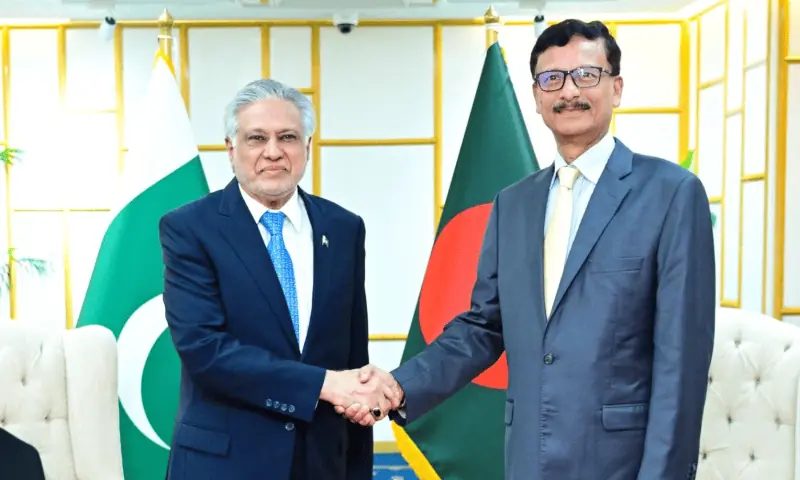
Dhaka has indicated that it could strategically consider joining a regional bloc with Pakistan in the future a grouping that may potentially exclude India according to a top Bangladeshi official.
Md Touhid Hossain, Bangladesh’s Foreign Adviser, told the state-owned Bangladesh Sangbad Sangstha (BSS) on Wednesday that while it is strategically feasible for Dhaka to participate in such a bloc, similar arrangements would be difficult for other South Asian countries like Nepal or Bhutan. It is possible for us (Bangladesh) strategically (but) it is not possible for Nepal or Bhutan to form a grouping with Pakistan excluding India, Hossain said.
Hossain’s remarks appear to be a response to comments made by Pakistan’s Foreign Minister Ishaq Dar at the recent ‘Islamabad Conclave,’ where he discussed a trilateral initiative involving Bangladesh, China, and Pakistan. Dar hinted that this initiative could expand to include additional countries within the region and beyond. Mr. Dar has said something, and perhaps at some point this could see some progress, Hossain noted.
Relations between Pakistan and Bangladesh have historically been complex and tense, dating back to Bangladesh’s independence in 1971. However, the recent political developments in Bangladesh, including the popular uprising that led to the ouster of Sheikh Hasina’s government in August 2024, appear to have opened a window for cautious diplomatic engagement.
In August 2025, Foreign Minister Ishaq Dar visited Bangladesh for the first time in 13 years, marking a significant step in reviving bilateral relations. Additionally, Prime Minister Shehbaz Sharif of Pakistan and Bangladesh’s Chief Adviser Muhammad Yunus have held cordial meetings in recent months, further signaling a thaw in historically strained ties.
Analysts suggest that Bangladesh’s potential participation in a Pakistan-led bloc could have wide-ranging geopolitical implications in South Asia. Such a move might strengthen strategic ties between Dhaka and Islamabad while simultaneously creating a grouping that excludes India, a major regional player. Hossain emphasized that Nepal and Bhutan would find it difficult to engage in a similar framework, highlighting Bangladesh’s unique position and geopolitical leverage.
While details remain speculative, the proposed bloc could focus on economic cooperation, regional security, trade facilitation, and infrastructure connectivity, particularly in sectors aligned with Chinese investment and strategic interests. However, officials caution that any concrete progress would require careful navigation of historical sensitivities, regional rivalries, and domestic political dynamics.
Although the discussions are at a conceptual stage, the comments from Hossain and Dar suggest a willingness on both sides to explore selective cooperation. Observers note that this could form part of a broader trend of regional realignment, where countries reassess partnerships based on strategic and economic considerations rather than traditional political alignments.
Hossain stressed that any engagement with Pakistan would be strategic and carefully calculated, reflecting Bangladesh’s efforts to diversify its foreign relations and safeguard its national interests. The next steps may involve feasibility studies, confidence-building measures, and bilateral consultations to ensure mutual benefits without destabilizing the broader South Asian regional balance.