

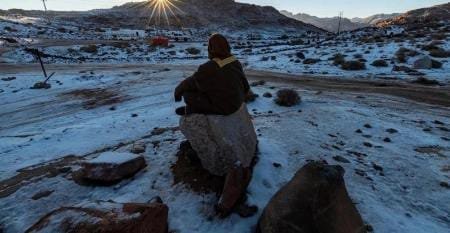
Saudi Arabia has once again witnessed weather conditions in recent days that have surprised both experts and the general public, with scenes emerging that are not usually associated with the region. Intense cold, unusually low temperatures, and signs of snowfall in some northern and elevated areas have made it clear that this year’s weather pattern is significantly different from what is normally expected. As a result, meteorologists are closely monitoring the situation and urging the public to take precautionary measures.
According to Hussein Al-Qahtani, spokesperson for the National Center for Meteorology, the recent weather changes are part of a widespread cold wave that has affected several regions of Saudi Arabia. He explained that particularly in the northern parts of Riyadh and in certain areas of Qassim, weather possibilities are developing that have rarely been observed in previous years. He described the chances of snowfall in these regions as unusual, emphasizing that this situation reflects the broader pattern of atypical climatic conditions currently prevailing in the country.
Al-Qahtani further stated that snowfall has already been recorded in elevated areas of Tabuk and Hail in the northern part of the Kingdom, which confirms that this cold wave is not limited merely to a drop in temperatures but has far more pronounced effects. According to him, these regions have experienced a clear and noticeable decline in temperatures, and although snowfall is not occurring everywhere, its presence in specific locations is evident. Taken together, these factors indicate that the weather has deviated from its usual course and adopted a distinctly different pattern.
He added that in some locations, temperatures may fall below zero degrees Celsius, while in certain areas they could drop as low as minus two degrees. These figures clearly illustrate the severity of the cold wave and demonstrate its direct and tangible impact. In this context, he strongly urged the public to take weather warnings seriously and to strictly follow official instructions in order to avoid potential risks.
Al-Qahtani emphasized that obtaining the latest and most accurate weather updates through official channels of the National Center for Meteorology is essential. He specifically mentioned the “Anwaa” application, the automated alert system, and other official platforms of the center as reliable sources for timely information. He also noted that those who wish to enjoy or observe these weather phenomena should act responsibly and choose appropriate times and safe locations in line with the guidance of relevant authorities, so they can witness these conditions without putting themselves in danger.
Meanwhile, climate experts are also sharing their perspectives on the situation. Dr. Abdullah Al-Musanad, former professor at Qassim University and Vice President of the Saudi Weather and Climate Society, explained on his official social media account that snowstorms do occasionally occur in northern Saudi Arabia, but they are usually confined to very limited geographical areas and last for only short periods. According to him, historical records do include such events, but they are neither common nor a regular annual occurrence.
Dr. Al-Musanad further clarified that specific geographical factors play a crucial role in snowfall within Saudi Arabia. Either the land must be at a significant elevation above sea level, such as in the Jabal Al-Lawz area, or the location must lie in the far northern parts of the country, where colder air masses exert a stronger influence. Without these factors, the likelihood of snowfall becomes extremely low, regardless of how intense the cold may be.
He went on to explain that snowfall requires more than just low temperatures; rather, it depends on a complex combination of natural conditions. For instance, surface temperatures need to be at or below zero to two degrees Celsius, while both lower and upper layers of the atmosphere must contain relatively high levels of moisture. In addition, the dew point must be close to zero. Unless all of these conditions are met simultaneously, the chances of snowfall remain very limited.
According to Dr. Al-Musanad, this is precisely why snowfall is considered a rare phenomenon in most parts of Saudi Arabia. He referred to historical examples to illustrate how infrequently these conditions align. One notable instance occurred in January 1973, when snowfall was recorded in Riyadh and Diriyah for approximately three hours. This event is still remembered as an exceptional meteorological occurrence, as snowfall in these areas is generally regarded as highly unlikely.
In light of the current situation, experts stress that while these weather conditions may be fascinating and attract public curiosity, caution is extremely important. Severe cold, slippery surfaces, and freezing temperatures can affect human health and disrupt daily life. Therefore, residents are advised to avoid unnecessary travel, wear appropriate warm clothing, and pay close attention to weather forecasts rather than ignoring them.