

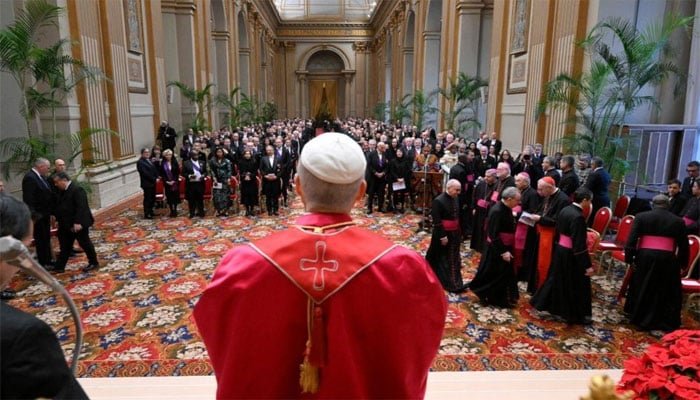
Vatican City: In a sobering address on Friday, Pope Leo XIV cautioned the international community against abandoning diplomacy in favor of coercion and military might, warning that the world is witnessing a troubling resurgence of war and a growing disregard for human rights.
Delivering his annual foreign policy speech at the Vatican, the Pope said, we are entering an era where nations increasingly rely on force rather than dialogue, and the madness of war is spreading once again. Yet, the law of human rights must always prevail, and the dignity of every individual must remain inviolable.
Highlighting the dangers posed by modern conflicts, Pope Leo condemned the deliberate targeting of civilians in war zones, calling it an affront to fundamental principles of morality and international law. He stressed that global powers and governments must prioritize the protection of non-combatants and respect humanitarian norms in all crises.
The Pontiff also expressed concern over shrinking freedoms in democratic societies. Freedom of expression is rapidly eroding in some Western nations, he said, urging governments to safeguard civil liberties even amid political and security challenges.
Turning his attention to Latin America, Pope Leo urged the international community to respect the will of the people of Venezuela and ensure full protection of both human and civil rights. He emphasized that long-term peace and stability can only be achieved through dialogue, accountability, and adherence to legal and ethical standards.
Pope Leo further criticized the weakening of international institutions, noting that their diminished effectiveness has contributed to the resurgence of global conflict. When international organizations falter, the risk of war increases, and societies suffer the consequences, he warned, calling for urgent reforms to strengthen global governance mechanisms.
Analysts say the Pope’s remarks are a clear critique of rising militarism and unilateral interventions, which have escalated tensions in regions from Eastern Europe to Latin America. By linking the erosion of democracy in Western countries with the resurgence of war elsewhere, the Pontiff is drawing attention to the interconnectedness of global peace, human rights, and good governance.
The Pope concluded his address with a call for international solidarity, urging nations to embrace diplomacy, multilateral cooperation, and justice as the guiding principles of foreign policy. “True security is not built on weapons or coercion, but on dialogue, justice, and the respect of every human life,” he said.
Observers note that this address comes at a critical time, as geopolitical rivalries intensify, international institutions face increasing strain, and civil liberties in many countries are under pressure. Pope Leo XIV’s message underscores the need for moral leadership, not only from governments but from all stakeholders in the international community.