

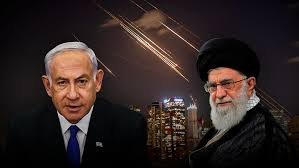
Rising tensions in the Middle East have once again placed Israel and Iran at the center of regional and global attention, as political rhetoric and military preparedness intensify. Recent developments suggest that the situation is entering a particularly sensitive phase, with senior Israeli officials signaling readiness for a forceful response should hostilities escalate. The atmosphere is marked by strategic calculations, diplomatic uncertainty, and heightened military alertness across multiple fronts.
Israeli Prime Minister Benjamin Netanyahu delivered a stern warning during a televised address at a military ceremony, emphasizing that Israel would respond decisively to any Iranian attack. He made it clear that Israel would not tolerate aggression against its territory or citizens and that any miscalculation by Tehran would result in consequences far beyond expectations. His remarks were widely interpreted as a direct message to Iran’s Supreme Leader, Ali Khamenei, underscoring the seriousness of Israel’s position.
The Prime Minister’s comments came shortly after renewed signals from U.S. President Donald Trump, who indicated that military action against Tehran remained a possibility. Although no formal announcement has been made regarding specific operations, the tone from Washington has reinforced speculation that contingency plans are under active consideration. Observers note that the alignment between Israeli and American rhetoric suggests close coordination at the strategic level.
Israeli media outlets, including Yedioth Ahronoth, have reported a significant shift in official assessments. Where earlier estimates suggested that any potential confrontation might unfold within weeks or even a month, more recent evaluations describe the timeframe as a matter of days. This revised outlook reflects what analysts describe as rapidly evolving political and military dynamics on the ground.
According to two Israeli sources who spoke to CNN, Israel has elevated its state of alert and accelerated operational preparations. Defensive systems have reportedly been reinforced, and contingency plans refined in anticipation of various escalation scenarios. One of the sources, identified as having military ties, indicated that discussions of a coordinated strike involving both the United States and Israel are no longer hypothetical but part of active strategic dialogue.
Israeli officials have reportedly maintained skepticism regarding ongoing diplomatic contacts between Washington and Tehran. While recent rounds of indirect negotiations were described publicly as constructive, Israeli leadership has continued to question whether diplomacy alone can effectively curb Iran’s strategic ambitions. As a result, Israel has intensified its defensive and operational planning even as diplomatic channels remain technically open.
One source suggested that if authorization were granted by the U.S. President, any prospective military operation could exceed previous limited engagements in scale and scope. Some analysts have referenced comparisons to earlier brief confrontations, suggesting that a new phase of conflict—should it occur—might involve broader coordinated strikes rather than isolated exchanges. Such an escalation would carry significant regional implications, potentially drawing in additional actors or destabilizing already fragile security balances.
Within Israel’s political and defense institutions, preparations appear equally serious. The Knesset’s Foreign Affairs and Defense Committee convened a closed-door session with the head of the Home Front Command to assess domestic readiness. Discussions reportedly focused on civil defense measures, emergency response planning, and infrastructure resilience. Committee officials acknowledged the gravity of the situation but emphasized that both the government and the public are prepared for a range of possible outcomes.
Former Israeli Military Intelligence chief Amos Yadlin also weighed in publicly, stating in a televised interview that the region appears closer to direct confrontation than at any point in recent months. He cautioned that miscalculations in such a volatile environment could quickly spiral into broader conflict. His remarks reflected a wider concern among security experts that the margin for error is shrinking.
Beyond Israel and Iran, regional and international stakeholders are closely monitoring developments. A direct military confrontation involving the United States would have far-reaching consequences—not only for Middle Eastern security but also for global economic stability. Energy markets, trade routes, and diplomatic alliances could all be affected by sustained hostilities. Gulf states, European governments, and Asian economies with strong ties to regional energy supplies are particularly attentive to the unfolding situation.
At the same time, analysts caution that forceful rhetoric does not always translate into immediate action. Public warnings may serve strategic purposes, including deterrence or negotiation leverage. Strong language can be intended to signal resolve while still leaving space for diplomatic de-escalation. However, the parallel increase in military readiness suggests that governments are preparing for scenarios beyond symbolic posturing.
The broader strategic landscape remains complex. Iran has consistently asserted its right to defend itself against perceived threats, while Israel has repeatedly emphasized its commitment to preventing what it views as existential risks. The United States, positioned as a pivotal actor in the equation, faces decisions that could reshape regional alignments.
The current climate is defined by heightened vigilance, sharpened rhetoric, and rapid strategic recalibration. Whether the coming days will lead to intensified diplomacy or open confrontation remains uncertain. What is clear, however, is that the stakes are high. Decisions made in the immediate future could significantly influence the trajectory of regional stability and international security. For now, governments, analysts, and citizens alike await the next move in what has become a delicate and potentially consequential geopolitical standoff.