

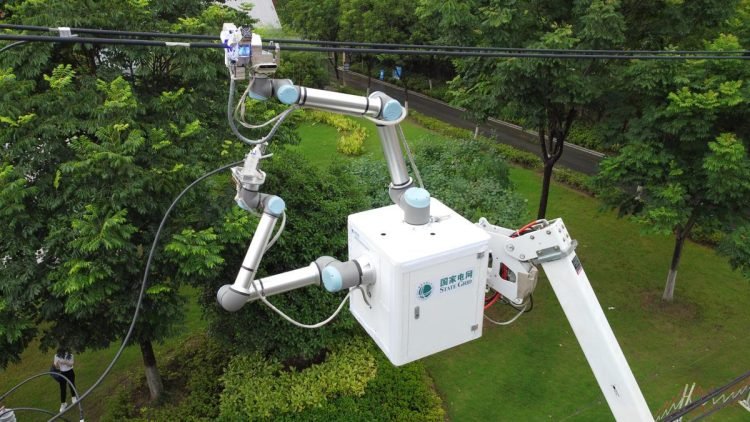
In a remarkable demonstration of technological innovation, China has introduced an advanced electrician robot capable of repairing high-tension power lines, astonishing experts and showcasing new possibilities for worker safety in the electricity sector. The experiment took place in Chongxin County, Hubei Province, where the robot successfully carried out complex repairs that would have been extremely dangerous for human workers. This event highlights the potential of automation to enhance operational efficiency while safeguarding human lives.
The robot was developed through a joint collaboration between the Hubei Electric Power Research Institute and the *Wuhan State Grid. It has been designed specifically to operate in environments with high-voltage electrical systems and intricate wiring networks, which are traditionally challenging and hazardous for humans. Utilizing *precision laser cutting technology, the robot can skillfully connect sub-wires to main lines, correctly install electrical connections, and troubleshoot various technical problems with exceptional accuracy.
Wu Zhen, a technician at the Wuhan State Grid, praised the robot’s performance, explaining that it is capable of operating even in highly complex wiring systems where human access is difficult or unsafe. He emphasized that the robot eliminates the risk of electric shocks entirely, ensuring maximum safety for personnel. According to Wu Zhen, the machine can handle scenarios that would otherwise be life-threatening for human electricians, making it an invaluable tool for high-risk environments.
Media reports indicate that the primary goal of this experiment was to enhance the safety of workers handling high-voltage electricity. Maintenance, repairs, and electrical line connections are inherently dangerous tasks, and even minor human errors can have serious consequences. The deployment of this robot mitigates these risks by performing tasks with precision and reliability, ensuring that repairs are completed safely and efficiently.
The robot is not limited to simple repair tasks; it can install new connections, inspect existing wiring, and correct faults immediately. Wu Zhen highlighted that this technology reduces the need for human intervention in high-risk areas, allowing personnel to focus on supervision and monitoring while the robot performs the critical hands-on work. The experiment demonstrated that the robot could effectively understand and navigate the complex electrical network, executing repairs with both accuracy and safety.
The implementation of such robotic technology has far-reaching implications not only in China but globally. High-voltage maintenance, electrical distribution, and complex wiring operations could increasingly rely on autonomous robots to reduce human exposure to hazardous conditions. By taking over dangerous tasks, the robot can prevent accidents, enhance operational speed, and improve the quality of electrical repairs.
Precision laser cutting allows the robot to make exact connections, ensuring long-term durability and reducing the likelihood of future faults. Every connection is analyzed and executed automatically, eliminating the errors that may occur during manual work. As a result, power supply disruptions are minimized, and maintenance efficiency is significantly increased.
Wu Zhen noted that the robot’s greatest advantage lies in its ability to function in environments that are highly delicate or unsafe for humans. It can navigate intricate wiring and complete repairs without the risk of electric shocks. This technology ensures worker safety while maintaining high standards of work quality and reliability, presenting a new standard for industrial safety.
The experiment in Chongxin County also highlighted the potential for robots to serve as vital assistants in industrial and electrical sectors. By integrating automation into routine maintenance tasks, human workers can focus on monitoring and decision-making, reducing exposure to hazardous conditions. This approach not only protects lives but also optimizes work efficiency, as the robot can handle high-risk tasks continuously without fatigue or error.
Moreover, the robot’s deployment ensures that repairs are faster and more precise. The machine can detect even minor faults and correct them instantly, which prevents potential future hazards and ensures uninterrupted power supply. Its ability to work under extreme conditions demonstrates that such technology could revolutionize how electricity infrastructure is maintained worldwide.
The successful demonstration proved that the robot can be deployed for a range of high-voltage operations, from routine maintenance to emergency repairs. It represents a significant advancement in workplace safety and operational efficiency in the electricity sector. By reducing human involvement in high-risk tasks, the robot allows workers to remain in supervisory roles, dramatically lowering the chances of accidents and injuries.
In addition to repairs, the robot can carry out full inspections, troubleshoot complex networks, and ensure that electrical systems are functioning optimally. Its autonomous functions, combined with precision technology, make it a game-changer for the energy industry. The experiment has shown that the future of high-voltage maintenance may rely heavily on robots, providing both efficiency and safety.
This technological innovation demonstrates how automation can transform hazardous work environments. Workers no longer need to risk injury from high-voltage lines, and maintenance tasks can be completed more quickly and reliably. By integrating such robots into power grids, energy companies can enhance operational safety, reduce downtime, and protect human life.
The success of this experiment has broad implications for industrial sectors worldwide. Similar robots could be used in other high-risk fields, including construction, infrastructure maintenance, and industrial plants, ensuring that dangerous work is performed by machines while humans maintain oversight.
The electrician robot developed by the Hubei Electric Power Research Institute and Wuhan State Grid represents a major breakthrough in industrial automation. Its ability to perform high-voltage repairs safely and efficiently showcases the potential of robotics in protecting human life while maintaining operational excellence. This innovation marks a new era where advanced robotics and automation will play a central role in ensuring workplace safety and efficiency in the electricity and industrial sectors worldwide.