

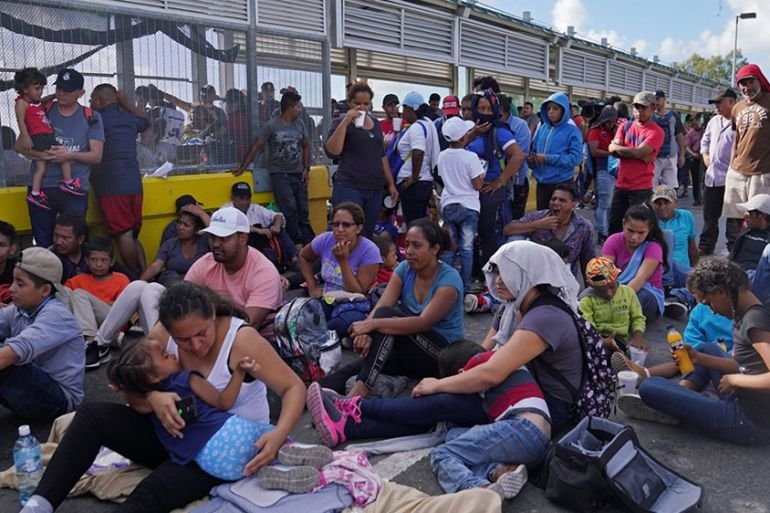
A significant legal battle over U.S. immigration policy is set to unfold as the United States Supreme Court prepares to examine the authority of the federal government to limit the processing of asylum claims at the southern border. The case, which is scheduled for hearing on Tuesday, centers on whether officials can lawfully turn away asylum seekers when border facilities are deemed too overwhelmed to manage additional applications.
At the heart of the dispute is a controversial approach known as “metering,” a practice that allows immigration authorities to restrict the number of asylum seekers processed at official border crossings. Although this method was discontinued during the administration of former President Joe Biden, it originated earlier and was formally institutionalized during Donald Trump’s first term in office. Now, with Trump back in power, his administration is seeking judicial backing to potentially reinstate this policy under certain conditions.
The legal question before the court is both technical and consequential: whether migrants who are halted on the Mexican side of the border can be considered as having “arrived” in the United States under federal immigration law. This distinction carries enormous implications, as U.S. law grants individuals the right to apply for asylum once they arrive in the country, requiring authorities to inspect and process their claims.
Supporters of the Trump administration argue that merely approaching the border does not constitute entry into the United States. Government lawyers have emphasized that the legal definition of arrival involves physically entering the country, not simply being present near its boundaries. From this perspective, migrants stopped before crossing into U.S. territory would not yet qualify for the legal protections afforded to asylum seekers.
Opponents, however, contend that this interpretation undermines both the spirit and the letter of asylum laws. Advocacy organizations, including a prominent group that initiated legal proceedings several years ago, argue that individuals who present themselves at designated border entry points should be entitled to have their claims heard, regardless of whether they have physically crossed the border line. They maintain that restricting access in this manner effectively denies vulnerable individuals the opportunity to seek protection.
The policy’s history reveals that such measures are not entirely new. Border officials began limiting the intake of asylum seekers as early as 2016, during a period of increased migration under President Barack Obama. However, the practice gained formal structure in 2018, when the Trump administration authorized agents to delay or refuse processing when capacity constraints arose. This move sparked legal challenges, with critics arguing that it violated federal obligations to assess asylum claims.
In 2021, the Biden administration rescinded the metering policy, signaling a shift toward a more open approach to asylum processing. However, the current administration has indicated in court filings that it may reinstate the policy if conditions at the border deteriorate, though no specific criteria for such a decision have been publicly outlined.
The case has already been examined by lower courts, with a federal appeals court ruling in 2024 that immigration authorities are required to process individuals who present themselves at official crossings, even if they have not yet stepped onto U.S. soil. The court concluded that the metering practice was inconsistent with federal law, prompting the Trump administration to appeal to the Supreme Court.
This legal confrontation unfolds against a broader backdrop of aggressive immigration measures introduced since Trump’s return to office. The Supreme Court has already sided with the administration in several emergency rulings, including decisions allowing the deportation of migrants to third countries and the termination of temporary legal protections for large groups of foreign nationals residing in the United States.
Further immigration-related cases are also on the court’s docket in the coming weeks. Among them is a challenge to a directive aimed at limiting birthright citizenship, a longstanding principle under U.S. law. Additionally, the justices are expected to hear arguments regarding efforts to revoke temporary protections for hundreds of thousands of migrants from countries such as Haiti and Syria.
The outcome of the current case could have far-reaching consequences for how the United States manages asylum claims at its southern border. A ruling in favor of the administration could grant officials broader discretion to control the flow of migrants during periods of high demand, while a decision against it may reinforce existing legal protections for asylum seekers and limit the government’s ability to impose restrictions.
Observers note that the case represents a critical test of the balance between national border management and humanitarian obligations. It raises fundamental questions about how immigration laws should be interpreted in practice, particularly in situations where administrative capacity is strained. The decision, expected by the end of June, will likely shape U.S. immigration policy for years to come and could influence similar debates in other countries grappling with migration challenges.
As the Supreme Court prepares to hear arguments, the issue remains deeply divisive, reflecting broader political and legal tensions surrounding immigration in the United States. Whatever the outcome, the ruling will play a pivotal role in defining the rights of asylum seekers and the scope of government authority at one of the world’s most closely watched borders.