

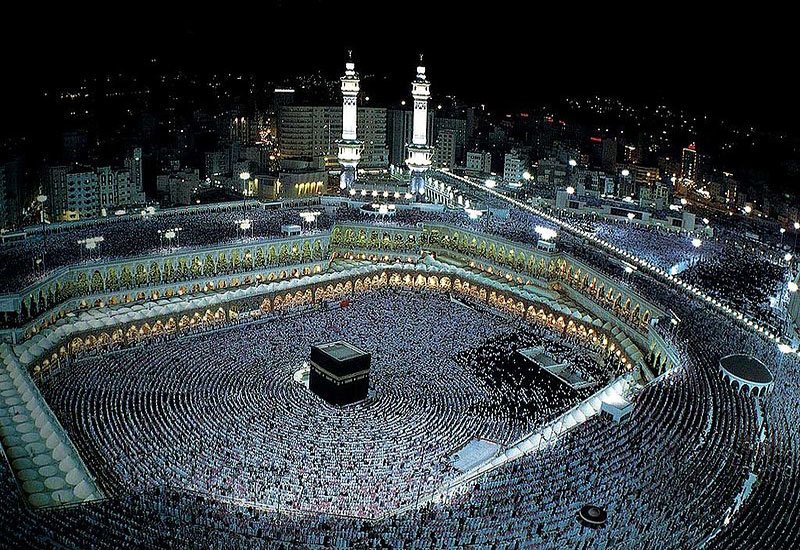
During the blessed month of Rabi Al-Awwal 1447 AH, the Grand Mosque in Makkah and the Prophet’s Mosque in Madinah together received a record-breaking number of worshippers and visitors, reflecting both the deep spiritual attachment of Muslims worldwide to these sacred places and the remarkable management efforts of the Saudi authorities.
According to official figures released by the General Authority for the Care of the Two Holy Mosques, an extraordinary total of 53,572,983 people entered the holy precincts of Makkah and Madinah during this single month.
This immense turnout symbolizes the central role of the Two Holy Mosques as focal points for devotion, religious tourism, and collective Muslim identity.
Breaking down these figures, the Grand Mosque in Makkah welcomed 17,560,004 worshippers. Among them, a notable number of 91,753 individuals performed their prayers within Hijr Ismail (commonly referred to as Al-Hatim), an area adjacent to the Kaaba held in great reverence.
In addition to the worshippers, more than 12.1 million pilgrims completed Umrah during the same month, demonstrating the continuous flow of believers seeking toperform this cherished act of worship.
At the Prophet’s Mosque in Madinah, the numbers were even higher. It was reported that 20,701,560 worshippers attended prayers there, with over 1,002,049 fortunate worshippers managing to pray inside Al-Rawdah Al-Sharifah, an area between the Prophet’s tomb and pulpit considered one of the holiest spots on earth.
Furthermore, 2,071,101 visitors specifically came to offer their salutations to the Prophet Muhammad (peace be upon him) and his two noble companions, Abu Bakr Al-Siddiq and Umar ibn Al-Khattab (may Allah be pleased with them both).
Such staggering statistics are not simply recorded for the sake of documentation. They are the result of a highly advanced monitoring system deployed by the Saudi authorities.
The General Authority explained that it employs sensor-based technologies at major entrances of both mosques to keep accurate track of the flow of worshippers and Umrah pilgrims.
This real-time data collection allows the management teams to regulate crowd movement, detect pressure points within the compounds, and respond immediately to any congestion.
With the help of these systems, operational efficiency improves significantly, ensuring that safety standards are maintained while pilgrims are allowed to complete their rituals with ease and peace of mind.
The adoption of digital tools reflects the broader vision of Saudi Arabia in integrating technology into religious administration.
Crowd management in places where millions gather daily is an enormous challenge, and only through the use of advanced monitoring, predictive models, and inter-agency collaboration can such challenges be overcome. The collected data also supports long-term planning: by analyzing the peak times of visitation, the flow of worshippers through specific gates, and the most crowded areas during different parts of the day, the authorities can enhance infrastructure, reassign resources, and introduce new services where they are most needed.
For example, knowing the number of people who enter Hijr Ismail or Al-Rawdah Al-Sharifah helps authorities manage access more fairly and efficiently. These two sacred locations are particularly sought after, and the demand to enter them often exceeds capacity. By regulating entry based on real-time data, the administration is able to provide more organized scheduling and reduce overcrowding, which directly enhances the worshippers’ experience.
The scale of management at the Two Holy Mosques is unlike anything in the world. Every month brings millions, but the month of Rabi Al-Awwal carries its own unique significance, as it is the month in which the Prophet Muhammad (peace be upon him) was born. Devotees from around the globe flock in larger numbers to Makkah and Madinah during this time to commemorate his life and teachings, which explains the exceptionally high statistics recorded this year.
It is important to understand that these figures are not just numbers; they represent a massive logistical achievement. Each worshipper requires access to prayer space, ablution areas, guidance on directions, safety monitoring, and sometimes medical attention.
Behind the smooth functioning of these sacred spaces is the coordinated effort of thousands of workers, security personnel, volunteers, and administrators who ensure that spiritual journeys remain undisturbed by logistical difficulties.
Saudi Arabia has long considered the service of pilgrims and visitors as both an honor and a responsibility. The phrase “Khidmat al-Haramain” — the service of the Two Holy Mosques — has been central to the Kingdom’s identity.
The data released for Rabi Al-Awwal 1447 is another illustration of how seriously the Kingdom takes this responsibility. This month alone saw tens of millions performing religious rituals in harmony, despite the potential challenges of such huge crowds.
That harmony is the result of careful preparation, infrastructure upgrades, and technology-driven monitoring.
The figures also highlight the global dimension of the Two Holy Mosques. Pilgrims and visitors do not come only from Saudi Arabia; they arrive from every corner of the Muslim world and beyond. Each person brings with them their own language, culture, and traditions, yet inside the sacred spaces, they merge into one united community.
This diversity makes crowd management even more complex, requiring signage, announcements, and assistance in multiple languages.
The introduction of digital screens, mobile apps, and electronic guidance systems has been particularly useful in bridging language barriers and ensuring that worshippers are well informed.
The authority also emphasized that such accurate data collection has long-term benefits for economic and social planning. Religious tourism is a cornerstone of Saudi Arabia’s Vision 2030 strategy, and the ability to measure and predict visitation patterns helps the government design better facilities, plan transport systems, and expand services for millions of international guests.
For example, knowing that more than 53 million visited the Two Holy Mosques in a single month helps estimate demand for hotels, public transportation, food services, and health care facilities in both Makkah and Madinah.
The figures reveal that the Two Holy Mosques are not only centers of spiritual devotion but also hubs of human movement on a scale larger than almost any global event.
The fact that these crowds can be accommodated without major disruptions is itself a testimony to the careful coordination of the authorities. For perspective, hosting 53 million people in a single month means accommodating nearly twice the population of Saudi Arabia itself, and yet the system continues to function with precision.
Officials pointed out that such organization would not be possible without the strong partnerships between the General Authority and other relevant government agencies, including those responsible for health, security, municipal services, and transportation. Together, they create an integrated framework in which every visitor’s journey, from entry at the gates to exit after prayers or rituals, is carefully managed.
What emerges from this entire picture is a sense of how modern tools, careful planning, and a spirit of service converge at the Two Holy Mosques.
The month of Rabi Al-Awwal 1447 is just one example, but it represents the growing scale of religious devotion worldwide and the Kingdom’s commitment to facilitating it. Each year the numbers increase, and each year new measures are introduced to make the experience smoother, safer, and more spiritually fulfilling.
the announcement that over 53.5 million worshippers and visitors were recorded at the Grand Mosque and the Prophet’s Mosque during just one month is more than a statistical note.
It is a story of faith on a grand scale, of millions of individuals crossing borders to connect with their Creator, and of a nation that has taken upon itself the noble task of welcoming them. Behind the figures lie untold stories of devotion, gratitude, and prayer, making this achievement both a spiritual triumph and a logistical marvel.