

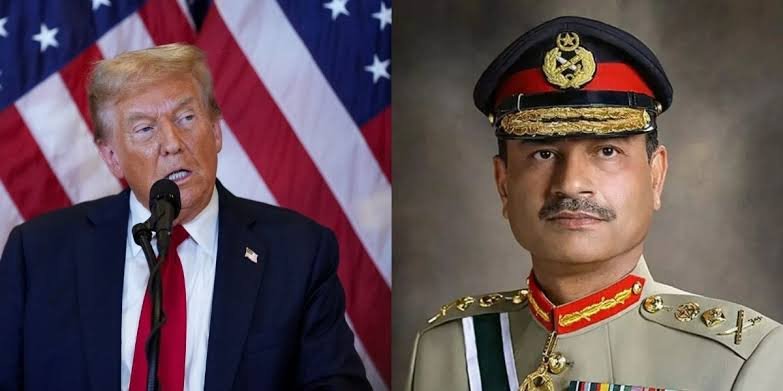
Washington D.C. / Islamabad: United States of America President Donald J. Trump has credited Pakistan’s Field Marshal Asim Munir with acknowledging his diplomatic efforts in preventing a full-scale war between India and Pakistan a conflict Trump claimed could have escalated into a nuclear confrontation, endangering millions of lives across the subcontinent.
Speaking during an address to senior U.S. military officials at the Department of Defense, Mr. Trump recounted a meeting with Pakistan’s Prime Minister and the Chief of Army Staff, Field Marshal Asim Munir, during which, he said, the Pakistani military leader lauded him for his timely intervention” that helped de-escalate a highly volatile situation between the two South Asian neighbors’.
You stopped a war between India and Pakistan, and in doing so, you saved millions of lives, Mr. Trump quoted Field Marshal Munir as saying. The former president described the moment as a great personal honor, adding that the remarks were made in the presence of two senior American generals.
The episode in question appears to refer to the intense military standoff that followed the Pulwama attack in February 2019, which led to airstrikes by both nations and the downing of fighter jets, prompting global concern over a possible war between two nuclear-armed states.
Donald Trump claimed that he used trade diplomacy as a means of diffusing the situation, urging both New Delhi and Islamabad to choose economic cooperation over confrontation. Instead of choosing war, I encouraged both nations to choose trade agreements, which ultimately brought them to the negotiating table, he said.
The former U.S. leader further asserted that during his term in office, he played a decisive role in ending seven global conflicts, one of which, he noted, had been concluded only recently. However, he did not elaborate on the specific nature or locations of these conflicts.
Trump’s comments come at a time when geopolitical tensions remain high in various regions, including the Middle East and Eastern Europe. Addressing other global issues, Mr. Trump reiterated his intention to mediate between Russian President Vladimir Putin and Ukrainian President Volodymyr Zelensky, insisting that negotiations were essential to restoring peace in Europe.
He also used the occasion to highlight U.S. military superiority, particularly in the field of submarine technology, claiming that the United States is 25 years ahead of both China and Russia in undersea warfare capabilities. He added that his defense policies, though sometimes unpopular among military brass, were designed to keep America strategically dominant.
If my policies upset some generals, they’re free to resign, he remarked bluntly. President Trump’s revelations regarding the Pakistan-India standoff and his interactions with Field Marshal Munir add a new dimension to the historical narrative surrounding one of the most dangerous military confrontations in recent South Asian history. While Islamabad has not issued an official statement in response to the former president’s remarks, diplomatic observers suggest that the recognition could bolster Trump’s foreign policy legacy as he eyes a potential return to the White House in 2024.
As the region continues to grapple with instability from Kashmir to Kabul the role of quiet diplomacy and backchannel negotiations remains a critical element in avoiding major escalation. Mr. Trump’s latest comments appear to position him as a central figure in that process during a pivotal moment in regional history.