

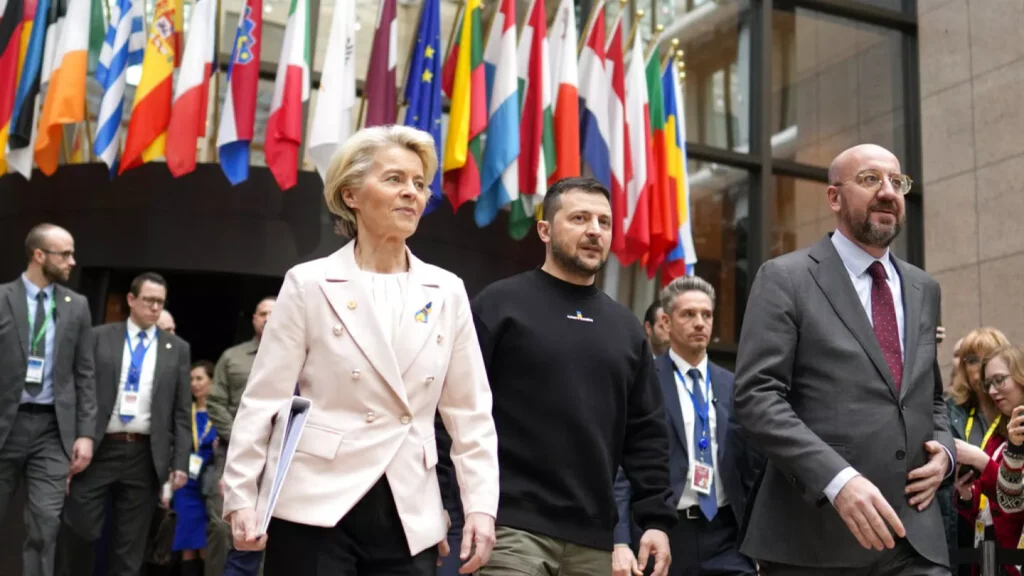
COPENHAGEN: European Union leaders met Wednesday to explore a bold new proposal to leverage hundreds of billions of dollars in frozen Russian assets to fund Ukraine’s financial and military needs through 2027 a move Moscow has condemned as outright “theft.”
The plan, still under negotiation, marks a significant step in Europe’s evolving strategy to support Ukraine as U.S. financial and military backing sharply declines under President Donald Trump’s administration, which has ended direct aid and halted major weapons shipments.
At the heart of the proposal is a “reparation loan” mechanism a financial instrument backed by frozen Russian central bank assets, mostly held in Europe. Of the estimated €260 billion ($274 billion) in immobilized Russian funds globally, the largest share €194 billion is located in Belgium, with additional sums held in Japan, the U.S., U.K., and Canada.
Ukraine’s projected budget and defense spending for 2026 and 2027 are expected to hit around €130 billion ($153 billion), according to internal EU estimates. Since Russia’s full-scale invasion began in February 2022, the EU has already funneled over €174 billion in military, humanitarian, and financial support to Kyiv.
“This is not just about funding Ukraine it’s about sending a message, said one EU diplomat on the sidelines of the Copenhagen summit. “If Russia causes destruction, it should foot the bill.
However, consensus among the 27 EU member states remains elusive. While countries like Germany, France, and the Baltic states are largely supportive, others remain cautious about the legal and geopolitical implications of repurposing sovereign Russian funds.
The European Commission has assured member states that the proposal would be compliant with international law, framing the initiative as a temporary loan facility rather than outright confiscation. The idea is to generate loans secured against the interest and profits generated by frozen assets, rather than spending the principal a distinction seen as key to mitigating legal risks.
Still, Russia has sharply denounced the move. The Kremlin has labeled the idea a “hostile and criminal expropriation, warning that any such action would prompt retaliatory measures and further escalate tensions between Moscow and the West.
Despite the legal and diplomatic hurdles, European leaders say the proposal reflects growing urgency and frustration as the war drags on into its fourth year, with no clear end in sight and uncertainty surrounding future U.S. involvement.
The time has come for Europe to lead, said another senior EU official. We cannot let Ukraine’s survival depend on the outcome of U.S. elections.
The outcome of the Copenhagen summit is expected to shape the EU’s long-term financial posture toward Ukraine and could redefine global norms around wartime reparations and asset seizure.