

ISLAMABAD: Pakistan has constituted an 18-member high-level committee to lead bilateral economic engagements and negotiations with the Kingdom of Saudi Arabia (KSA), marking a new phase in Islamabad’s push to deepen strategic and financial cooperation with Riyadh.
According to an official notification issued by the Prime Minister’s Office on Sunday, the committee will be co-chaired by Climate Change Minister Musadik Malik and the National Coordinator for the Special Investment Facilitation Council (SIFC), Lieutenant General Sarfraz Ahmad.
The notification stated that the co-chairs “shall constitute core/negotiation teams for talks with the Saudi counterparts,” ensuring the implementation of agreed initiatives on a fast-track basis.
Prime Minister Shehbaz Sharif has directed the SIFC to submit travel proposals for committee members’ visits to Saudi Arabia, emphasizing that the Prime Minister’s Office will process and approve these within one hour of submission to expedite the mission.
Among the key members of the committee are Economic Affairs Minister Ahad Khan Cheema, Special Assistant to PM Haroon Akhtar Khan, Power Minister Awais Ahmed Leghari, Commerce Minister Jam Kamal Khan, Food Security Minister Rana Tanveer Hussain, Communications Minister Abdul Aleem Khan, and IT Minister Shaza Fatima Khawaja, among others.
The formation of the committee underscores Pakistan’s intent to accelerate long-term economic collaboration with Saudi Arabia a country that has historically been a cornerstone of Islamabad’s economic and energy stability.
In February, Riyadh extended a $1.2 billion deferred oil facility, releasing $100 million monthly until February 2026. Pakistan is also seeking a rollover of $5 billion in Saudi loans $2 billion maturing in December 2025 and $3 billion in June 2026 at a concessional rate of four percent.
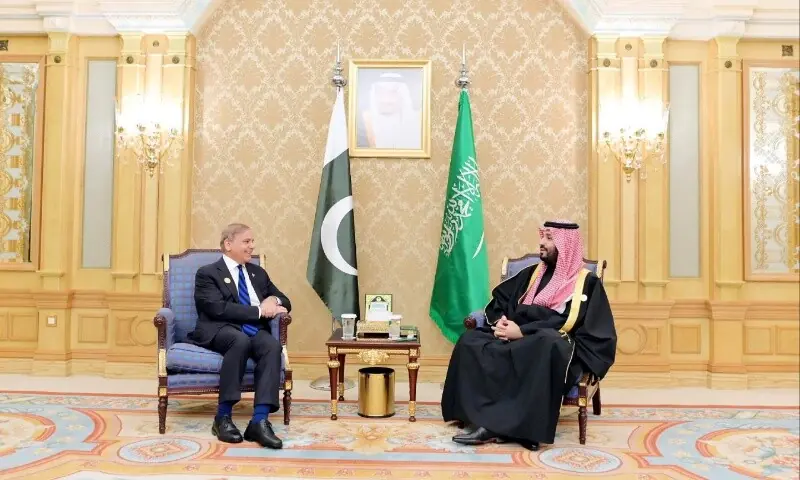
Last year, Prime Minister Shehbaz Sharif described Saudi Arabia as central to Pakistan’s economy during his meeting with Crown Prince Mohammed bin Salman on the sidelines of the Future Investment Initiative (FII) in Riyadh.
According to a Reuters report, a Saudi business delegation led by Prince Mansour bin Mohammad Al-Saud, former governor of Hafar Al-Batin Province, is expected in Pakistan this week to explore new investment opportunities.
The visit follows the signing of a mutual defence agreement between the two nations last month, pledging a joint response to any aggression a development analysts say could pave the way for broader economic-military cooperation.
Initial investment plans worth $1 billion are anticipated, potentially through the establishment of a new investment fund, with Pakistan aiming to attract larger Saudi participation in the months ahead.
The delegation is expected to focus on technology, food and agriculture, and sports equipment sectors, and will hold meetings with Prime Minister Shehbaz Sharif and key government officials.
Islamabad is also seeking Saudi investment in state-owned enterprises and the development of a petrochemical complex. Riyadh has previously expressed interest in mining projects, including acquiring a stake in Pakistan’s share of the multibillion-dollar Reko Diq copper and gold project in Balochistan.
Observers say these developments signal Pakistan’s effort to align its economic diversification goals with Saudi Arabia’s Vision 2030, aiming for a deeper, mutually beneficial partnership across trade, energy, and investment domains.