

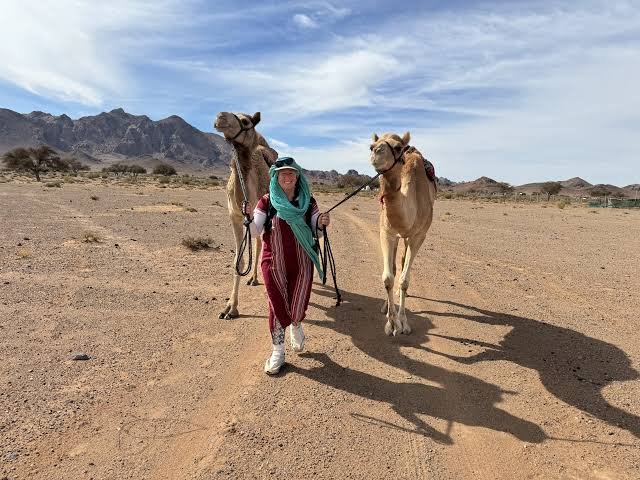
Scottish adventurer, author, and BBC presenter Alice Morrison has entered the defining phase of an extraordinary journey across Saudi Arabia — a mission that aims to make her the first person in recorded history to walk the entire length of the Kingdom, from its northern border with Jordan all the way to the southern frontier near Yemen.
This expedition is not a typical exploration; it is a combination of endurance, cultural discovery, and human curiosity. With her two camels, Juicy and Lulu, by her side, Morrison began the final leg of her trek from Madinah on October 10. This stage alone covers about 1,370 kilometers and will end in Najran on December 17, completing a monumental 2,300-kilometer route that she started earlier this year.
In February 2025, she had already completed the first segment — a 930-kilometer journey on foot from the Jordanian border to Madinah.
Now, she embarks on the most challenging portion, traversing the wild and untamed landscapes of western Saudi Arabia. Over the next seventy days, Morrison plans to walk for sixty-three days and rest for seven, averaging about 21 kilometers — nearly half a marathon — each day.
Speaking about her experience, Morrison expressed how being a woman has become a source of empowerment during her travels through Saudi Arabia.
“Being a woman is my superpower here,” she said, adding that her gender has allowed her to interact openly with both men and women and to hear women’s voices that are often left unheard. During her earlier journey, she was deeply moved by what she described as a “cultural revolution,” as Saudi women increasingly take charge of their futures with confidence and vision.
Morrison emphasizes that while countless travelers have crossed the Arabian Peninsula over the centuries, her attempt stands apart because she is completing the entire route solely on foot — without vehicles, camels, or wheels of any kind. According to her team’s extensive research, there is no record, in either Arabic or English, of anyone having completed such a feat before.
Beyond its physical demands, Morrison’s expedition is also a journey of exploration and documentation. Her support team is equipped with night-vision cameras to observe and record the region’s elusive wildlife, including gazelles, hyenas, wolves, and possibly the critically endangered Arabian leopard. They are also searching for ancient petroglyphs, burial sites, and archaeological remnants scattered across the desert silent traces of Arabia’s layered past.
Her route follows stretches of the legendary Derb el Fil, known as “The Elephant’s Road,” one of the oldest trade routes in the Arabian Peninsula. Centuries ago, this path connected markets, civilizations, and cultures through the exchange of goods, ideas, and traditions. Morrison plans to stop along these historical sites, meeting local Saudi tribes and communities, including the famous Flower Men of Aseer — recognized for their striking floral crowns and deep-rooted heritage.
In addition to documenting Saudi Arabia’s natural and cultural beauty, Morrison is highlighting how modernization and heritage now coexist in harmony. “What fascinates me most,” she said, “is seeing how old traditions are evolving without disappearing — how communities are honoring their roots while embracing change.”
Each night, her team sets up wild camps under the vast desert sky, surrounded by the silence of the dunes and the glittering constellations above. The only vehicle accompanying them carries essential supplies like water and food, ensuring the journey remains largely self-reliant.
Morrison noted that the physical strain of walking long distances under the harsh desert sun is both exhausting and exhilarating. “We’ll start walking before dawn to beat the afternoon heat,” she explained, “and water management will be a real challenge. I just hope to avoid the blisters I got during the first stage.”
Her journey has also become a living testament to human endurance and cross-cultural connection. She has been welcomed warmly by locals, who often share stories, meals, and traditional songs with her along the way. These encounters, she says, have reshaped her understanding of Saudi Arabia — not just as a landscape of sand and stone, but as a living, breathing nation in transformation.
Ultimately, Morrison’s expedition is more than an individual adventure. It symbolizes a new era of exploration in the Kingdom one that bridges history, nature, and the human spirit.
Through her footsteps, she is tracing not just a physical path across the desert, but also a story of change, resilience, and connection that reflects the evolving soul of Saudi Arabia itself.