

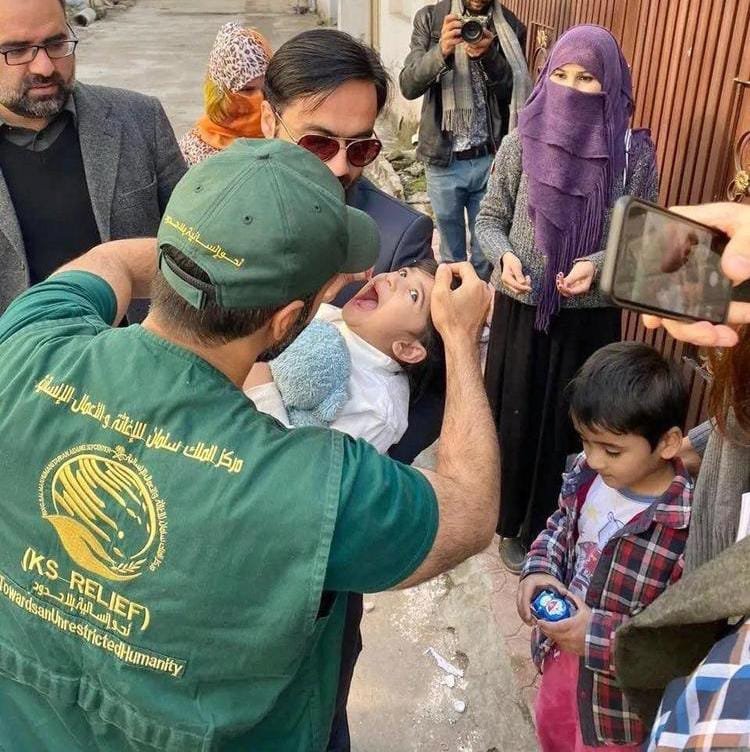
Saudi Arabia’s leading humanitarian organization, the King Salman Humanitarian Aid and Relief Center (KSrelief), has once again reaffirmed the Kingdom’s global humanitarian leadership through its continuous efforts to eradicate one of the most persistent public health challenges—polio. Marking World Polio Day, observed annually on October 24, Saudi Arabia’s initiative not only symbolizes its strong commitment to global health security but also highlights its role as a consistent and reliable partner in combating diseases that disproportionately affect vulnerable populations, especially in low-income countries.
Over the years, Saudi Arabia has worked tirelessly alongside international agencies such as the World Health Organization (WHO) and the United Nations Children’s Fund (UNICEF) to support the global eradication of polio. In 2025, the Kingdom took a major step by signing two landmark agreements worth a combined $500 million, reflecting a powerful message of solidarity and responsibility toward protecting future generations. These agreements were specifically designed to enhance vaccination campaigns, strengthen healthcare infrastructure, and promote disease surveillance in countries most affected by the poliovirus.
Under the first agreement, $300 million was allocated to the WHO to support preventive and monitoring efforts in high-risk regions. A substantial portion of this funding has been directed to Pakistan and Afghanistan, the last two countries in the world where polio remains endemic. The support covers a wide range of initiatives, from community-level vaccination drives and emergency response teams to the strengthening of epidemiological surveillance systems that help track virus circulation. In addition, Saudi funding assists in building the capacity of healthcare workers, providing them with training, equipment, and logistical tools necessary to operate in difficult and often unsafe environments.
The second agreement, valued at $200 million, focuses on UNICEF’s polio eradication initiatives. This includes expanding cold chain systems, a critical component for vaccine preservation, by supplying solar-powered refrigeration units and vaccine carriers to ensure uninterrupted immunization programs even in remote or conflict-prone areas. Through this collaboration, Saudi Arabia has facilitated the vaccination of hundreds of millions of children, ensuring that lifesaving doses reach communities that otherwise lack access to healthcare. Furthermore, the initiative also promotes health education and community engagement programs designed to raise awareness about the importance of immunization and the prevention of infectious diseases.
Beyond financial contributions, KSrelief plays an instrumental role in coordinating field operations and humanitarian logistics in partnership with regional governments. The center’s technical teams frequently provide on-ground support to ensure that vaccination campaigns are effectively executed and monitored. Saudi Arabia’s consistent engagement reflects its belief that the eradication of polio is not merely a health goal but a moral duty shared by the global community. The Kingdom’s interventions are aligned with its Vision 2030 objectives, which emphasize health diplomacy, sustainable development, and international cooperation.
In many countries, particularly those affected by conflict and instability, KSrelief’s interventions have filled a critical gap where traditional healthcare systems have collapsed or become inaccessible. Saudi-funded initiatives have helped sustain polio immunization programs in regions facing humanitarian crises, ensuring that outbreaks are contained and prevented from spreading across borders. The comprehensive support provided by the Kingdom includes not only vaccination drives but also the provision of medical supplies, transportation vehicles, and digital tools for data collection and real-time monitoring of vaccination coverage.
Saudi Arabia’s dedication to the global eradication of polio is deeply rooted in its broader humanitarian vision, guided by the leadership of the Custodian of the Two Holy Mosques, King Salman bin Abdulaziz Al Saud, and His Royal Highness Crown Prince Mohammed bin Salman. The Kingdom views the fight against polio as part of its larger mission to promote public health, protect children, and alleviate human suffering worldwide. Through KSrelief, Saudi Arabia has extended medical aid to dozens of countries across Asia, Africa, and the Middle East, becoming one of the most consistent contributors to international health and relief programs.
Experts and global health organizations have frequently acknowledged Saudi Arabia’s significant contribution to the global campaign against polio. The Kingdom’s model of combining financial assistance, technical expertise, and community outreach is now being viewed as a framework for future disease eradication efforts. It has also helped strengthen Saudi Arabia’s position as a humanitarian leader in the global South, emphasizing its commitment to sustainable global health systems.
By observing World Polio Day, KSrelief continues to remind the world that although tremendous progress has been made, the mission is not yet complete. Eradicating the virus from its final strongholds will require continued global cooperation, funding, and vigilance. The Kingdom’s renewed commitments in 2025 are a testament to its resolve to see this mission through, ensuring that no child, regardless of nationality or geography, remains at risk of paralysis caused by polio.
In essence, Saudi Arabia’s proactive stance in fighting polio demonstrates how humanitarian diplomacy can translate into measurable results that improve the quality of life worldwide. The Kingdom’s vision, embedded in compassion and sustainability, reinforces the belief that health security is a shared responsibility. With its continued dedication through KSrelief, Saudi Arabia stands at the forefront of global efforts to eliminate polio once and for all, leaving behind a legacy of hope, health, and human dignity for future generations.