

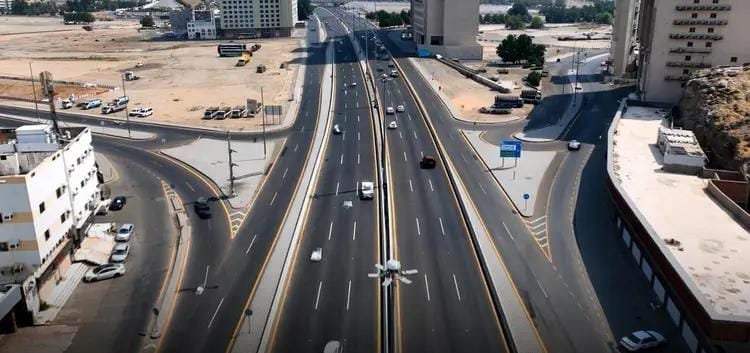
The holy city of Makkah has entered a new phase of infrastructural advancement, marked by one of the most extensive road development programs in its modern history. Under the guidance of the Royal Commission for Makkah City and the Holy Sites, a series of interconnected projects have reshaped how people and vehicles move through the city, especially during high-density periods such as Hajj and Umrah seasons. The primary aim of these projects is not only to facilitate smoother traffic flow but also to elevate the quality of life for residents, pilgrims, and visitors while preserving the city’s sacred identity and historical character.
The comprehensive transformation has centered around the completion and operation of Makkah’s four major ring roads — the First, Second, Third, and Fourth — which together now form an integrated network spanning more than 105 kilometers. This massive web of roads encircles the holy city, linking vital neighborhoods, entrances, and exit points with advanced transportation infrastructure.
The network is designed to integrate seamlessly with modern public transit systems, including future metro expansions, bus routes, and smart parking facilities. By establishing such an interconnected structure, the Royal Commission has sought to reduce travel time, alleviate congestion, and streamline access to the Grand Mosque, hospitals, hotels, and other critical zones within the central district.
A major highlight of these works is the Third Ring Road, where development teams completed several key intersections and opened new sections exceeding ten kilometers in total length. Among these are the Prince Miteb and Muzdalifah junctions, both of which play an essential role in distributing traffic during the Hajj season.
The northern corridor of the same road — a 7.5-kilometer stretch connecting the Tan’eem intersection to the Jamarat area — has also been inaugurated, establishing a smooth route between the holy sites. This section is particularly significant for its role during pilgrimage, as it helps divert large volumes of vehicles away from congested central areas, allowing emergency and service vehicles easier access during peak times.
Parallel to this, substantial progress has been made on the Second Ring Road. A 1.7-kilometer segment extending from the Sulaymaniyah tunnels to Hussein Arab Street has been fully completed and opened to traffic. The new route includes a modern tunnel interchange connecting directly with the Masar destination, one of Makkah’s most ambitious urban redevelopment zones. The project was executed through coordination between the Ministry of Transport, the Holy Capital Municipality, and Umm Al-Qura Company, ensuring consistency with the city’s long-term transportation and urban development master plan.
On the Fourth Ring Road — the outermost and strategically vital loop — two new connections were inaugurated in the Al-Rayyan and Al-Khadhra neighborhoods, along with the completion of a key link to King Faisal Road. These new corridors have significantly improved vehicular flow from the city’s outskirts into major entry routes, supporting both residents and logistical operations, especially during the annual pilgrimage season. The Fourth Ring Road also serves as a gateway for large transport vehicles, diverting heavy traffic away from central areas and helping maintain the city’s safety and environmental balance.
Safety and pedestrian accessibility have been major priorities throughout these upgrades. To enhance the experience of walking within the city, 49 smart pedestrian crossings have been installed in critical zones. These crossings are equipped with motion sensors, intelligent lighting, and safety alerts designed to protect pedestrians in high-traffic areas, particularly around schools, hospitals, and prayer sites.
In addition, the Royal Commission addressed 14 major traffic points that previously posed challenges for both residents and pilgrims. By redesigning these junctions and deploying modern traffic control systems, authorities have significantly reduced accident rates and improved overall traffic safety. Reports indicate an 86 percent increase in safety levels following these implementations, underscoring the success of the integrated approach.
Urban development around Makkah has also been synchronized with the ongoing road enhancements. Streets leading directly to the Grand Mosque — such as Al-Masial Street — have been upgraded with artificial granite flooring, modern lighting systems, decorative poles, and smart signage to improve both functionality and aesthetics. These beautification efforts extend the spirit of the Two Holy Mosques’ architectural identity into the urban fabric of the city. The installation of smart parking systems and navigation sensors ensures that visitors can find available spaces efficiently, further reducing traffic congestion.
Such infrastructural evolution is part of a broader vision linked to Saudi Arabia’s Vision 2030 and the Pilgrim Experience Program, which aim to make Makkah a model city for smart mobility and sustainable urban growth. Through the integration of digital traffic monitoring, smart signals, and automated pedestrian systems, Makkah’s transport network is gradually transitioning into a data-driven ecosystem. This not only improves daily commuting for residents but also ensures smoother logistical operations during Hajj and Umrah when millions of worshippers converge on the city.
Moreover, environmental considerations have been woven into the road expansion plans. The Royal Commission has implemented landscape initiatives around the ring roads to mitigate the impact of heat and dust, planting greenery along corridors and establishing shaded pedestrian paths where possible. Solar-powered streetlights have been introduced on select sections, reducing energy consumption while ensuring continuous nighttime visibility.
The transformation of Makkah’s road network, therefore, represents more than just the completion of highways and tunnels — it is an investment in the city’s future mobility, sustainability, and safety. By combining heritage sensitivity with cutting-edge engineering, the Royal Commission for Makkah City and the Holy Sites has created a model that balances spiritual sanctity with modern efficiency. As these projects continue to expand, they are expected to play a pivotal role in welcoming future generations of pilgrims, making their journey to the Grand Mosque smoother, safer, and more spiritually fulfilling than ever before.