

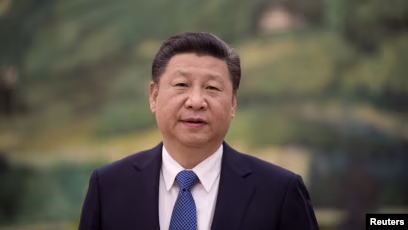
Chinese President Xi Jinping has called for the creation of a World Artificial Intelligence Cooperation Organization (WAICO), a new global institution intended to guide the governance, development, and ethical regulation of artificial intelligence (AI). The proposal was presented during the Asia-Pacific Economic Cooperation (APEC) Leaders’ Summit held in Gyeongju, South Korea, where Xi outlined his vision for a cooperative and inclusive approach to AI regulation. The initiative reflects China’s growing ambition to position itself as a global leader in technology governance and a credible alternative to the United States in shaping the rules of future innovation.
According to international media reports including Reuters, BBC, and the South China Morning Post, this marked the first time Xi offered public remarks about the plan, which Beijing has been quietly introducing to several partner nations throughout the year. The Chinese leader emphasized that the proposed body would not only focus on creating global standards for responsible AI use but would also ensure that artificial intelligence is treated as a shared resource for all nations rather than a competitive weapon in the geopolitical rivalry between major powers.
Xi highlighted that the organization could be based in Shanghai, which has rapidly evolved into one of the world’s most active technology and research centers. The city already houses major AI research laboratories, technology start-ups, and innovation hubs supported by the Chinese government. By situating the institution there, Beijing hopes to make China a nerve center for future-oriented cooperation in digital technology, while projecting a more inclusive and multilateral image on the world stage.
The APEC forum, which brings together 21 member economies and represents roughly half of global trade, provided a fitting backdrop for the announcement. The summit this year was marked by growing tensions surrounding trade protectionism, export restrictions, and tariff disputes between China and the United States. These tensions have affected global supply chains and placed technological self-reliance and AI development at the heart of strategic competition.
Xi’s remarks also extended beyond AI governance. He urged APEC members to promote the free exchange of environmentally friendly technologies and innovations, such as renewable energy systems, electric vehicles, and battery manufacturing — industries in which China already holds a dominant global position. He stressed that green technology, much like AI, should be used to support sustainable growth and shared development across borders.
The United States, meanwhile, has rejected several calls for creating global AI regulatory mechanisms under international organizations, favoring domestic regulation and regional alliances instead. President Donald Trump did not participate in the main APEC sessions, departing for Washington after his bilateral meeting with Xi. Their discussion reportedly resulted in a one-year understanding to partially ease restrictions on trade and technology exchange, a move analysts believe could reduce immediate friction between the world’s two largest economies.
Within China, Xi’s AI initiative aligns closely with the government’s long-term strategy of achieving “algorithmic sovereignty.” Domestic companies such as DeepSeek have introduced low-cost AI models that compete with Western systems, while state policies encourage innovation that minimizes reliance on American semiconductor technologies. The rise of local AI ecosystems, supported by firms like Huawei, Baidu, and SenseTime, has been framed by Beijing as essential to national security and digital independence.
Experts in technology policy have interpreted Xi’s APEC proposal as a strategic maneuver aimed at reshaping global digital governance. Rather than merely promoting cooperation, China seeks to establish a framework that allows it to influence the rules, ethics, and distribution of emerging technologies worldwide. This effort, they argue, represents Beijing’s broader attempt to move from being a participant in the global system to a rule-maker within it.
At the close of the summit, APEC member nations agreed on a joint declaration addressing two pressing global challenges: artificial intelligence and the issue of aging populations. While the declaration signaled a willingness to engage in collaborative dialogue, significant differences remain over how AI should be regulated and by whom.
China will host the next APEC Summit in 2026 in Shenzhen, a megacity known for its rapid transformation from a small fishing village into a thriving hub of robotics, electric vehicle production, and semiconductor innovation. Xi used Shenzhen’s story as a metaphor for China’s own technological rise, describing it as evidence of how strategic planning and innovation can transform national fortunes.
Overall, the proposal for an international AI cooperation organization reflects China’s determination to play a defining role in the future of global technology governance. Whether the rest of the world accepts Beijing’s vision—or views it as a geopolitical challenge to the U.S.-led digital order—will determine the direction of global AI regulation in the years ahead.