

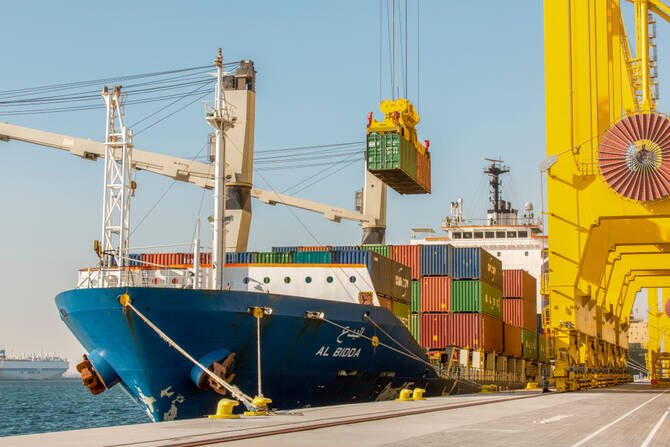
The Gulf Cooperation Council (GCC) countries recorded a historic surge in merchandise foreign trade in 2024, with the total volume, excluding intra-GCC trade, rising 7.4 percent to reach $1.6 trillion, according to the GCC Statistical Center. This marks the highest level recorded between 2017 and 2024, reflecting the council’s growing economic clout in global trade.
The data showed merchandise exports reached about $850 billion, up 3.4 percent from $821 billion in 2023, driven by a 22.5 percent increase in non-oil exports and a 1.4 percent rise in re-exports, while oil and gas exports declined slightly by 1.8 percent. Imports, however, surged 12.3 percent to approximately $740 billion, resulting in a trade surplus of $110 billion, down from $162 billion the previous year due to faster import growth.
Asia maintained its strategic dominance in GCC trade, with China, India, and Japan topping the list of trading partners. China alone accounted for $299 billion, or 18.8 percent of the GCC’s total trade, followed by India with $158 billion and Japan with $114 billion. The United States and South Korea rounded out the top five, collectively accounting for nearly half of the GCC’s global trade. Notably, China also remained the largest destination for GCC exports, with $137 billion worth of goods shipped in 2024, representing 16.2 percent of total exports.
Intra-GCC trade also reached record levels, hitting $146 billion, a 9.8 percent increase over 2023, led by the UAE ($69.9 billion) and Saudi Arabia ($40.7 billion), which together accounted for nearly 76 percent of regional trade. Kuwait and Qatar each contributed $10.2 billion, while Oman and Bahrain recorded $7.9 billion and $7.1 billion, respectively. The growth in intra-GCC re-exports, up 19.1 percent, further strengthened regional trade flows.
The 2024 figures confirmed the GCC’s global economic standing, ranking fifth worldwide in merchandise trade volume, with exports representing 3.5 percent of global totals. Imports growth propelled the GCC to eighth place globally, highlighting the region’s dual role as a major energy exporter and a significant importer of industrial and technological goods. The statistics underscore the GCC’s reliance on Asia and the US for imports, while continuing to position the region as a key player in global energy and raw material markets.