

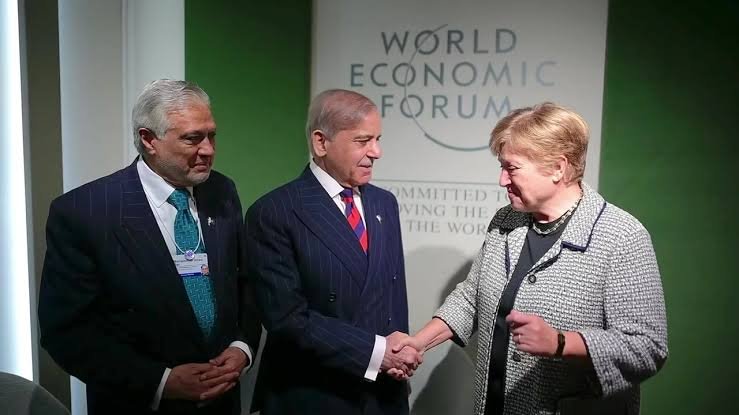
Recent discussions at the global level on economic stability and reform have brought Pakistan into a more positive spotlight, following remarks by the Managing Director of the International Monetary Fund (IMF), Kristalina Georgieva, who openly acknowledged the economic reform efforts undertaken by the Pakistani government under the leadership of Prime Minister Shehbaz Sharif. Her comments were widely seen as a significant endorsement of Pakistan’s current economic direction, particularly at a time when the country has been navigating complex financial challenges.
Speaking on the sidelines of the World Economic Forum held in Davos, Georgieva highlighted what she described as a noticeable shift in Pakistan’s approach toward economic management and policy implementation. According to her, Pakistan’s leadership is demonstrating seriousness and determination in pursuing positive change and long-term economic development. She noted that such commitment is essential for countries seeking sustainable recovery and resilience in an increasingly uncertain global economic environment.
The IMF chief emphasized that Prime Minister Shehbaz Sharif’s leadership style is marked by a strong sense of purpose and follow-through. In her assessment, once the Pakistani prime minister commits to a particular course of action, he focuses on seeing it through to completion rather than allowing it to remain at the level of political intent or public rhetoric. This quality, she suggested, plays a critical role in ensuring that economic reforms are not only announced but also implemented effectively.
Kristalina Georgieva further observed that Pakistan’s current government has moved beyond short-term crisis management and is instead prioritizing structural reforms that can strengthen the economy over time. She explained that such reforms often require difficult decisions, especially in developing economies where political and social pressures can complicate policy execution. However, she noted that Pakistan’s leadership appears willing to take these tough steps in the interest of long-term stability.
According to the IMF Managing Director, one of the most encouraging signs is the government’s seriousness in enforcing economic reforms rather than treating them as temporary measures tied to external assistance. She stated that Pakistan is now implementing reforms with a level of discipline and consistency that had not been evident in the past. As a result, the early benefits of these efforts are beginning to surface, offering cautious optimism about the country’s economic trajectory.
Georgieva pointed out that for the first time in a considerable period, there are visible signs of fiscal discipline in Pakistan’s budgeting process. She noted that the government has shown greater restraint in managing expenditures and has taken steps to align spending more closely with available resources. This renewed focus on budgetary discipline, she said, is a crucial foundation for macroeconomic stability and investor confidence.
The IMF chief also highlighted changes in how public resources are being allocated. According to her, there is growing evidence that government spending is increasingly directed toward areas that can have a tangible impact on the lives of ordinary citizens. Investments in social protection, development initiatives, and essential public services, she noted, are becoming more prominent within the broader reform agenda. This shift reflects an understanding that economic reform must ultimately translate into improvements in people’s daily lives.
Kristalina Georgieva stressed that meaningful economic reform is not solely about meeting numerical targets or satisfying international lenders. Instead, she said, it is about creating a system that enables inclusive growth, reduces vulnerabilities, and strengthens public trust. In this regard, she observed that Pakistan’s current reform efforts are beginning to align more closely with these broader objectives.
She also underscored the importance of political ownership in sustaining reform momentum. From the IMF’s perspective, Georgieva explained, the success of any economic program depends heavily on whether a country’s leadership genuinely believes in the reforms it is implementing. In Pakistan’s case, she noted, there are clear indications that the leadership recognizes both the necessity and the long-term benefits of reform, which enhances the credibility of its policy commitments.
During her remarks in Davos, Georgieva touched on how international financial institutions assess cooperation with member states. She explained that beyond economic data and projections, institutions like the IMF closely monitor a government’s willingness to maintain reforms over time. According to her, Pakistan’s recent actions suggest that the country is increasingly viewing economic reform as a continuous process rather than a temporary response to crisis.
The IMF Managing Director also acknowledged the broader challenges faced by developing economies such as Pakistan, particularly the need to ensure that reform outcomes are felt by the general population. She noted that fiscal discipline and policy adjustments can be difficult for citizens in the short term, but if managed responsibly, they create the space for increased spending on education, healthcare, and employment opportunities. In Pakistan’s case, she observed, the government appears to be moving in this direction.
Georgieva expressed cautious optimism that if Pakistan maintains its current level of commitment and policy consistency, it could gradually rebuild investor confidence and strengthen its standing within the global financial community. She emphasized that credibility and predictability are essential factors for attracting investment, and sustained reform efforts can significantly enhance both.
She further noted that global economic conditions remain challenging, with inflationary pressures, geopolitical tensions, and financial uncertainty affecting both advanced and developing economies. In such an environment, she said, countries that demonstrate discipline, transparency, and reform-oriented leadership are better positioned to navigate external shocks. Pakistan’s recent steps, in her view, indicate progress toward this goal.
In concluding her remarks, Kristalina Georgieva described the current phase as a critical opportunity for Pakistan. She stated that maintaining reform momentum and prioritizing public welfare could help transform short-term stabilization into long-term economic resilience. Under Prime Minister Shehbaz Sharif’s leadership, she suggested, Pakistan has the potential to build a more stable and inclusive economic framework.
She added that recognition of Pakistan’s reform efforts at a global forum such as the World Economic Forum is not merely symbolic. Rather, it reflects growing international acknowledgment that Pakistan is taking concrete steps to address its economic challenges. This recognition, she said, should serve as encouragement for continued progress rather than complacency.
Georgieva’s remarks at Davos represented more than routine diplomatic praise. They signaled a degree of confidence from one of the world’s most influential financial institutions in Pakistan’s reform agenda and leadership approach. While significant challenges remain, her assessment suggested that Pakistan is moving in a direction that could yield lasting economic benefits if current policies are sustained and strengthened in the years ahead.