

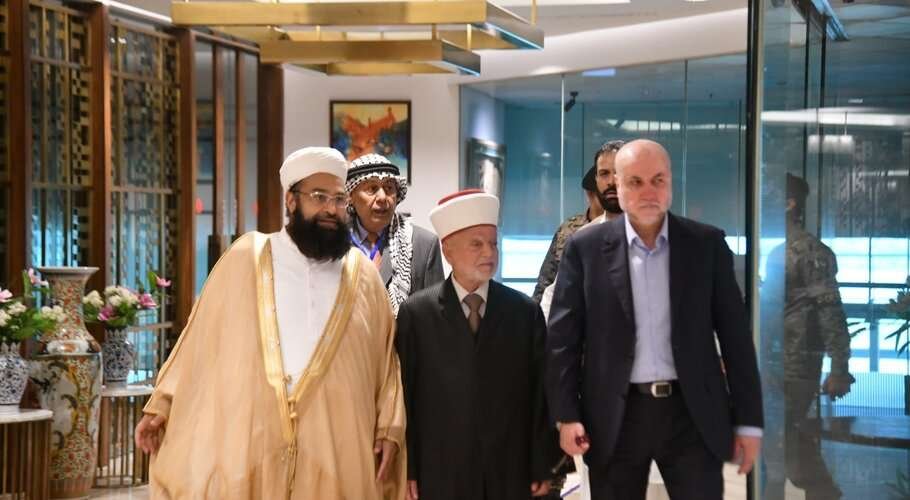
A significant international religious gathering is set to take place in Islamabad this week, drawing prominent scholars and spiritual leaders from across the Muslim world. The event has gained added importance with the arrival of senior Palestinian religious and judicial figures, highlighting both its global relevance and its focus on unity within the Muslim community.
Palestine’s Grand Mufti, Sheikh Muhammad Ahmad Hussein, along with Chief Justice Dr. Mahmoud Al-Habbash, arrived in the Pakistani capital on Monday for an official five-day visit. During their stay, they are scheduled not only to attend the upcoming International Paigham-e-Islam Conference but also to hold high-level meetings with Pakistan’s political leadership. These engagements are expected to cover a range of topics, including bilateral relations, challenges faced by the Muslim world, and the ongoing situation in Palestine.
Upon their arrival in Islamabad, the Palestinian delegation received a warm welcome. Among those present were Chairman of the Pakistan Ulema Council Hafiz Muhammad Tahir Mahmood Ashrafi, senior officials from the Ministry of Religious Affairs, and the Palestinian ambassador to Pakistan. The reception underscored the longstanding ties between the two nations and their shared commitment to cooperation on religious and humanitarian issues.
The conference, titled the Sixth International Paigham-e-Islam Conference, is scheduled to be held on May 6 at the Jinnah Convention Centre. It is part of a continuing series of forums aimed at promoting peace, harmony, and inter-sect unity within the Muslim world. Organizers have indicated that the event will bring together leading scholars, religious authorities, and representatives from various schools of thought, both from Pakistan and abroad, to discuss pressing issues and explore collective solutions.
During his visit, the Grand Mufti expressed appreciation for Pakistan’s consistent support for the Palestinian cause. He specifically acknowledged the efforts of President Asif Ali Zardari, Prime Minister Shehbaz Sharif, and other senior officials for their solidarity with the Palestinian people. He emphasized that Pakistan has historically stood by Palestine on international platforms and continues to advocate for its rights.
Sources indicate that Sheikh Muhammad Ahmad Hussein will meet with key figures in Pakistan’s leadership, including the president, prime minister, foreign minister Ishaq Dar, and other senior officials. These discussions are expected to focus on strengthening diplomatic ties as well as addressing broader issues affecting the Muslim world, particularly the ongoing humanitarian crisis in Gaza.
Hafiz Tahir Mahmood Ashrafi also highlighted the importance of the upcoming conference, describing it as a vital platform for presenting a unified stance on major issues confronting the Muslim Ummah. He noted that representatives from Pakistan, Saudi Arabia, and other Islamic countries would have the opportunity to articulate a مشترکہ perspective and work toward greater cohesion and understanding.
The conference comes at a time when the situation in Gaza continues to draw global concern. Israel’s ongoing military operations have resulted in significant casualties, with reported deaths exceeding 72,000 according to local health authorities. Pakistan has strongly condemned these actions and has consistently called for an end to the violence.
Pakistan’s leadership has reiterated its position that the Palestinian people must be granted their fundamental rights, and that a just resolution to the conflict should be achieved in accordance with international law and United Nations resolutions. In this context, the visit of the Palestinian delegation is being viewed as particularly meaningful, as it reinforces diplomatic ties and provides an opportunity to amplify the palestine opinion on the global stage.
The International Paigham-e-Islam Conference is expected to serve as a platform not only for discussing current crises but also for promoting messages of peace, tolerance, and coexistence. Religious scholars participating in the event are likely to present practical ideas aimed at fostering unity and addressing the challenges faced by Muslim societies worldwide.
Overall, the presence of the Palestinian delegation and the convening of this conference signal a renewed effort to strengthen cooperation among Muslim nations and to emphasize shared values of solidarity, dialogue, and mutual support in an increasingly complex global environment.