

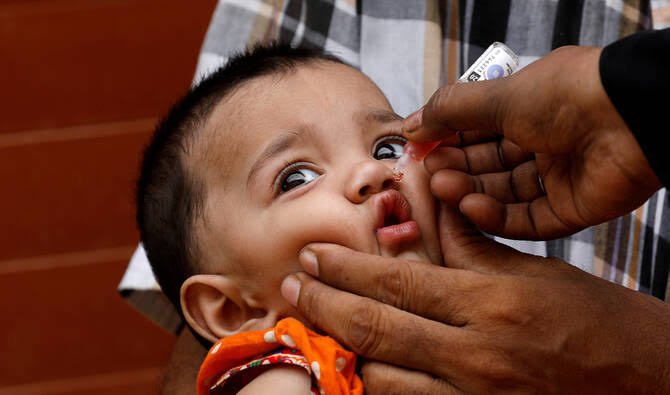
Pakistan has once again mobilized its vast public health machinery in a renewed push to eradicate poliomyelitis, launching the first nationwide anti-polio immunization campaign of the year on Monday. The campaign reflects Islamabad’s continued resolve to wipe out a disease that still poses a serious challenge to the country’s health system and global standing, particularly as Pakistan remains one of only two countries in the world where the poliovirus has not yet been eliminated.
According to state-run media, the latest vaccination drive aims to immunize more than 45 million children below the age of five across the country. This massive undertaking involves hundreds of thousands of trained frontline health workers and volunteers, who will be going from house to house to ensure that every eligible child receives the life-saving oral polio vaccine. Authorities view the campaign as a crucial step in sustaining recent gains made against the virus and preventing any resurgence.
Polio eradication continues to be one of Pakistan’s most important public health priorities. Despite years of progress, the virus has proven stubborn, fueled by a combination of misinformation, logistical challenges, security threats, and natural disasters. Alongside neighboring Afghanistan, Pakistan remains among the last two countries globally where polio is still endemic, a reality that places the country under intense international scrutiny and pressure.
Health officials note, however, that there has been measurable improvement in recent years. In 2025, Pakistan recorded 31 confirmed cases of poliomyelitis, a sharp reduction compared to the 74 cases reported in 2024. Authorities describe this decline as encouraging, though they caution that even a single case is unacceptable and underscores the need for relentless vaccination efforts. The persistence of the virus in certain pockets of the country means that complacency could quickly reverse hard-won progress.
The schedule and scope of the current immunization campaign were outlined last month by Ayesha Raza Farooq, the prime minister’s focal person for polio eradication. She announced that the campaign would be conducted nationwide from February 2 to February 8, covering urban centers, rural communities, and hard-to-reach areas alike. During this period, health teams are tasked with administering polio drops to millions of children, ensuring that no child is missed.
To achieve this ambitious target, approximately 400,000 trained vaccinators and support staff have been deployed. These teams are operating under a door-to-door strategy, widely regarded as the most effective method for reaching young children, particularly in communities with limited access to health facilities. The approach also allows health workers to directly engage with parents and caregivers, addressing concerns, dispelling myths, and emphasizing the importance of repeated vaccination.
While the campaign is national in scope, authorities have adopted a staggered or varied-duration strategy in some provinces to better manage logistical and security challenges. State broadcaster Radio Pakistan reported that vaccination activities in Punjab, Sindh, and Khyber Pakhtunkhwa would begin on Monday, with tailored timelines designed to maximize coverage and efficiency in each region. This flexible approach reflects lessons learned from previous campaigns, where rigid schedules sometimes hampered outreach.
Provincial leadership has also been visibly involved in the campaign to underscore its importance and encourage public participation. In Sindh, Chief Minister Syed Murad Ali Shah formally inaugurated the drive in Karachi by personally administering polio drops to children. His gesture was intended to send a strong message of confidence in the vaccine and the government’s commitment to protecting children from the disease.
Speaking at the launch, Shah stressed that eradication is the only acceptable outcome in the fight against polio. He remarked that the virus must be eliminated completely, emphasizing that partial success or temporary declines in case numbers are not enough. His comments echoed the broader consensus among health experts that polio can only be defeated by sustained, nationwide immunization without gaps in coverage.
The National Emergency Operations Center (NEOC), which coordinates polio eradication efforts at the federal level, has repeatedly highlighted the importance of consistent vaccination campaigns. In a statement issued earlier, the NEOC revealed that six nationwide polio drives were carried out across Pakistan during 2025 alone. These repeated campaigns are designed to ensure that immunity levels remain high, particularly in areas where the virus has historically circulated.
The NEOC has once again appealed to parents and caregivers to fully cooperate with vaccination teams. Officials stress that the oral polio vaccine is safe, effective, and essential for protecting children from paralysis and lifelong disability. They warn that refusal or hesitation can leave children vulnerable and allow the virus to continue circulating within communities.
Despite these efforts, the road to eradication has been fraught with challenges. One of the most serious obstacles has been the persistent threat to the safety of polio workers. Vaccination teams and their security escorts have been targeted in militant attacks, particularly in parts of northwestern Khyber Pakhtunkhwa and the southwestern province of Balochistan. These attacks have not only claimed lives but have also disrupted campaigns, making it difficult to reach children in remote and high-risk areas.
A particularly tragic incident occurred in December 2025, when a gun attack on a polio vaccination team in the Bajaur district resulted in the deaths of a police constable and a civilian. Such incidents underscore the dangers faced by frontline health workers and highlight the complex intersection of public health and security in certain regions of the country. Authorities continue to provide security cover to vaccination teams, but risks remain.
In addition to security concerns, natural disasters have also hampered polio eradication efforts. Floods and other climate-related emergencies in recent years have displaced large populations, damaged infrastructure, and disrupted routine health services. In affected areas, vaccination campaigns have often had to be postponed or modified, creating gaps in immunization coverage that the virus can exploit.
Health experts argue that overcoming these challenges requires not only medical interventions but also sustained community engagement, political commitment, and international support. They emphasize that polio eradication is as much a social and governance issue as it is a medical one. Building trust, countering misinformation, and ensuring uninterrupted access to vaccines are all critical components of success.
As the latest nationwide campaign gets underway, Pakistani authorities are hopeful that continued vigilance and cooperation will bring the country closer to its goal of a polio-free future. The sharp decline in cases over the past year has provided renewed optimism, but officials are keenly aware that the final stages of eradication are often the most difficult.
For now, the focus remains firmly on reaching every child, in every community, without exception. With millions of children to be vaccinated, hundreds of thousands of workers in the field, and the eyes of the world watching, Pakistan’s first anti-polio drive of the year represents both a challenge and an opportunity—one that could determine whether the country finally consigns poliovirus to history.