

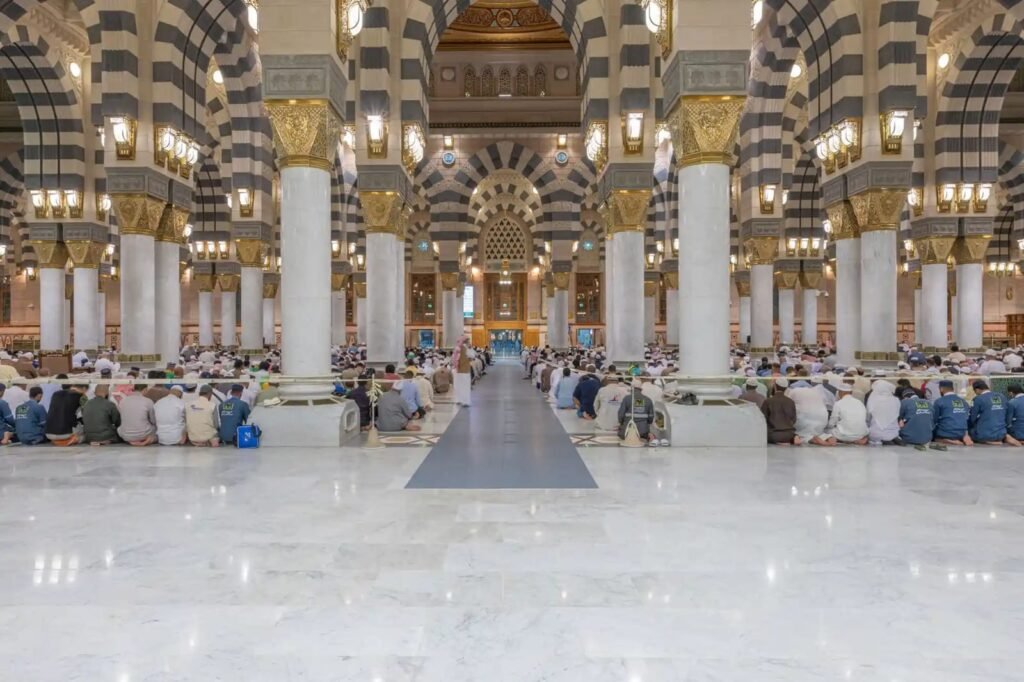
The General Authority for the Care of the Affairs of the Grand Mosque and the Prophet’s Mosque has implemented a highly advanced and integrated technological infrastructure across the Two Holy Mosques, including their surrounding courtyards, to guarantee the safety, comfort, and smooth experience of worshippers throughout the day and night. This initiative reflects a sophisticated approach to managing the immense crowds that visit these sacred sites while maintaining an environment conducive to spiritual practices.
In Makkah, the Grand Mosque benefits from one of the world’s most extensive cooling systems, designed to ensure optimal indoor temperatures despite the region’s extreme heat. The system’s total refrigeration capacity reaches an impressive 155,000 tons, made possible by the joint operations of two primary plants.
The larger Al-Shamiyah plant provides 120,000 tons of cooling, while the Ajyad plant contributes 35,000 tons, forming a comprehensive network to circulate chilled water throughout the mosque’s massive interior spaces. Water is cooled to a precise range of 4°C to 5°C before being pumped via an extensive distribution system to maintain indoor conditions between 22°C and 24°C.
Advanced monitoring and air purification technologies underpin the system’s effectiveness. Seventy-seven temperature sensors continuously track environmental conditions, while air purification units operate at up to 95% efficiency to maintain clean, breathable air, even during the peak periods of congregation when visitor density is at its highest.
According to reports from the Saudi Press Agency, the cooling network in the Grand Mosque spans approximately 1.5 million square meters, covering the main prayer halls, corridors, and open courtyards. Notably, the Al-Shamiyah station is situated roughly 900 meters from the mosque, while the Ajyad station is about 500 meters away, ensuring efficient coverage throughout the sacred site.
The cooling and purification process is enhanced by advanced filtration and ultraviolet technology, which purifies air up to nine times daily, eliminating approximately 95% of harmful germs before distribution. The system is also designed to adjust automatically in response to external temperature changes, ensuring that indoor conditions remain stable year-round regardless of weather fluctuations.
Meanwhile, in Madinah, the Prophet’s Mosque is supported by a central cooling plant located seven kilometers away, extending across 70,000 square meters. This facility contains six powerful cooling units, each capable of generating 3,400 tons of refrigeration. Additionally, seven main pumps circulate chilled water maintained between 4°C and 5°C, supplying temperature-controlled water to 2,357 columns and supporting around 550 individual air-conditioning units distributed throughout the mosque. These measures ensure consistent thermal comfort and high-quality air circulation for worshippers in all parts of the mosque.
The Two Holy Mosques also prioritize ease of movement for visitors. In the Grand Mosque, more than 200,000 individuals can move through the premises per hour, facilitated by 220 escalators and 29 elevators, all maintained according to rigorous safety standards. Similarly, the Prophet’s Mosque is equipped with 180 escalators and 25 elevators, enabling smooth crowd management while adhering to approved operational protocols. Regular inspection programs ensure these facilities remain safe and fully functional at all times.
Lighting in both mosques is similarly extensive and technologically advanced. The Grand Mosque features more than 120,000 lighting units and 6,900 chandeliers, while the Prophet’s Mosque is illuminated by over 137,000 LED units. Centralized control systems dynamically adjust the intensity and distribution of lighting according to prayer schedules and crowd density, enhancing visibility and ensuring an aesthetically harmonious environment for worshippers.
Operational efficiency and maintenance are supported by centralized control rooms that continuously monitor system performance in real time. Using sophisticated analytics and predictive technologies, potential faults are anticipated and addressed before they impact operations. This proactive approach enhances sustainability, reduces the risk of service interruptions, and ensures that worshippers experience uninterrupted comfort and convenience during their visits.
The integration of cooling, air purification, movement facilitation, and lighting reflects a holistic strategy to manage the immense scale of the Two Holy Mosques. Each component is carefully calibrated and monitored to maintain optimal conditions for visitors, demonstrating a commitment to combining technological innovation with the spiritual and cultural significance of these sites. The authority’s approach ensures not only the safety and comfort of millions of worshippers but also the long-term sustainability of operations in some of the most visited religious sites in the world.
In essence, these advanced systems—from temperature management to air purification, lighting control, and crowd facilitation—highlight a meticulous planning framework designed to meet the demands of high visitor volumes while preserving the sanctity and serenity of the Two Holy Mosques. By continuously refining and integrating these technologies, the General Authority ensures a seamless experience for all visitors, upholding a standard of excellence that combines operational sophistication with the spiritual experience of worship.
The scope of these systems illustrates a remarkable fusion of engineering, technology, and religious stewardship. By leveraging state-of-the-art monitoring, predictive maintenance, and environmental control systems, the Two Holy Mosques maintain a comfortable and safe atmosphere for millions of pilgrims and visitors, all year round. Each component, from the chilled water distribution networks and air purification units to lighting automation and escalator operations, is coordinated to provide a flawless environment that aligns with both modern technological standards and the spiritual significance of the sites.
The commitment to operational excellence extends beyond the physical infrastructure. Staff at both mosques receive specialized training to monitor, maintain, and operate these sophisticated systems efficiently. This ensures that visitors experience not only comfort and safety but also a seamless blend of modern technology with traditional religious practices. These efforts collectively reinforce the General Authority’s dedication to providing a superior worship environment that accommodates the immense scale, complexity, and cultural importance of the Grand Mosque in Makkah and the Prophet’s Mosque in Madinah.
This comprehensive technological ecosystem underscores a future-focused approach to religious site management, one that harmonizes cutting-edge engineering solutions with the spiritual needs of worshippers, creating an environment where comfort, safety, and devotion coexist in perfect balance.