

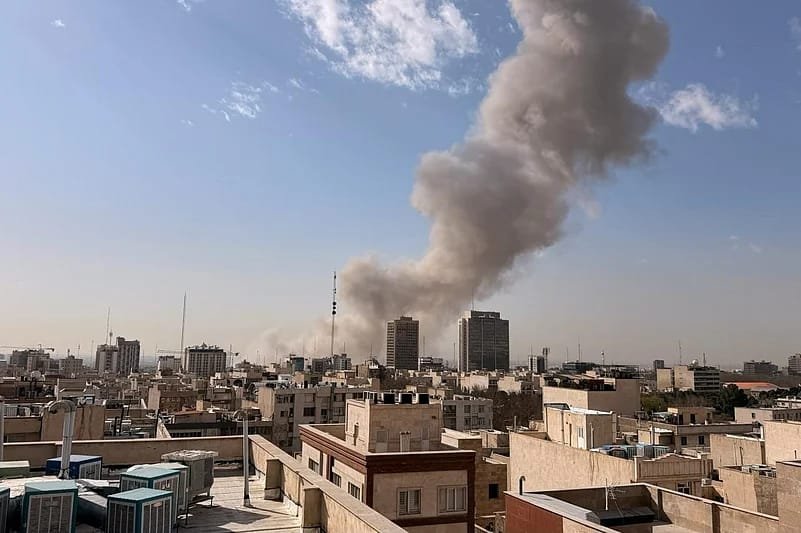
Following the launch of coordinated military strikes by Israel and the United States against Iran, tensions across the Middle East have escalated dramatically, with Tehran issuing stark warnings that signal a dangerous new phase in the confrontation.
An unnamed senior Iranian official declared that, in the aftermath of what he described as joint American-Israeli aggression, every U.S. “asset and interest” in the Middle East is now considered a legitimate target. According to the official, previous constraints that may have limited Iran’s response no longer apply. “All red lines have been erased,” he asserted, emphasizing that scenarios once viewed as unlikely or merely theoretical have now become part of Iran’s active strategic calculations.
The official addressed Israel directly, cautioning it to prepare for an overt and uncompromising response. He stressed that Iran’s retaliation would be public and would not be bound by traditional limitations. This message was framed as both a warning and a declaration of intent, signaling that Tehran is prepared to broaden the scope of the conflict if necessary.
These remarks came shortly after Israel and the United States initiated a joint military operation targeting multiple locations inside Iran, including areas in and around the capital, Tehran. Israeli sources later indicated that senior figures within Iran’s governing structure were among the intended targets. The strikes reportedly followed growing frustration in Washington over the stalled progress of nuclear negotiations between the two countries.
U.S. President Donald Trump had publicly expressed dissatisfaction with the direction of talks just a day earlier, reiterating that his administration would not tolerate any form of uranium enrichment on Iranian soil. Tehran had already rejected that position, maintaining that its nuclear program is a sovereign right and not subject to external dictates. The breakdown in diplomatic momentum appears to have been followed almost immediately by the escalation on the battlefield.
Iran’s Supreme National Security Council also weighed in, warning that the attacks might not be a one-time event. In an official statement, the council suggested that intelligence assessments indicated the possibility of continued operations by Israel and the United States, particularly in Tehran and potentially other major cities. In response to the security situation, authorities announced the closure of schools and universities until further notice, though banks were instructed to remain operational to prevent economic disruption.
Meanwhile, Iran’s Foreign Ministry issued a strongly worded condemnation, characterizing the joint strikes as a grave threat not only to regional stability but to global peace. In a statement released via official communication channels, the ministry argued that the attacks occurred at a particularly sensitive moment—while diplomatic engagement between Tehran and Washington was still technically underway. It described the military action as a reckless move that undermines international efforts to de-escalate tensions.
The ministry also appealed to the international community, especially neighboring countries and members of the Islamic world, to denounce what it termed unlawful aggression. It called for immediate collective measures to counter what it sees as a destabilizing act that could ignite a broader regional conflict.
On the military front, Iran signaled that its response would not be symbolic. Foreign Minister Abbas Araghchi confirmed that all American bases in the region could be considered potential targets. This statement was widely interpreted as a direct threat to U.S. installations scattered across Gulf states and beyond.
Shortly thereafter, Iran’s Islamic Revolutionary Guard Corps (IRGC) announced the commencement of what it described as large-scale retaliatory operations against Israel. Through a statement broadcast on Iranian state media, the IRGC declared that the first wave of missile and drone strikes had already been launched toward what it referred to as “occupied territories,” a term used by Tehran to describe Israel. The announcement underscored that the campaign would be extensive and sustained.
Israel’s military confirmed that it had detected and engaged incoming projectiles launched from Iranian territory. Defense systems were activated across various regions of the country in response to missile fire. While details regarding damage and casualties were not immediately disclosed, the acknowledgment signaled that the confrontation had moved beyond rhetoric and into direct exchange.
The repercussions were not confined to Israel and Iran alone. In Bahrain, authorities reported that a service facility associated with the U.S. Fifth Fleet in the Juffair area had come under missile attack. In Qatar, warning sirens sounded near the Al Udeid Air Base, one of the largest American military installations in the region. These developments indicated that the conflict’s geographic footprint was widening.
Reports from international news agencies further suggested that explosions were heard in Abu Dhabi, the capital of the United Arab Emirates, as well as in parts of Kuwait. These incidents occurred after Iran officially declared that it was targeting American military positions across the region. The emerging pattern points to a rapidly expanding theater of operations that now encompasses multiple Gulf states.
Collectively, these events mark one of the most serious escalations between Iran and its adversaries in recent years. What began as a dispute over nuclear policy and diplomatic impasse has swiftly transformed into open military confrontation. With Iran vowing a forceful and unconstrained response, and with Israeli and American forces already engaged, the risk of further regional destabilization appears high.
The coming days will likely determine whether this conflict remains limited to targeted exchanges or evolves into a broader regional war. For now, both sides appear entrenched in positions that leave little room for compromise, and the Middle East stands on the brink of yet another potentially far-reaching crisis.