

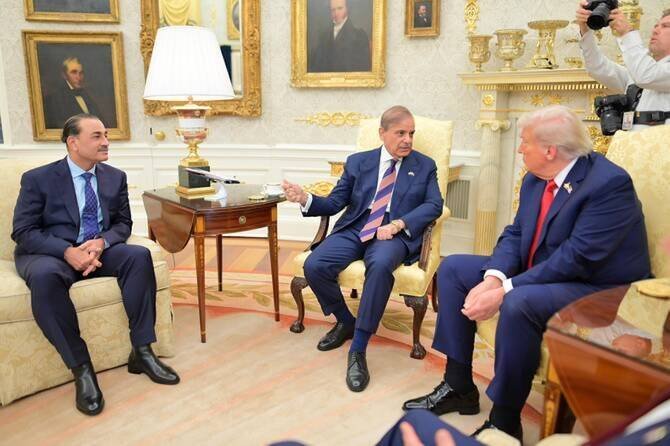
Prime Minister Shehbaz Sharif has expressed strong appreciation for what he described as “kind and gracious” remarks by United States President Donald Trump, following a renewed exchange of warm messages between the leadership of Pakistan and the United States on social media. The statements come at a time when diplomatic activity is intensifying over efforts aimed at reducing tensions in the ongoing US-Iran situation.
The exchange gained momentum after President Donald Trump once again acknowledged Pakistan’s leadership in positive terms, including Prime Minister Shehbaz Sharif and Chief of Defence Staff (CDF) and Chief of Army Staff (COAS) Field Marshal Syed Asim Munir. His comments were seen as a reflection of improving diplomatic engagement between Washington and Islamabad, particularly as Pakistan has played a facilitative role in broader regional communication efforts.
In response, Prime Minister Shehbaz Sharif took to social media platform X, where he conveyed “deep and profound appreciation” on behalf of the people of Pakistan as well as the country’s civil and military leadership. He stated that such recognition from the US President reflects the strength of dialogue and mutual respect between the two nations.
President Trump, posting on Truth Social, reciprocated the sentiment by referring to Pakistan’s leadership in positive language and describing them as “fantastic people.” His remarks further contributed to a visible warming of tone between the two sides, especially in the context of sensitive regional developments.
These exchanges are unfolding alongside broader diplomatic movements related to the Iran situation. Iranian Foreign Minister Abbas Araghchi recently stated that movement of commercial shipping through the Strait of Hormuz remains open for the duration of the ceasefire period. He further clarified that maritime traffic through this crucial waterway will follow coordinated routes established by Iran’s Ports and Maritime Organisation, ensuring continued flow of commercial activity despite regional tensions.
At the same time, President Trump has indicated in interviews that discussions between American and Iranian negotiators are likely to take place over the weekend. Speaking to Axios, he suggested that there is optimism regarding the possibility of reaching an agreement within a very short timeframe, possibly within “a day or two,” signaling urgency in ongoing diplomatic efforts.
In another development, Trump also remarked that if a peace agreement related to the conflict is finalized in Islamabad, he may consider traveling to Pakistan. He added that Iran has reportedly agreed to “almost everything,” suggesting progress in negotiations, though no formal confirmation has been issued by all parties involved.
Against this backdrop, Pakistan’s leadership has found itself referenced in multiple diplomatic discussions, particularly in relation to regional peace efforts and communication channels between key stakeholders. The tone of recent statements from both Washington and Islamabad indicates an attempt to maintain constructive engagement while broader geopolitical negotiations continue.
The latest exchanges highlight a period of active diplomatic signaling, where social media statements, public remarks, and ongoing negotiations are collectively shaping perceptions of international relations and potential pathways toward de-escalation in the region.