

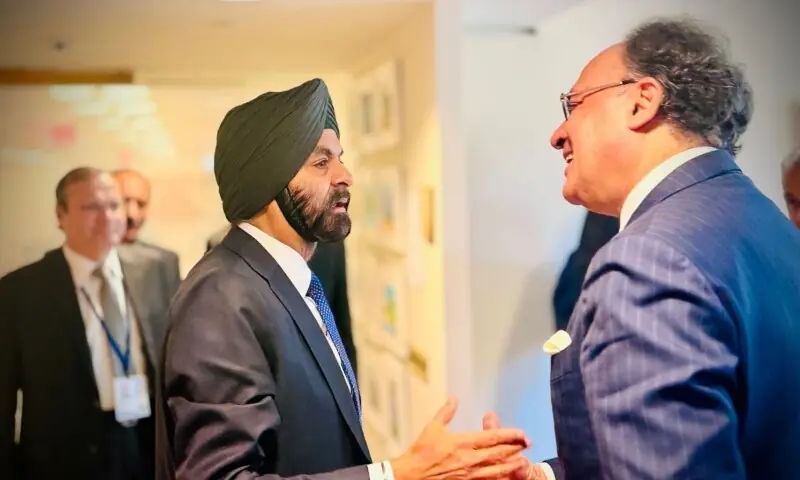
WASHINGTON, D.C.:Finance Minister Muhammad Aurangzeb held a series of high-level meetings with global financial leaders, including World Bank President Ajay Banga, Fitch Ratings officials, and UK Minister for International Development Baroness Jenny Chapman, reaffirming Pakistan’s commitment to economic reforms, resilience, and sustainable growth.
On the sidelines of the IMF–World Bank Annual Meetings, Aurangzeb briefed Banga on Pakistan’s comprehensive flood response strategy and appreciated the Bank’s timely post-flood support.
He highlighted Pakistan’s initiatives to leverage technology and cooperatives to empower small farmers and strengthen agricultural resilience. The minister also discussed progress on the Country Partnership Framework (CPF) and reiterated Pakistan’s commitment to deepening its partnership with the World Bank.
Aurangzeb requested additional support under the International Development Association (IDA), citing reduced allocations, and underscored the importance of a holistic reform approach for the gas and power sectors to ensure long-term sustainability and efficiency.
In a separate meeting, Aurangzeb thanked Fitch Ratings for upgrading Pakistan’s sovereign credit rating to B- with a stable outlook, expressing satisfaction that all major rating agencies were now aligned on Pakistan’s improving economic trajectory.
He briefed Fitch officials on structural reforms in taxation, energy, privatisation, and state-owned enterprises, and reaffirmed the government’s plan to accelerate privatisation for fiscal discipline.
The minister also shared updates on Pakistan’s efforts to issue Panda Bonds in the Chinese market and secure competitive tariff agreements with the United States.
During his meeting with UK Minister Baroness Jenny Chapman, Aurangzeb acknowledged the UK’s long-standing development partnership and collaboration on Pakistan’s reform and growth agenda.
He commended the Digital Dashboard Initiative, which aims to enhance transparency and monitoring of development projects, and emphasised better coordination and oversight of off-budget projects to align with national priorities.
Both sides reaffirmed their commitment to strengthening Pakistan–UK development cooperation.
At a roundtable hosted by the Peterson Institute for International Economics (PIIE) titled Challenges and Opportunities for the Pakistani Economy through 2025 and Beyond, Aurangzeb highlighted Pakistan’s macroeconomic recovery, staff-level IMF agreement, and recent credit rating upgrades.
He noted progress in Federal Board of Revenue (FBR) reforms and reaffirmed the government’s determination to sustain reform momentum. Aurangzeb said that favourable geopolitical shifts had opened new opportunities for foreign investment and trade cooperation.