

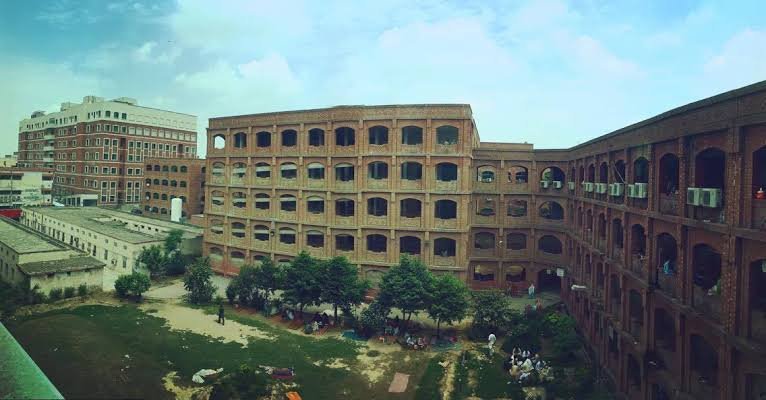
In a truly extraordinary display of medical excellence and human determination, a team of young surgeons at Lahore General Hospital (LGH) accomplished what many would call a miracle — saving the life of a critically injured young man whose heart had been severely damaged by a deep stab wound. The incident, which unfolded in the heart of Lahore, has become a powerful example of Pakistan’s growing medical capabilities, proving that government hospitals, too, can deliver world-class healthcare when skill, urgency, and compassion come together.
According to officials at LGH, the 22-year-old patient, Rizwan from Kasur district, was brought to the emergency department late one night in a perilous state. He had sustained a deep knife injury to his back that had punctured his heart, causing uncontrollable internal bleeding. By the time he reached the hospital, his blood pressure had dropped dangerously low, and doctors feared that even a few minutes’ delay could cost him his life. The trauma team quickly realized that this was not an ordinary case — it required immediate open-heart surgery.
Within moments, the hospital’s Surgical Unit One transformed into a high-stakes battlefield between life and death. Under the leadership of the unit’s head, Professor Farooq Afzal, an emergency team comprising young surgeons — Dr. Saeed Mahmood, Dr. Muhammad Taimoor, Dr. Owais, Dr. Amna Tariq, and Dr. Lubna — began an urgent operation to repair the damage. Every heartbeat mattered. The team worked in unison, each member fully aware that even a minor error could lead to irreversible consequences.
The knife had entered dangerously close to one of the major cardiac arteries, a region where surgical precision is critical. Despite this, the team managed to control the bleeding, restore circulation, and reconstruct the injured portion of the heart. The complex procedure lasted several hours and tested the limits of both human endurance and technical expertise. As the final sutures were placed, the monitors began showing steady heart activity — a sign that Rizwan’s life had been saved.
After the surgery, the patient was transferred to the Intensive Care Unit (ICU) for post-operative care. Over the next two weeks, he remained under close medical observation, receiving continuous monitoring from a team of doctors and nurses. Gradually, his condition stabilized. He began to breathe normally, regain his strength, and eventually recover enough to walk again. For Rizwan’s family, it was nothing short of a second chance at life.
Speaking about the emotional ordeal, a relative said, “We had lost hope. We were watching him fade away in front of our eyes. But the doctors didn’t give up — they fought for him when we couldn’t.” The family expressed profound gratitude to the entire medical staff and the Punjab government for providing all treatment, surgery, and medicines completely free of cost.
Professor Farooq Afzal later shared that this achievement reflects both the training and dedication of young Pakistani doctors. He said, “Our surgeons have shown that public sector hospitals can perform miracles when equipped with the right training and resources. This success belongs to the entire nation — to every young doctor who chooses to serve humanity with passion and commitment.” He further mentioned that the Punjab government’s support in ensuring free treatment played a crucial role, demonstrating that healthcare excellence is not bound by wealth but by will.
Experts from the medical community praised the accomplishment, emphasizing that heart injuries caused by stab wounds are among the most dangerous cases in surgery worldwide. Survival rates are often extremely low, even in advanced medical systems. For a government hospital in Pakistan to successfully perform such a delicate operation under pressure was, in their words, “a benchmark moment for public healthcare.”
Medical specialists also highlighted that such achievements boost public confidence in the national healthcare system. “This case shows that Pakistani doctors possess not only technical skill but also the courage to handle life-threatening emergencies,” said a senior cardiologist from Lahore. “When young doctors perform at this level, it gives us hope that the next generation of physicians will take Pakistani medicine to new heights.”
Beyond the operating room, the incident has sparked a broader discussion about the importance of strengthening medical training, emergency response systems, and investment in government hospitals. The success at Lahore General Hospital has become a symbol of what can be achieved when experience meets enthusiasm and when young doctors are empowered to act decisively in moments of crisis.
Rizwan’s story has since become one of inspiration — not just for his family but for thousands who believe in the resilience of Pakistan’s healthcare system. Today, he is back home in Kasur, fully recovered, living proof of what can happen when faith, skill, and teamwork come together in perfect harmony.
As one senior nurse at LGH put it, “This wasn’t just a surgery — it was a race against time, a fight for hope, and a triumph of humanity.”