

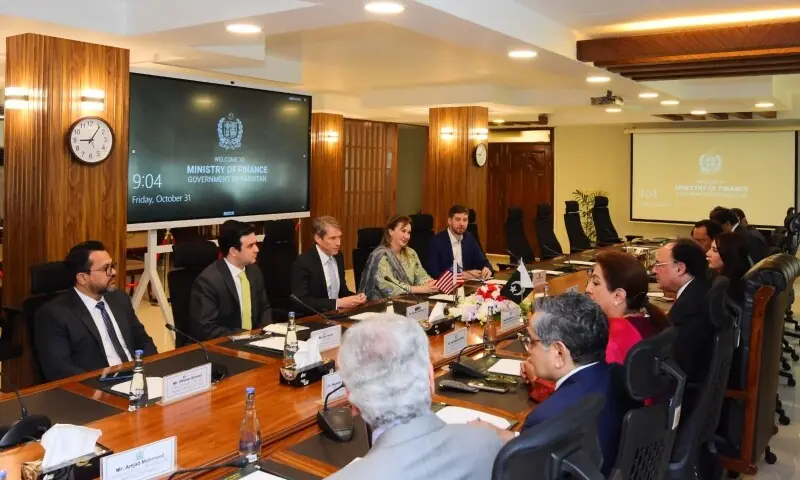
ISLAMABAD: A high-level US delegation led by Robert Louis Strayer II, president of the Critical Minerals Forum (CMF), held extensive talks with Pakistani officials in Islamabad on Friday, exploring ways to develop secure and transparent mineral supply chains for American industries amid Washington’s growing concern over China’s dominance in global rare earth resources.
The US delegation met with a Pakistani team headed by Finance Minister Muhammad Aurangzeb, discussing cooperation in mining, sustainable investment, and supply-chain security, according to an official statement. The visit coincided with the announcement of a new 10-year US-India defense framework, underscoring Washington’s intensified strategic engagement in South Asia.
Mr. Strayer highlighted Pakistan’s scientific and engineering talent, calling it a “competitive advantage” that could help the country emerge as a future hub for critical mineral development. He said the CMF’s global mission was to support reliable supply chains for US industries, especially in emerging markets, and to “de-risk” investments from both financial and security perspectives.
The CMF focuses on key resources such as copper, antimony, lithium, and rare earth metals, which are vital for advanced energy technologies, military equipment, and high-performance manufacturing. Strayer also pledged technology transfer, intellectual property protection, and efforts to boost US investor confidence in Pakistan’s mining sector.
Accompanying the delegation, US Chargé d’Affaires Natalie Baker reaffirmed Washington’s commitment to commercial engagement in Pakistan and stressed the importance of regulatory clarity and investor security in the minerals industry.
Finance Minister Muhammad Aurangzeb welcomed American investment and outlined Pakistan’s ongoing legal and regulatory reforms aimed at creating a conducive environment for foreign investors.
We encourage you to return with a detailed framework for collaboration, he said. Pakistan will evaluate it with a view to facilitating responsible investment and ensuring mutual benefit.
Aurangzeb underscored that Pakistan’s mineral wealth could drive export-led growth, transforming the economy from consumption-driven cycles and easing balance-of-payments pressures. He also noted that Pakistan’s recent engagements with global financial bodies such as the DFC and IFC had generated interest in expanding mining-related investments.
US officials view China’s control over critical mineral supply chains as a strategic vulnerability. According to the CMF, Beijing’s dominance stems from state subsidies, vertical integration, and lax environmental regulations, especially in refining sectors where the US remains under-invested.
The Atlantic Council recently warned that the global supply of critical minerals essential for technologies from fighter jet magnets to EV batteries has become dangerously concentrated in a few countries and largely refined in China. The Council noted that Beijing has even weaponized its dominance, restricting exports of key materials such as graphite and antimony in response to US trade measures.
Despite optimism, Mr. Strayer acknowledged significant barriers to US investment, citing unusually high uncertainty in both production costs and mineral prices. This volatility, he said, discourages profit-driven companies from entering new markets.
Investors prefer to engage in projects where risk-adjusted returns are clearer, he noted, calling for long-term stability and transparency to attract sustainable private-sector capital.