

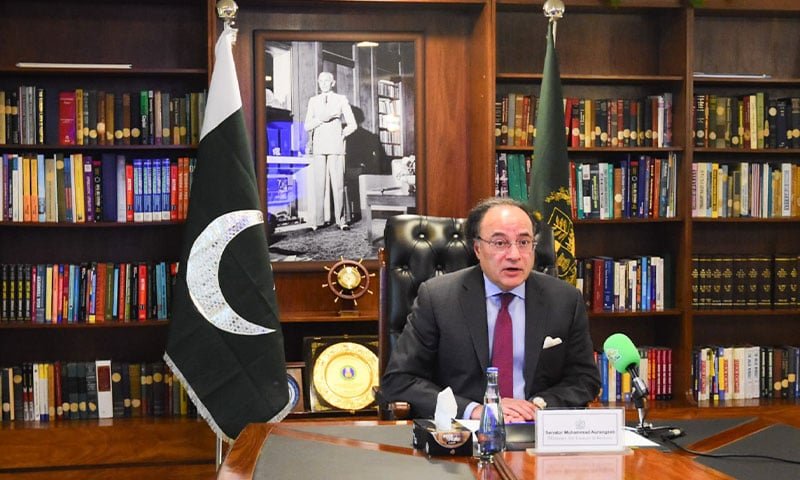
ISLAMABAD / KARACHI: Federal Minister for Finance and Revenue Muhammad Aurangzeb has described Pakistan’s blue economy as a “game changer” for the country’s long-term growth, projecting its potential to reach $100 billion by 2047, while reaffirming the government’s commitment to policy continuity and economic reform.
Delivering a virtual address at the inaugural session of the Pakistan International Maritime Expo & Conference (PIMEC), organised in Karachi by the Pakistan Navy and the Ministry of Maritime Affairs, the minister underscored the immense untapped opportunities within the maritime sector.
Mr Aurangzeb noted that the blue economy encompassing fisheries, aquaculture, port logistics, and ocean-based renewable energy currently contributes only 0.4 to 0.5 per cent of GDP, roughly $1 billion, but holds transformative potential for Pakistan’s economic future.
We have a clear and robust roadmap to turn the blue economy into a $100 billion sector by 2047 an ambitious but achievable target aligned with Pakistan’s 100th anniversary and its $3 trillion economic vision, the minister said.
He endorsed the Ministry of Maritime Affairs’ vision to accelerate value-added processing in fisheries and aquaculture, supported by modern cold-chain logistics and international-standard hygiene practices. Under the National Fisheries and Aquaculture Policy, developed with the Food and Agriculture Organization (FAO), seafood exports could increase from $500 million to $2 billion within four years, he said.
Mr Aurangzeb also stressed the need to modernise and digitise port operations at Karachi, Port Qasim, and Gwadar, aligning them with global standards to enhance regional trade connectivity. He highlighted new opportunities in renewable energy projects, such as tidal and offshore wind power, and urged exploring innovative financing tools including blue bonds and blended finance to fund sustainable marine development and conservation.
The finance minister also reviewed recent progress on Pakistan’s macroeconomic stabilisation efforts, noting that the exchange rate remains stable, while foreign exchange reserves have risen to over $14 billion, covering more than two and a half months of imports.
He said inflation remains in single digits, despite temporary pressures from recent floods, and added that the policy rate has been reduced in line with easing inflation.After nearly three years, all three major global rating agencies have upgraded Pakistan’s outlook to stable, signalling renewed international confidence in our policy direction, he said.
Mr Aurangzeb further noted that the recent staff-level agreement with the IMF in Washington had reinforced global trust in Pakistan’s reform trajectory.
Calling for a shift from government-to-government dealings toward trade and investment-driven partnerships, the minister said Pakistan must capitalise on its relations with China, the United States, and the Gulf nations particularly Saudi Arabia and the UAE.
He reiterated that the government is firmly committed to ensuring policy consistency and continuity, which he said was essential for building investor confidence and enabling long-term growth. We find ourselves in a good spot today, he concluded, with a convergence of factors economic reform, stability, and opportunity that can propel Pakistan towards a sustainable and inclusive future.