

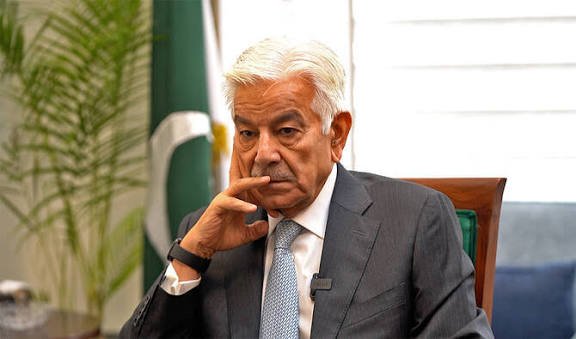
The Government of Pakistan is entering a crucial phase of legislation concerning defense laws and constitutional amendments. According to Defense Minister Khawaja Asif, political consensus on the proposed 27th Constitutional Amendment is expected within the next two to three days, after which the bill will likely be presented in Parliament next week.
In an interview with a private television channel, Khawaja Asif stated that the government is reviewing certain laws related to the armed forces to ensure that they align with modern defense requirements. He explained that a potential amendment to Article 243 of the Constitution is under discussion, as the country’s defense needs have evolved over time. Article 243 specifies that the command and control of the armed forces rest with the federal government, while the President of Pakistan serves as the supreme commander of the armed forces.
At the same time, the government has assured the National Assembly that there is no intention to revoke the 18th Amendment through any new legislation. This clarification came amid concerns in some political circles that upcoming amendments might compromise provincial autonomy.
Inside Parliament, a separate debate unfolded over the leadership of the opposition. Barrister Gohar formally submitted a request to the Speaker’s office to officially announce the Leader of the Opposition. He warned that if the Speaker failed to make the announcement, he would ask Mahmood Achakzai to assume the position himself. Gohar also referred to the 2022 Supreme Court verdict, which instructed the government to enact legislation within 45 days granting civilians convicted by military courts the right to appeal in civilian courts.
During the same session, MNA Malik Amir Dogar also demanded that Mahmood Achakzai be immediately declared the Leader of the Opposition in accordance with parliamentary rules. However, Deputy Speaker Ghulam Mustafa Shah, who was presiding over the session, suggested that opposition members should discuss the matter directly with the Speaker’s office, as a related case is currently sub judice.
Meanwhile, another scene unfolded earlier that Wednesday when journalists covering the parliamentary proceedings walked out of the press gallery. Their protest was against the recent wave of journalist dismissals from various TV channels and the growing restrictions on media freedom. The Deputy Speaker directed Information Minister Attaullah Tarar to engage in dialogue with the protesting journalists.
During the discussions, Parliamentary Reporters Association (PRA) representative M.B. Soomro expressed deep concern over the government’s suspension of advertisements to Dawn newspaper and the ongoing dismissals of journalists across media organizations. He urged the government to take immediate notice of these developments.
Later, while addressing the National Assembly floor, Information Minister Attaullah Tarar voiced serious concern over the arbitrary layoffs of journalists without prior notice or justification. He assured that the government was taking the issue seriously and that a meeting with media owners would be held next week to address it. Tarar emphasized that the government has ensured timely financial payments to media houses, and it now expects that the resulting benefits will also reach the working journalists and staff members.
The minister further revealed that a delegation from the Pakistan Federal Union of Journalists (PFUJ) had met with him to present a charter of demands. These demands will be discussed in an upcoming meeting involving representatives of the Pakistan Broadcasters Association (PBA) and the All Pakistan Newspapers Society (APNS) to find a sustainable and fair resolution.
Thus, within Pakistan’s current political and parliamentary atmosphere, the government finds itself navigating two parallel challenges — on one hand, constitutional and defense reforms, and on the other, the protection of media freedom and journalists’ rights.