

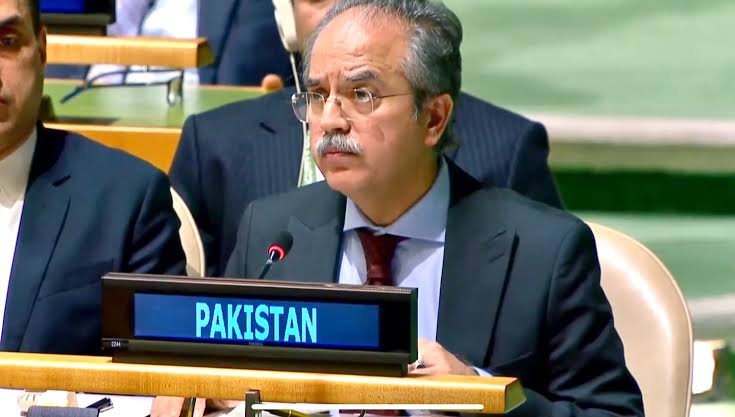
At the United Nations Security Council’s recent session devoted to the environmental consequences of armed conflicts and the security threats created by climate change, Pakistan’s Permanent Representative to the UN, *Ambassador Asim Iftikhar Ahmad, strongly criticised India’s decision to **unilaterally suspend the Indus Waters Treaty (IWT). Speaking to global diplomats and environmental experts, he described New Delhi’s move as an *attempt to weaponise shared natural resources—a step that, in his words, not only violates a long-standing international accord but also places the region’s ecological balance and human security in jeopardy.
He emphasised that millions of people living across the Indus Basin, from the Himalayas to the Arabian Sea, depend on this river system for *agriculture, drinking water, and electricity generation, and any unilateral disruption could have devastating socio-economic and environmental consequences. Ambassador Ahmad noted that *India’s suspension earlier this year was not merely a political gesture but a breach of trust that erodes the cooperative framework established over six decades ago through the Indus Waters Treaty of 1960 — a treaty that has long been regarded as one of the world’s most successful examples of transboundary water management.
Recalling the historical background, he explained that the treaty, brokered by the *World Bank, allocates the six rivers of the Indus basin between the two countries: **India controls the eastern rivers — Ravi, Beas, and Sutlej — while Pakistan retains rights over the western rivers — Indus, Jhelum, and Chenab. This arrangement, despite several political and military tensions, has remained a cornerstone of water cooperation in South Asia. Yet, Ahmad warned that India’s decision to act outside the treaty’s framework has jeopardised this delicate balance, raising concerns not only for Pakistan but for the broader principle of *international water law.
He reminded the Council that the *Permanent Court of Arbitration (PCA) in The Hague, in a 2025 ruling, reaffirmed the *validity of the Indus Waters Treaty and made clear that neither party has the right to unilaterally suspend or alter its terms. The court underscored that disputes must be resolved through established mechanisms of dialogue and arbitration. Ahmad argued that India’s disregard for this ruling demonstrates a worrying trend of unilateralism in regional resource management, potentially undermining the credibility of global treaties that safeguard equitable access to natural resources.
The Pakistani envoy went on to link the issue to a wider pattern of environmental and security challenges. He observed that climate-related stress, melting glaciers, and irregular monsoon patterns are already threatening South Asia’s water security. When coupled with politically motivated disruptions of water flow, these factors could lead to food shortages, migration pressures, and cross-border tensions. Ahmad urged the international community to recognise that environmental degradation and security instability are deeply interconnected, and called on the UN Security Council to integrate environmental protection and sustainable resource management into its peacebuilding and conflict-prevention agenda.
He also reiterated Pakistan’s stance that climate finance and biodiversity conservation should be supported through *grant-based international assistance, rather than debt-creating instruments. The ambassador insisted that funding for post-conflict ecological recovery must be *transparent, equitable, and additional to existing humanitarian and development commitments, ensuring that vulnerable countries are not burdened by new financial obligations in the name of climate action.
In addition to highlighting the Indus dispute, Ambassador Ahmad also addressed another key matter during the session — Pakistan’s support for a UN Security Council resolution that approved the delisting of Syrian President Ahmed al-Sharaa and Interior Minister Anas Khattab from the UN’s 1267 sanctions committee. He described this decision as a constructive step toward enabling Syria’s political normalisation, institutional rebuilding, and economic recovery after more than a decade of civil war and humanitarian crisis. Ahmad said that while sanctions relief alone cannot ensure stability, it can help create space for a Syrian-led peace process and sustainable reconstruction, provided that international engagement remains consistent and principled.
By linking these two seemingly separate issues — water governance in South Asia and post-conflict reconstruction in the Middle East — Pakistan sought to highlight a *broader diplomatic vision: that shared natural resources and cooperative engagement must become tools of **peace, not pressure. Ambassador Ahmad concluded his remarks by stressing that when nations manipulate water, energy, or climate resources for political leverage, they endanger not just their neighbours but global peace and stability itself. He urged all members of the Security Council to reaffirm their commitment to *international law, environmental responsibility, and multilateral cooperation as the only sustainable path toward collective security.
Through its recent interventions at the UN, Pakistan has positioned itself as an advocate for climate justice and responsible resource management, emphasizing that the future of peace depends on how fairly and sustainably nations share the planet’s natural wealth. The statement also signals Islamabad’s intent to frame environmental diplomacy as a cornerstone of its foreign policy, turning issues like water sharing, energy cooperation, and climate resilience into opportunities for collaboration rather than confrontation.