

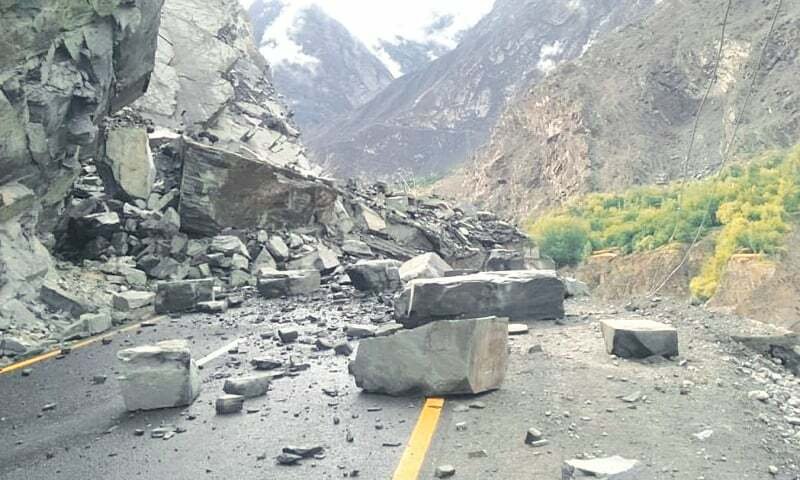
The recent *landslide in Chilas, located in the Gilgit-Baltistan region along the **Karakoram Highway, has once again highlighted the growing environmental vulnerabilities of Pakistan’s northern areas. The incident occurred near the area of **Gandlu, where tons of rocks, mud, and debris suddenly rolled down from the steep mountains, burying a major stretch of the highway under rubble.
In a matter of minutes, the roaring sound of falling rocks turned into chaos — **six vehicles were trapped beneath the debris, while several others sustained heavy damage. Eyewitnesses reported that *two passenger vehicles lost control and plunged straight into the Indus River, vanishing in the turbulent waters below.
Soon after the disaster, *panic spread across the area, and local residents, police officials, and highway maintenance staff rushed to assist the victims. According to **Faizullah Faraq, spokesperson for the Gilgit-Baltistan government, *rescue teams fear that several individuals may still be trapped beneath the debris, though no fatalities have yet been officially confirmed. Some passengers acted quickly, leaping out of their vehicles just moments before the landslide struck, narrowly escaping what could have been a tragic outcome. Locals also joined in the rescue efforts, pulling survivors to safety and providing first aid where possible.
Upon receiving reports of the incident, the Chief Minister of Gilgit-Baltistan immediately took notice and issued directives for a *swift and coordinated rescue operation. Emergency response teams, including Rescue 1122, local police, and district administration units, were dispatched to the site. Nearby hospitals were placed on *high alert, with emergency rooms prepared to receive potential casualties. Medical staff and ambulance services were instructed to remain on standby to handle any injured victims without delay. Heavy machinery, including cranes and excavators, has been deployed to clear the massive blockage and restore traffic on the Karakoram Highway as soon as possible.
Rescue workers described the operation as extremely challenging. The scale of the landslide has *completely blocked the road, leaving hundreds of travelers stranded on both sides of the highway. The mountain slopes remain unstable, and the risk of *further rockfall is still high, making it difficult for teams to access the site safely. The suspension of traffic has not only disrupted the movement of local commuters and tourists but also halted the transport of essential goods, affecting trade and daily life in the surrounding valleys.
Experts believe that this tragic event is another consequence of climate change and rapid environmental degradation in the northern mountain ranges. Rising temperatures have accelerated glacier melt, which weakens the structural integrity of the mountains and increases the likelihood of landslides, floods, and other natural hazards. The Karakoram Highway, often referred to as an engineering marvel connecting Pakistan to China, runs through some of the world’s most fragile geological zones. Even minor rainfall or tremors can trigger large-scale landslides in this region, posing constant danger to travelers.
Local residents in Chilas and Gandlu reported that light to moderate rain had been falling intermittently over the past few days. The continuous moisture likely softened the soil and loosened rock layers, which eventually led to this massive slide. Communication and power services in the affected zone have also been temporarily disrupted, adding to the difficulties faced by residents and rescue workers alike.
Government officials have urged the public to avoid traveling on the Karakoram Highway until clearance work is completed. Meteorological departments have also issued warnings of more rain in the coming days, which could worsen the situation if preventive measures are not taken immediately.
This incident serves as a stark reminder of the urgent need to strengthen Pakistan’s disaster preparedness, early warning systems, and environmental monitoring frameworks, particularly in mountainous regions like Gilgit-Baltistan. As the frequency of such natural disasters continues to rise, experts emphasize that proactive planning, sustainable infrastructure development, and rapid emergency response mechanisms are vital to protect human lives and preserve the delicate ecosystem of the northern frontier.