

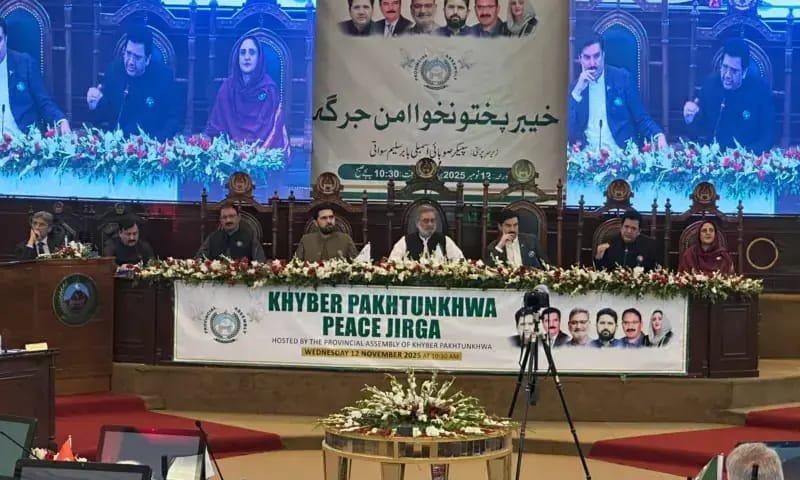
The Khyber Pakhtunkhwa government has convened a high-level peace jirga in the provincial assembly to address the rising incidents of terrorism and the deteriorating law and order situation in the province. The assembly meeting brings together political leaders, religious scholars, social representatives, and former officials with the goal of developing comprehensive strategies to restore peace and eliminate extremism from the region.
*Speaker of the Provincial Assembly, Babar Saleem Swati, is presiding over the jirga, which has drawn participation from the Chief Minister of Khyber Pakhtunkhwa **Suhail Afridi, Governor **Faisal Karim Kundi, representatives of the federal government, and senior leaders from all major political and religious parties in the province. Notable participants include **Asad Qaiser, former National Assembly Speaker and senior PTI leader; **Abadullah Khan, opposition leader from PML-N; *Mian Iftikhar Hussain of ANP; Siraj-ul-Haq, former Emir of Jamaat-e-Islami; and representatives from Jamiat Ulema-e-Islam (F) and Pakhtunkhwa Milli Awami Party.
During his opening remarks, Chief Minister Suhail Afridi welcomed all participants and emphasized that the jirga is intended to find sustainable and long-term solutions to counter the scourge of terrorism. He noted that while discussions about peace have been ongoing, there remain elements opposed to stability, highlighting that the solution cannot rely solely on temporary or isolated measures but requires a comprehensive and coordinated approach.
Speaker Babar Saleem Swati acknowledged the presence of courageous security forces and intelligence operations but pointed out that despite these efforts, achieving lasting peace remains challenging. He stressed the importance of political consensus, social engagement, and collective action across all sectors to create a secure and stable environment for the citizens of Khyber Pakhtunkhwa.
Former Chief Ministers *Mahmood Khan, former Governor **Shaukatullah Khan, legal experts, and representatives from various social and political groups also participated in the jirga. *PPP parliamentary leader Ahmad Karim Kundi praised the decision to convene the jirga, highlighting that it represents the first time the provincial assembly has brought together such a broad spectrum of leaders to represent the province’s four million residents in a united call for peace.
The jirga also revisited previous warnings by the Chief Minister regarding *the commencement of new military operations in tribal districts, emphasizing that sustainable peace requires political, social, and diplomatic engagement alongside security measures. Leaders at the jirga stressed that *stability along the Pakistan-Afghanistan border is essential, as peace in Afghanistan directly impacts security within Pakistan.
Political parties participating in the jirga agreed to set aside differences in the interest of peace. PML-N leader Abadullah Khan reiterated that the sole agenda of the gathering is the elimination of terrorism and the restoration of order, making it clear that there will be no negotiations or compromises with terrorists, particularly those responsible for heinous attacks on civilians and children.
Senior PTI leader Asad Qaiser emphasized that for the province’s leadership, *peace is a priority above politics. He stated that his party will present its demands regarding counter-terrorism measures to the federal government, and a *national-level policy framework will be crafted to tackle terrorism comprehensively. He also stressed the importance of diplomatic engagement with Afghanistan to ensure lasting security in the region.
The jirga took place against the backdrop of a recent wave of terrorist attacks across the country. Notable incidents include a bomb attack targeting security forces in Daraban, Dera Ismail Khan, which injured at least 14 personnel; an assault on Cadet College in Wana, South Waziristan, where students and faculty were safely evacuated, while three terrorists were neutralized; and a suicide attack in Islamabad that killed 12 people. These incidents underscore the urgency of coordinated political, social, and security measures to safeguard citizens and maintain stability.
The peace jirga represents a historic and unprecedented effort to bring together provincial leaders, political parties, religious organizations, and civil society in pursuit of a common goal: peace, security, and stability for the people of Khyber Pakhtunkhwa. Chief Minister Suhail Afridi expressed hope that the outcomes of the jirga would pave the way for lasting solutions and provide citizens with a secure environment where they can live without fear, thus ensuring that peace becomes the cornerstone of the province’s future.