

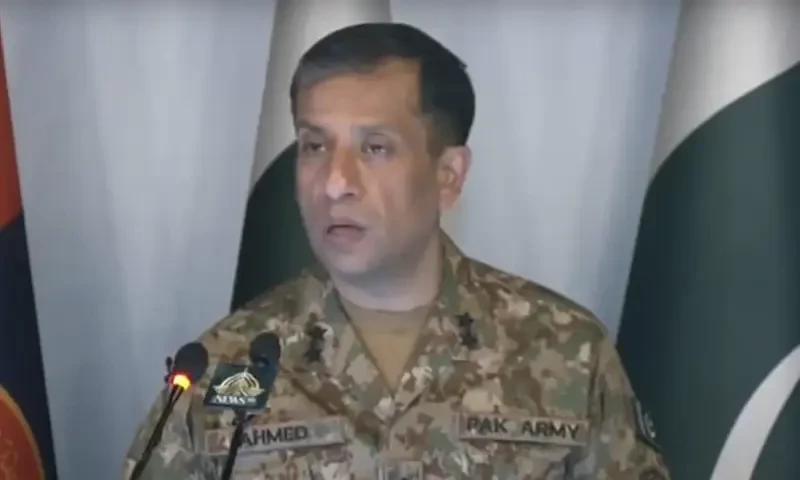
Pakistan’s security leadership has issued a stark warning about the escalating regional threat emanating from Afghanistan, with Inter-Services Public Relations (ISPR) Director General Lieutenant General Ahmed Sharif Chaudhry accusing the Afghan Taliban regime of enabling instability by supporting cross-border terrorist attacks. Addressing senior journalists, the DG ISPR said a strong nexus of political terror crime has taken shape across the border, posing a direct challenge to Pakistan’s internal stability. He asserted that Pakistan’s issue is not with the Afghan people but with the Afghan Taliban leadership, which he said has failed to uphold its commitments under the Doha Agreement. The DG ISPR revealed that Al-Qaeda, ISIS (Daesh), and multiple anti-Pakistan outfits continue to operate openly from Afghan soil, receiving arms and financing that fuel deadly attacks inside Pakistan.
Highlighting the urgency of the situation, Lt Gen Chaudhry disclosed extensive operational statistics, saying Pakistani security forces had conducted 67,023 operations nationwide this year, including 12,857 in KP and 53,309 in Balochistan, resulting in the elimination of 1,873 terrorists, 136 of whom were linked to Afghanistan. He also noted that since November 4 alone, 4,910 intelligence-based operations (IBOs) have been carried out, killing 206 terrorists.
The DG added that Pakistan witnessed 4,729 terrorist incidents this year, the vast majority occurring in KP and Balochistan. He pointed out the pressing challenges in securing the rugged 1,229-km Pak-Afghan border, where long distances between posts and divided border villages make complete control extremely difficult without coordinated efforts from across the border.
Lt Gen Chaudhry also exposed the deep connection between illicit trade and terrorism financing, revealing that before recent crackdowns, 20.5 million liters of smuggled Iranian diesel entered Pakistan daily, and providing funds for groups like the Baloch Liberation Army (BLA) and Baloch Yakjehti Committee (BYC). This figure has now been reduced to 2.7 million liters. He stressed that millions of non-custom-paid (NCP) vehicles remain a major security risk, as they are frequently used in terror attacks, including suicide bombings. Despite these challenges, he praised improvements in Baluchistan, where 27 districts have been transitioned to police jurisdiction, marking a significant step toward stabilizing the province.
On Afghanistan, the DG ISPR said the Taliban regime has failed to honour its promise of preventing Afghan territory from being used against other states, adding that Pakistan had provided solid evidence of terrorist safe havens to Kabul, but the information was ignored. He rejected the Afghan claim that certain militants are “migrants” or “guests,” challenging the regime to hand them over if they are Pakistani citizens. Citing a SIGAR report, he noted that $7.2 billion worth of U.S. weapons left behind in Afghanistan have empowered non-state actors, making the region more volatile. Lt Gen Chaudhry reiterated that Pakistan seeks a verifiable mechanism even one overseen by a third party to ensure Afghan soil is not used by militants.
The DG ISPR emphasized that Pakistan’s political leadership, regardless of party, remains united on eliminating terrorism under the National Action Plan (NAP). He warned that trade and bloodshed cannot occur simultaneously, and security must remain the top priority. He concluded with a strong message: There is no good or bad terrorist a good terrorist is one who has gone to hell. We stand with the truth, and the truth will always prevail.