

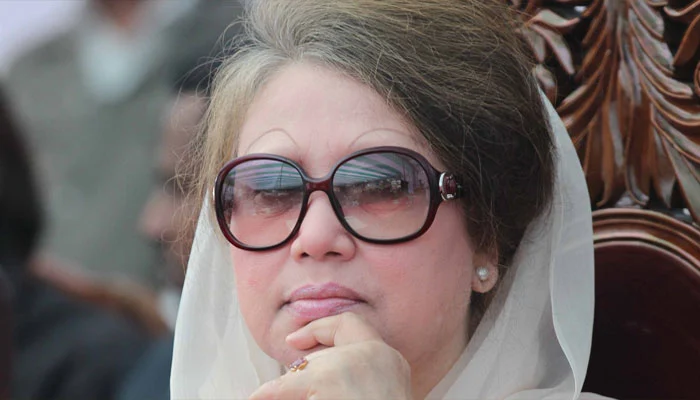
Dhaka: Bangladesh is in mourning following the death of Khaleda Zia, the country’s first female prime minister and a towering figure in its political history. Zia passed away early Tuesday at 6:00 a.m. (0000 GMT) after a prolonged battle with multiple health issues, including advanced cirrhosis of the liver, arthritis, diabetes, and heart complications, her doctors confirmed.
The BNP chairperson and former prime minister, the national leader Begum Khaleda Zia, passed away today, just after the Fajr prayer, the Bangladesh Nationalist Party (BNP) announced. The party urged citizens to offer prayers for her soul.
Interim leader Muhammad Yunus described her as “a great guardian” of the nation, whose leadership repeatedly helped Bangladesh emerge from undemocratic conditions. Nobel laureate Yunus praised her for inspiring citizens to reclaim their liberty. Ousted Prime Minister Sheikh Hasina also paid tribute, praying for her “eternal peace and forgiveness.”
The Bangladeshi government declared three days of state mourning. Funeral prayers will take place in front of the Parliament after midday prayers on Wednesday, with burial planned alongside her late husband, former President Ziaur Rahman. Interim leader Yunus appealed to citizens to maintain discipline during mourning.
Khaleda Zia, known for her quiet determination and careful approach, rose to political prominence following her husband’s assassination in 1981. She led the BNP to victory in the 1991 general election, becoming Bangladesh’s first female prime minister and only the second woman to head a democratic government in a majority Muslim country after Pakistan’s Benazir Bhutto.
During her tenure, she replaced the presidential system with a parliamentary one, lifted restrictions on foreign investment, and made primary education free and compulsory. Despite losing the 1996 election, she returned to power in 2001 with a surprise landslide victory. Her second term faced criticism over rising militancy and corruption allegations.
Zia’s political journey was defined by her bitter rivalry with Sheikh Hasina, the daughter of Bangladesh’s founding father. Dubbed the “battling begums,” the two women’s contrasting styles dominated Bangladeshi politics for decades, often fueling strikes, street violence, and political instability.
In 2018, Khaleda Zia and her son Tarique Rahman faced corruption charges, resulting in imprisonment and house arrest. Following Hasina’s ouster in 2024, she was released and acquitted by the Supreme Court in early 2025. Despite years of ill health, Zia had vowed to campaign in the February 12, 2026 general election, in which the BNP is widely regarded as a frontrunner. Her son, Rahman, returned to Bangladesh after 17 years in exile to lead the party.
International leaders expressed sorrow at her passing. Pakistan’s Prime Minister Shehbaz Sharif described her as a “committed friend of Pakistan,” while President Asif Ali Zardari praised her leadership. India’s Prime Minister Narendra Modi sent condolences, highlighting Zia’s vision and legacy for regional partnership.
Khaleda Zia’s death marks the end of an era in Bangladesh’s political landscape, leaving behind a complex legacy of resilience, leadership, and unwavering commitment to her party and nation.