

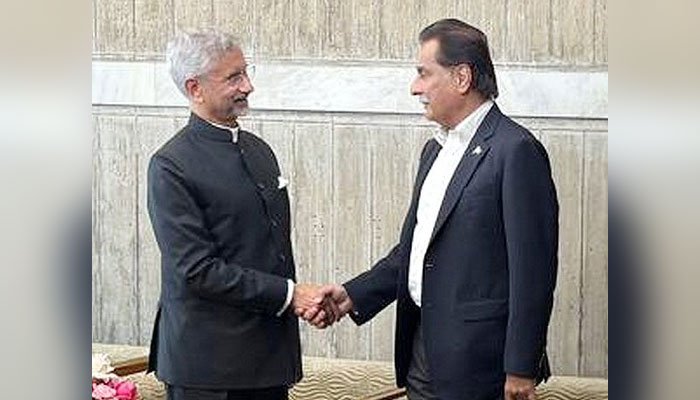
Dhaka: In a symbolic gesture that could signal a thaw in tense relations, Speaker of Pakistan’s National Assembly, Ayaz Sadiq, and Indian External Affairs Minister, Subrahmanyam Jaishankar, shook hands in Dhaka on Wednesday. This marks the first high-level contact between Pakistani and Indian officials since the military clashes in May.
The encounter occurred during Sadiq’s visit to Bangladesh for the funeral of former Prime Minister Khaleda Zia. According to a press release from the National Assembly Secretariat, Jaishankar approached Sadiq, introduced himself, and extended a handshake.
Since the May Pahalgam attack in Indian-administered Kashmir, which New Delhi blamed on Pakistan, relations between the two nuclear-armed neighbors hit their lowest point in years. Pakistan has consistently denied involvement and has repeatedly called for an independent investigation into the incident.
The Pahalgam attack triggered a series of aggressive measures by India, including unilateral suspension of the Indus Waters Treaty (IWT) a 1960 agreement brokered by the World Bank that has historically survived wars and political crises. India also closed a key border transit point, further straining bilateral ties.
The May escalation escalated into a four-day military clash, including airstrikes in Punjab and Azad Kashmir. A ceasefire was eventually brokered on May 10, following diplomatic intervention by the United States.
In June, the Permanent Court of Arbitration (PCA) issued a Supplemental Award of Competence, ruling that India cannot unilaterally suspend the IWT. Despite this, New Delhi’s recent fluctuations in the flow of the Chenab and Jhelum rivers sparked alarm in Pakistan, with farmers in Punjab reporting significant distress. Pakistan’s Foreign Office, led by Minister Ishaq Dar, condemned these moves, describing them as the “weaponisation of water” and reaffirmed the treaty’s continued validity under international law.
During the Dhaka meeting, the National Assembly press release emphasized Pakistan’s consistent call for dialogue, restraint, and cooperation, including proposals for peace talks and joint investigations, aiming to prevent unprovoked aggression and further escalation.
The handshake, while brief, represents a rare moment of civility amid months of heightened tensions and could pave the way for renewed diplomatic engagement between Islamabad and New Delhi.