

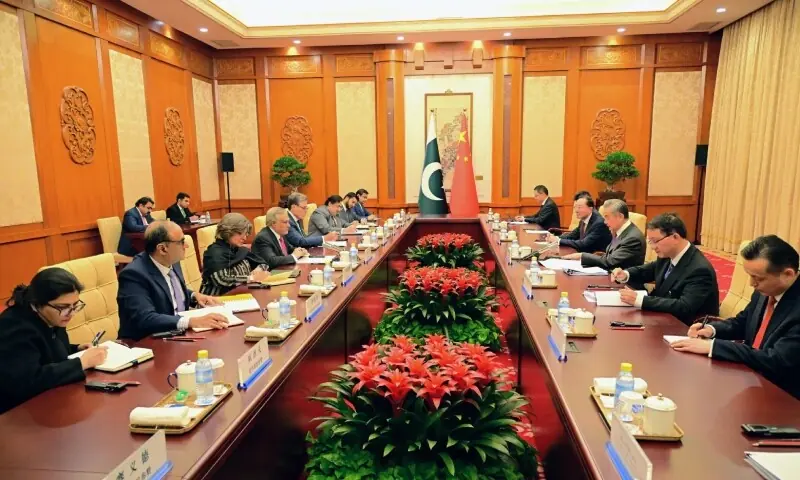
BEIJING / ISLAMABAD: Pakistan and China on Monday issued a joint communique urging “visible and verifiable” actions to dismantle terrorist organisations operating from Afghanistan and prevent Kabul’s territory from being used for attacks against other countries. The statement followed the conclusion of the 7th round of the Pakistan-China Foreign Ministers’ Strategic Dialogue, attended by Deputy Prime Minister Ishaq Dar in Beijing.
“The two sides called for more visible and verifiable actions to dismantle and eliminate all terrorist organisations in Afghanistan which continue to threaten regional and global security,” the communique said. Both countries agreed to maintain close coordination on Afghanistan, encourage the Afghan government to adopt inclusive policies, focus on development, and play a constructive role in regional stability.
China also commended Pakistan for measures to protect Chinese personnel, projects, and institutions, recognising Islamabad’s long-standing sacrifices in combating terrorism. The communique reaffirmed both nations’ zero-tolerance stance on terrorism, highlighting commitments to strengthen counter-terrorism cooperation, safeguard the China-Pakistan Belt and Road projects, and oppose double standards in international counter-terrorism efforts.
The dialogue covered bilateral and regional cooperation across multiple sectors, including defense, security, economy, trade, investment, and cultural exchanges. Both countries agreed to enhance strategic communication, deepen mutual trust, and safeguard common interests, marking the 75th anniversary of diplomatic relations as an opportunity to consolidate friendship and expand cooperation.
In a landmark announcement, Pakistan and China pledged to develop an “upgraded version 2.0” of the China-Pakistan Economic Corridor (CPEC), with a focus on industry, agriculture, mining, Gwadar Port operations, the Karakoram Highway, and sustainable development initiatives. The two sides also agreed to deepen cooperation in IT, cybersecurity, education, vocational training, and people-to-people exchanges, and to keep the Khunjerab Pass open year-round to boost trade.
On strategic and global issues, Pakistan reiterated its support for the one-China principle, including positions on Taiwan, Xinjiang, Hong Kong, and the South China Sea. China reaffirmed its support for Pakistan’s sovereignty, economic development, and role in regional and international affairs, including Pakistan’s UN Security Council presidency and upcoming SCO chairmanship (2026–2027).
The communique also highlighted space cooperation, with plans for Pakistani astronauts to participate in the China Space Station program, and continued collaboration under global frameworks such as the Global Development, Security, Civilisation, and Governance Initiatives to promote multilateralism and equitable global governance.
On regional and international issues, the two countries stressed adherence to UN principles and international law, opposition to unilateral actions, and peaceful resolution of disputes, including occupied Kashmir. They also reiterated support for a two-state solution in Palestine and an unconditional ceasefire in Gaza.
During his visit, Deputy Prime Minister Dar met Chinese officials, including China Minmetals Corporation and CIDCA, to discuss ongoing projects, socio-economic cooperation, and flagship initiatives marking the 75th anniversary of Pakistan–China relations. The next round of the Foreign Ministers’ Strategic Dialogue is scheduled to be held in Islamabad next year.