

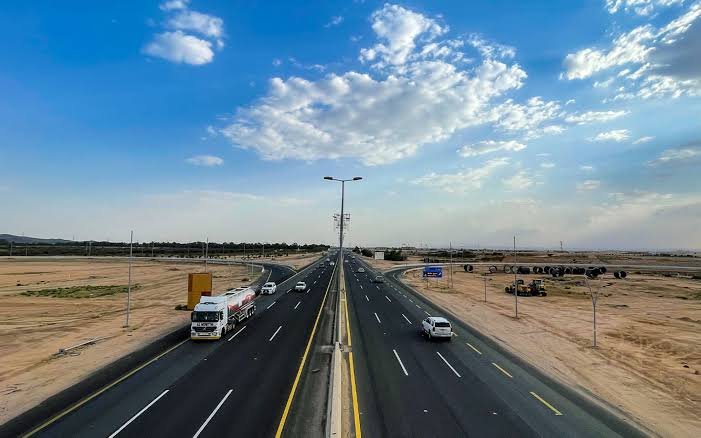
Over the past several decades, the Kingdom of Saudi Arabia has quietly but decisively built one of the most comprehensive and strategically significant road systems in the world. What may initially appear as a simple figure becomes far more meaningful when examined in context: the total length of the Kingdom’s road network now stretches beyond 73,000 kilometers, a distance that far surpasses the full circumference of the Earth, which measures roughly 40,075 kilometers.
This comparison alone illustrates the extraordinary scale of development achieved, yet the true value of this network lies not merely in its size, but in the role it plays in shaping mobility, economic growth, safety, and international connectivity.
The expansion of Saudi Arabia’s road infrastructure has transformed how people and goods move across the country. From remote desert regions to densely populated urban centers, the road system functions as a lifeline that supports daily life, commerce, and national integration.
It allows citizens and residents to travel efficiently between cities and regions, shortens distances that were once difficult to traverse, and strengthens social and economic ties across vast geographical areas. This internal connectivity has been a cornerstone in supporting development across all provinces, ensuring that growth is not limited to a few major cities but is shared more broadly throughout the Kingdom.
Beyond its domestic importance, the Saudi road network has also elevated the country’s position on the global stage. According to international assessments issued by the World Competitiveness Forum, the Kingdom has secured the top position worldwide in the Road Network Connectivity Index. This ranking reflects how effectively roads link population centers, industrial zones, ports, and border crossings, enabling seamless movement across the country. Achieving first place globally is not the result of chance; rather, it is the outcome of long-term planning, sustained investment, and a clear national vision that recognizes transportation as a fundamental driver of competitiveness and prosperity.
One of the defining strengths of Saudi Arabia’s road system is its regional reach. The network does not stop at national boundaries but extends outward to connect the Kingdom with eight neighboring countries. These include fellow Gulf Cooperation Council states as well as Jordan, Iraq, and Yemen. Such extensive cross-border connections enhance regional integration and reinforce Saudi Arabia’s role as a central corridor linking Asia, Africa, and Europe. By facilitating the smooth flow of goods and travelers across borders, the road network supports international trade, strengthens diplomatic and economic ties, and positions the Kingdom as a pivotal hub within regional and global logistics chains.
This strategic connectivity is particularly vital for sectors that are central to the Kingdom’s identity and economic diversification efforts. The annual Hajj and Umrah pilgrimages, which bring millions of visitors from around the world, depend heavily on reliable and well-managed road infrastructure. Pilgrims traveling between holy sites, airports, and accommodation areas rely on safe and efficient roads to complete their journeys with ease and dignity.
Similarly, the growing tourism sector, driven by Vision 2030 initiatives, benefits immensely from high-quality roads that enable visitors to explore historical sites, natural landscapes, and emerging entertainment destinations throughout the country. Trade and logistics operations also gain from reduced transportation costs, faster delivery times, and improved reliability, all of which are supported by a strong road network.
Quality, not just quantity, has been a defining focus of Saudi Arabia’s road development strategy. Among the G20 nations, the Kingdom has achieved a ranking of fourth place in the Road Infrastructure Quality Index. This standing highlights the emphasis placed on design excellence, durability, and user experience. Roads are built not only to meet immediate needs but to perform reliably over the long term, even under challenging climatic conditions such as extreme heat and sandstorms. Continuous upgrades and maintenance ensure that infrastructure remains resilient and capable of supporting increasing traffic volumes as the population grows and economic activity expands.
Oversight and regulation play a crucial role in maintaining these high standards, and this responsibility is carried out by the Roads General Authority. The authority has adopted internationally recognized best practices to enhance safety, efficiency, and sustainability across the road sector. One of its most significant initiatives has been the introduction of the Road Code, which serves as a unified technical framework governing all aspects of road-related work.
This code provides clear guidance for planning, engineering design, construction methods, and ongoing maintenance, ensuring consistency and quality across projects implemented by different entities. By establishing a single reference point, the Road Code minimizes discrepancies, reduces risks, and raises overall performance levels.
In addition to technical standards, regulatory measures have been introduced to better manage activities that take place within road corridors. The issuance of the Road Right-of-Way Permits Regulation represents an important step in organizing how utilities, construction works, and other interventions interact with road infrastructure. By regulating these activities, the authority aims to protect road assets, reduce disruptions to traffic flow, and enhance safety for all users. This approach also contributes to a more positive experience for drivers and pedestrians alike, reflecting a broader shift toward user-centered infrastructure management.
Safety remains a central priority within the Kingdom’s road sector strategy. Despite the vast scale of the network, efforts are continuously underway to reduce accidents and fatalities. The Roads General Authority is implementing projects designed to enhance road safety features across the network, drawing on the methodologies of the International Road Assessment Programme.
These measures include improved signage, safer intersections, better lighting, and road designs that reduce the likelihood and severity of crashes. The ultimate objective is ambitious yet clear: to reduce road-related deaths to fewer than five per 100,000 people, a benchmark aligned with leading global standards.
Looking ahead, Saudi Arabia has set defined targets to further elevate its standing in global road infrastructure rankings. By 2030, the Kingdom aims to rank sixth worldwide in the Road Quality Index, a goal that reflects ongoing commitment rather than complacency with current achievements. Meeting this target will require sustained investment, innovation, and close coordination between public and private stakeholders. It will also depend on maintaining advanced service levels that ensure roads can handle future demand without compromising safety or efficiency.
The continued rollout of major projects and sector-wide initiatives demonstrates that the development of the road network is an evolving process. As economic diversification accelerates and new cities, industrial zones, and tourism destinations emerge, the road system will continue to adapt to support these changes. In doing so, it will remain a foundational element of the Kingdom’s transformation, enabling mobility, fostering connectivity, and reinforcing Saudi Arabia’s role as a leading logistics and transportation hub on the global map.