

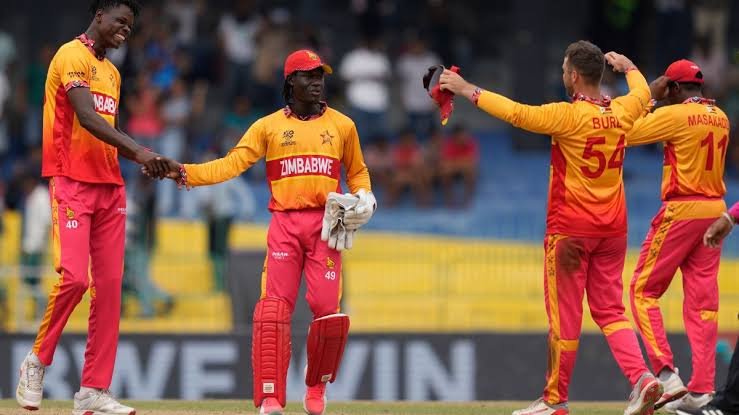
Zimbabwe surged to the top of the Group B standings after producing a composed and spirited performance to defeat Sri Lanka by six wickets in a gripping encounter at the R. Premadasa International Cricket Stadium on Thursday. The contest unfolded as a battle of momentum shifts, with both sides enjoying dominant passages, but it was Zimbabwe’s calculated chase, anchored by Brian Bennett and energized by captain Sikandar Raza, that ultimately proved decisive in the closing stages.
Sri Lanka, after being put in to bat, began their innings with aggressive intent. Openers Kusal Perera and Pathum Nissanka wasted little time asserting themselves, taking advantage of the powerplay restrictions to pierce the field and accumulate quick runs. Their stroke play was crisp and authoritative, forcing Zimbabwe’s bowlers onto the defensive early on.
The pair constructed a brisk 54-run opening partnership that laid a solid platform within the first five overs. Perera, in particular, looked dangerous as he found the boundary repeatedly, but his promising start was halted when Blessing Muzarabani delivered a breakthrough, dismissing him for a lively 22 off just 14 balls.
While Perera’s departure slowed the initial charge, Nissanka continued to anchor the innings with calm assurance. Displaying a blend of timing and placement, he rotated the strike effectively while punishing loose deliveries. His fluent knock carried Sri Lanka past the 100-run mark by the 12th over, and he soon registered his 19th half-century in T20 internationals.
However, as Zimbabwe tightened their lines and lengths, the middle overs brought a shift in control. Kusal Mendis struggled to accelerate and was eventually stumped by Ryan Burl after consuming 20 deliveries for 14 runs, a dismissal that stalled Sri Lanka’s momentum.
Zimbabwe sensed an opportunity and pressed harder. Veteran spinner Graeme Cremer played a pivotal role in dragging his side back into contention. He removed the well-set Nissanka for a crucial 62 off 41 balls, an innings decorated with elegant boundaries that had earlier threatened to push Sri Lanka toward a much larger total. Cremer struck again soon after, dismissing Kamindu Mendis and leaving Sri Lanka wobbling. Captain Dasun Shanaka failed to provide stability, falling cheaply to Muzarabani, who claimed his second wicket of the match.
As wickets fell at regular intervals, Sri Lanka’s innings risked losing its earlier impetus. However, Pavan Rathnayake injected late urgency with a counterattacking display. His brisk 44 off 25 deliveries, featuring clean strikes over the boundary and well-timed fours, ensured the hosts maintained a competitive scoring rate in the death overs.
Yet his charge was cut short by Brad Evans, who also removed Dushan Hemantha in the same over to further dent Sri Lanka’s finishing push. In the final moments, Dunith Wellalage contributed an unbeaten 15 from eight balls, nudging the total to 178 for seven at the conclusion of 20 overs. While it was a respectable score, the earlier loss of wickets meant Sri Lanka perhaps fell slightly short of the commanding total they once appeared destined to post.
Zimbabwe’s bowlers shared responsibility effectively. Muzarabani, Evans, and Cremer each claimed two wickets, combining pace and spin to disrupt Sri Lanka’s rhythm during key phases. Their ability to strike during the middle overs prevented the hosts from capitalizing fully on their promising start.
Chasing 179 required both composure and calculated aggression, and Zimbabwe’s openers rose to the challenge. Brian Bennett and Tadiwanashe Marumani approached the target with positivity, refusing to allow Sri Lanka’s bowlers to settle. They capitalized on scoring opportunities in the powerplay, rotating the strike intelligently while dispatching boundary balls with authority. Their 69-run opening partnership provided Zimbabwe with a crucial foundation and kept the required rate manageable.
Marumani played his part fluently, scoring 34 from 26 deliveries with a mixture of elegant drives and a well-struck six. His dismissal in the ninth over, courtesy of Wellalage, gave Sri Lanka a glimmer of hope. Ryan Burl then entered and delivered a short but impactful cameo, scoring 23 off just 12 balls. His quick acceleration eased any building pressure before he was dismissed by Shanaka.
The defining moment of the chase unfolded when Sikandar Raza joined Bennett at the crease. The Zimbabwe captain injected urgency into the innings with fearless stroke play. Raza targeted the boundary with intent, launching consecutive sixes that shifted momentum decisively. His partnership with Bennett was characterized by controlled aggression and smart running between the wickets. Together, they added a rapid 50 runs, steadily reducing the equation and placing Zimbabwe firmly in command.
Bennett, meanwhile, continued to anchor the innings with maturity beyond his years. He paced his knock carefully, ensuring he remained until the closing stages. His half-century was a testament to disciplined shot selection and situational awareness.
However, Sri Lanka refused to surrender without a fight. In the 19th over, Dushan Hemantha dismissed Raza for a scintillating 45 off 26 balls, an innings that included four towering sixes. Hemantha struck again in the same over to remove Tashinga Musekiwa, briefly tilting the tension back toward the hosts.
With eight runs needed from the final over, the contest hung in the balance. Tony Munyonga stepped up under pressure, smashing a decisive six that effectively sealed the outcome. Bennett then calmly ensured there were no further hiccups, guiding Zimbabwe to victory with four wickets to spare. He finished unbeaten on 63 from 48 deliveries, striking eight boundaries in a composed and match-winning performance. Munyonga remained not out on eight from three balls as Zimbabwe completed a memorable chase.
The victory not only earned Zimbabwe two valuable points but also elevated them to the top of Group B, reflecting the team’s growing confidence and cohesion. It was a triumph built on collective effort—disciplined bowling to restrict Sri Lanka’s scoring surge and a structured batting response anchored by partnerships at critical junctures.
For Sri Lanka, despite strong contributions from Nissanka and Rathnayake, the inability to maintain pressure during Zimbabwe’s chase ultimately proved costly. Zimbabwe, on the other hand, demonstrated resilience, tactical clarity, and composure under pressure, qualities that could serve them well as the tournament progresses.