

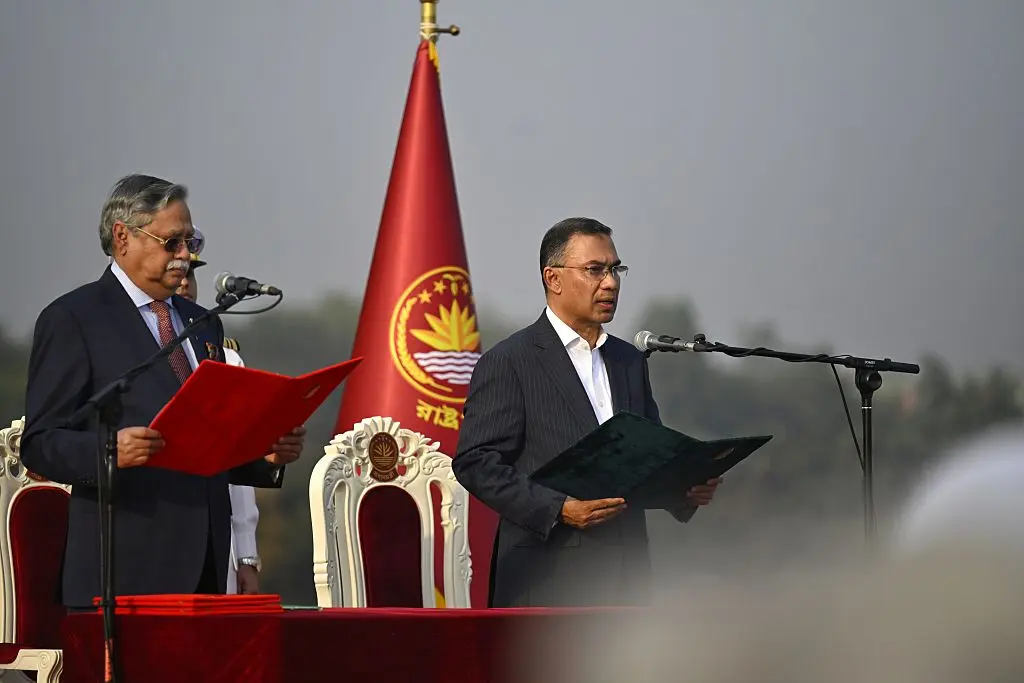
The recent political developments in Bangladesh have opened a new chapter in regional diplomacy, with the country’s newly elected Prime Minister Tarique Rahman signalling a strong commitment to enhancing relations with Gulf nations, particularly the Kingdom of Saudi Arabia. His public admiration for Saudi Arabia’s Vision 2030 has been widely noted and is viewed as a positive indicator of strengthened bilateral cooperation between Dhaka and Riyadh.
Following his party’s decisive victory in the general elections, which secured a two-thirds parliamentary majority, Prime Minister Rahman assumed office with a clear message: Bangladesh seeks closer engagement with long-standing partners in the Gulf. In remarks given prior to the election, he described Saudi Arabia as a “long-standing friend” and expressed sincere appreciation for the Kingdom’s transformative Vision 2030 initiative. He emphasised his willingness to work closely with Saudi leadership and other Gulf states to build long-term partnerships founded on trust and shared progress.
The Kingdom of Saudi Arabia responded warmly, with senior leadership conveying congratulations and best wishes for Bangladesh’s prosperity and development. Such diplomatic gestures reflect the enduring strength of ties between the two nations, which formally established relations in the mid-1970s and have since cultivated cooperation across labour, trade, and development sectors.
Today, more than three million Bangladeshi nationals live and work in Saudi Arabia, forming one of the largest expatriate communities in the Kingdom. Over the decades, Bangladeshi professionals, engineers, healthcare workers, and skilled labourers have contributed to Saudi Arabia’s development, while remittances and shared opportunities have supported Bangladesh’s economic growth. This longstanding people-to-people connection continues to serve as a strong foundation for bilateral relations.
Prime Minister Rahman has acknowledged the historical roots of Saudi–Bangladesh ties, noting that diplomatic relations began during his father’s presidency and expanded during the tenure of his mother, former Prime Minister Khaleda Zia. With the new government now in office, he has expressed hope for further cooperation with Gulf countries, including the United Arab Emirates, Qatar, Bahrain, Kuwait, and Oman, with Saudi Arabia remaining a central partner.
His positive references to Vision 2030 are particularly significant. The Saudi reform programme, which focuses on economic diversification, innovation, and sustainable development, has attracted global interest and admiration. By expressing support for this ambitious vision, Bangladesh’s leadership signals an interest in aligning with the Kingdom’s forward-looking initiatives in trade, investment, workforce development, and cultural exchange.
As Saudi Arabia advances its diversification agenda, Vision 2030 is steadily reshaping the Gulf into a global crossroads for trade, talent, and transformation—creating space for trusted partners to grow alongside the Kingdom’s ambitions. For Bangladesh, deeper engagement with Saudi Arabia can move beyond traditional cooperation toward structured collaboration in skills development, industry support, and investment channels that serve both economies in the long term. This moment offers an opportunity to frame Saudi–Bangladesh ties within a forward-looking economic narrative, where Vision 2030 becomes a shared platform for stability, opportunity, and mutually beneficial growth.
The political transition in Bangladesh follows months of domestic change, culminating in elections that returned Rahman’s party to power after two decades. With a strong parliamentary mandate, the new administration has identified economic recovery, national unity, and improved governance among its top priorities. Observers note that closer cooperation with Gulf partners could play a constructive role in supporting Bangladesh’s development goals, particularly through investment, labour cooperation, and knowledge exchange.
Saudi Arabia’s leadership has consistently underscored the importance of international partnerships and regional stability, and the Kingdom’s positive response to the new Bangladeshi government underscores its commitment to strengthening ties with friendly nations. The congratulatory messages sent by Saudi leaders highlight a shared aspiration for continued growth, prosperity, and collaboration.
For both countries, the relationship is built not only on diplomatic engagement but also on deep cultural and economic links. The presence of a large Bangladeshi community in the Kingdom has fostered mutual understanding and respect, while trade and labour cooperation have provided tangible benefits to both sides. With Bangladesh’s leadership now expressing strong interest in working more closely with Saudi Arabia and the wider Gulf region, there is renewed optimism for expanded collaboration.
As Vision 2030 continues to reshape Saudi Arabia’s economic landscape, opportunities for partnership in sectors such as infrastructure, workforce development, and investment are expected to grow. Bangladesh’s emphasis on strengthening ties with Gulf countries aligns naturally with the Kingdom’s vision of global engagement and sustainable progress.
The new government in Dhaka faces significant challenges, including economic management and national reconciliation. However, its clear diplomatic outreach to trusted partners in the Gulf reflects a forward-looking approach to international relations. By praising Saudi Arabia’s Vision 2030 and reaffirming the importance of long-standing friendship, Bangladesh’s leadership has signalled a commitment to deepening cooperation and fostering a stable, mutually beneficial partnership.
In an evolving regional landscape, the strengthening of Saudi–Bangladesh relations stands as a positive development. With shared interests in growth, stability, and human connectivity, both nations now stand at a point where historic friendship can evolve into a future-focused strategic partnership shaped by Vision 2030 and renewed regional cooperation.
About the Author:Dr. Sameera Aziz is a senior Saudi journalist, businesswoman, author, poet, and cross-cultural commentator based in Jeddah. Holding a PhD in Mass Media, she is one of the pioneers of female journalism in Saudi Arabia and a strong advocate for Vision 2030. She can be reached at: Consultant.sameera.aziz@gmail.com