

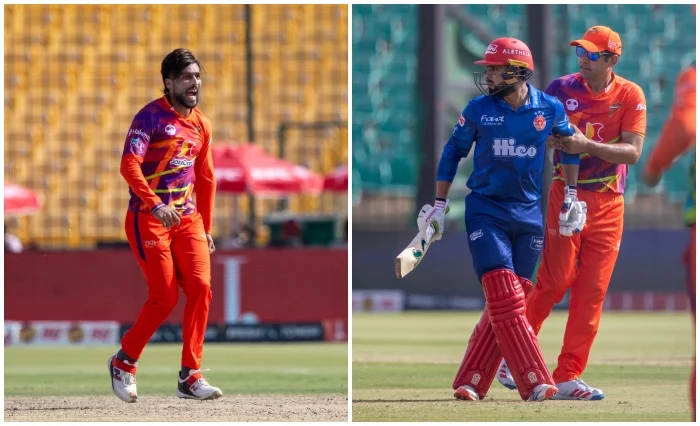
A competitive Pakistan Super League (PSL) 11 encounter in Karachi turned intense on Thursday when emotions flared between Rawalpindi’s fast bowler Mohammad Amir and Islamabad United all-rounder Faheem Ashraf, leading to a brief but heated on-field confrontation at the National Bank Stadium.
The moment of tension emerged during the 17th over of Islamabad United’s innings. On the third ball of that over, Amir delivered a sharp slower bouncer that tempted Faheem into an aggressive upper-cut attempt. However, the shot did not connect cleanly, resulting in an edge that was safely caught behind the wickets by Mohammad Rizwan. The dismissal immediately shifted the atmosphere on the field, as celebrations quickly escalated into confrontation.
As Amir celebrated the wicket, a verbal exchange broke out between the two players. The Rawalpindi pacer appeared animated and gestured toward Faheem, signaling him to return to the pavilion. Faheem, visibly displeased, reacted strongly and moved toward Amir while pointing his bat in a confrontational manner. The situation looked ready to escalate further before other players intervened.
On-field teammates Asif Afridi and Saad Masood quickly stepped in to separate the two cricketers, preventing the exchange from developing into a larger altercation. Their timely intervention helped calm the situation, and both players eventually moved away, allowing the match to resume without further disruption.
Despite the brief tension, the match continued with Islamabad United already under pressure due to a fragile batting performance. Earlier in the game, Rawalpindi had opted to bowl first but the decision initially appeared risky as Islamabad’s opening pair attempted to settle in cautiously. Devon Conway and Sameer Minhas struggled to find rhythm early on, with scoring remaining slow in the opening overs.
The breakthrough came when Mohammad Amir struck in the fifth over, dismissing Minhas, who had scored six runs off 11 deliveries. That wicket ended a 20-run opening partnership and set the tone for a consistent collapse. Shortly after, Naseem Shah added further pressure by removing Mohammad Faiq for just five runs, leaving Islamabad at 29 for 2 within the powerplay.
The pressure continued to mount as Saad Masood joined the attack and claimed the wicket of Shadab Khan, who managed only a single run. With three wickets down for just 30 runs, Islamabad found themselves struggling to rebuild their innings.
A brief period of resistance came from Conway and Mark Chapman, who combined for a crucial partnership that helped stabilize the innings and pushed the total beyond the 50-run mark. Their stand gave Islamabad temporary relief and raised hopes of recovery.
However, the partnership was broken when Daryl Mitchell made an important breakthrough by dismissing Conway for a well-constructed 40 off 33 balls, an innings that included three boundaries and two sixes. This wicket shifted momentum back in Rawalpindi’s favor, reducing Islamabad to 79 for 4.
Soon after, Asif Afridi struck again by removing Chapman, who contributed 23 runs from 18 deliveries, including a four and a six. The middle and lower order then began to collapse rapidly under sustained pressure.
Haider Ali was unable to make a significant impact, falling for six runs off 13 balls, again to Saad Masood, further deepening Islamabad’s troubles. The innings continued to unravel as wickets fell at regular intervals, preventing any meaningful recovery.
Amir returned later in the innings and once again made his presence felt by dismissing Faheem Ashraf, who scored 11 runs from 12 balls. This dismissal occurred shortly after their earlier heated exchange, adding further intensity to the narrative of the match.
By the time Islamabad reached 99 for 7 in 16.3 overs, their innings had already lost momentum. Although Chris Green attempted a late counterattack, managing to push the score beyond the hundred mark with a quick 29 off 16 balls, including two fours and two sixes, his effort only provided brief resistance.
In the final stages of the innings, Dian Forrester delivered the finishing blows, first removing Mohammad Hasnain for a first-ball duck and then dismissing Richard Gleeson to wrap up Islamabad’s batting effort. His final overs ensured the innings ended at a modest total of 137 runs within the full 20 overs.
Rawalpindi’s bowling unit, despite the mid-match tension, maintained discipline throughout the innings, consistently striking at key moments and preventing Islamabad from building any long-term partnerships. The combination of pace, spin, and timely breakthroughs played a decisive role in restricting the opposition to a below-par score.