

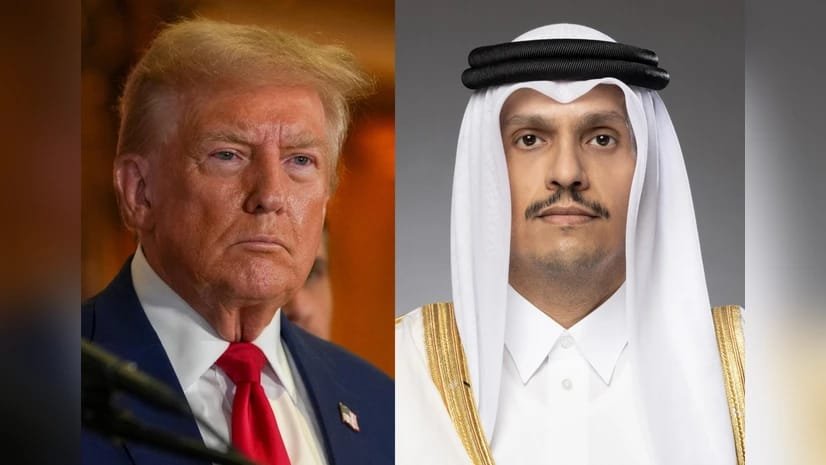
On the sidelines of the United Nations General Assembly in New York, Qatar’s Prime Minister Sheikh Mohammed bin Abdulrahman bin Jassim Al Thani delivered a powerful message to the international community. He made it clear that the Arab world today is looking toward Donald Trump as the only political figure who can realistically bring an end to the war in Gaza and stop Israeli Prime Minister Benjamin Netanyahu from continuing his aggressive course of action.
In a wide-ranging conversation with Breitbart News, the Qatari leader explained that Trump’s meetings with Arab and Muslim leaders earlier this week were not ordinary diplomatic gatherings but pivotal engagements that signaled a shift in how the United States might once again play a decisive role in the Middle East. According to Al Thani, the discussions created a rare moment of unity where leaders were able to directly present to Trump the dangers posed by unchecked Israeli actions, while also highlighting the urgency of halting the violence before it spirals further out of control.
He emphasized that the meeting with Trump was not symbolic but crucial, because it allowed the Arab and Islamic leaders to express their fears and hopes directly to a U.S. president who appeared willing to listen.
Al Thani went on to argue that any pathway toward peace must begin with Gaza. He explained that what Israel has been doing, particularly under Netanyahu’s leadership, has reached a point where it not only threatens the broader security of the Middle East but also places America’s own credibility and long-standing regional partnerships in jeopardy.
The recent Israeli strike on Doha, Qatar’s capital, served as an alarming example. That operation, which Israel claimed was aimed at Hamas negotiators, left civilians injured and even resulted in the death of a Qatari security officer. The consequences of that attack sparked anger across the Arab world and raised fresh questions about whether Israel’s leadership recognizes any boundaries at all.
From Al Thani’s perspective, this was not merely an isolated incident but a deliberate action that sabotaged ongoing negotiations, especially considering that Doha was hosting talks based on proposals that had come from Washington. The attack was therefore seen not only as an affront to Qatar but also as a direct undermining of American diplomatic efforts.
The outrage was not limited to Qatar. Several Arab leaders condemned Netanyahu’s actions in public forums, including King Abdullah II of Jordan who used his speech at the United Nations to openly express disapproval.
For many across the region, the attack was interpreted as proof that Netanyahu is acting with impunity and disregarding both regional stability and the interests of the United States. This, Al Thani suggested, is exactly why so much hope is being placed on Trump, who is viewed as the only leader with the capacity and the will to restrain Netanyahu and put an end to the cycle of violence.
Trump himself reacted quickly after the Doha strike. He issued a statement through his Truth Social account declaring the attack counterproductive and damaging to both Israeli and American interests.
He described the bombing of a sovereign ally such as Qatar, which has been taking serious risks to mediate peace, as an action that does not advance any legitimate strategic goal. While some media outlets suggested that Netanyahu may have informed Trump about the strike in advance, Trump has categorically denied this, insisting he had no prior knowledge.
Instead, Trump shifted into an active diplomatic role, meeting with Arab leaders in New York, hosting Al Thani privately at Trump Tower, and preparing to discuss the matter further with Turkish President Recep Tayyip Erdoğan during a scheduled White House visit. All of this underscored how central Gaza has become in Trump’s foreign policy conversations at this critical moment.
During his private meeting with Trump, Al Thani recounted that the former U.S. president made clear his commitment to stop the war in Gaza. Trump reportedly assured his counterparts that he is working with his team on a comprehensive plan for peace, one that would be built in consultation with regional partners so it could gain wide support across the Middle East.
Al Thani explained that Qatar and other Arab nations are prepared to assist in shaping and strengthening this plan so that it does not appear as an external imposition but as a cooperative project that reflects the needs and aspirations of the people most affected by the conflict.
For this reason, Al Thani said, Trump’s role is seen as indispensable. While many in the region remain deeply skeptical of Israel, the willingness of the U.S. president to engage directly with Arab leadership and to consider their perspectives has renewed a degree of optimism that had been missing for years.
For Arab nations, Netanyahu himself is now viewed as the greatest obstacle to peace. Al Thani did not mince words, stating that Netanyahu acts as if there are no red lines, pursuing personal ambitions without regard for regional stability or international consequences.
This, he stressed, is not a matter of opposing Israel as a state but about opposing Netanyahu’s dangerous course of action, which even endangers America’s standing in the region. According to Al Thani, Trump is the only one who can check Netanyahu’s behavior, and the events in Doha proved it.
When Israeli bombs fell in Qatar while negotiators were discussing a proposal tied to Trump’s peace process, the attack not only killed and injured innocent people but also directly undermined U.S. diplomacy. Trump himself recognized that the incident contradicted America’s interests, a point that gave Arab leaders some reassurance that Washington might not tolerate Netanyahu’s unilateral actions indefinitely.
Beyond Gaza, Al Thani also placed Trump’s potential role within a larger framework. He noted that Trump’s political approach has often been defined not by starting new wars but by trying to bring existing ones to a close. That perspective resonates strongly with Arab leaders who want to see a shift from conflict toward economic development and stability.
Al Thani explained that cooperation with Trump is not just about solving Middle Eastern disputes but also about laying the groundwork for prosperity in other parts of the world.
The message, in his view, is that peace in Gaza can become the foundation for a wider transformation, one where the U.S. and Arab partners work together to turn away from cycles of violence and focus instead on building opportunities for future generations.
The Qatari prime minister concluded by reiterating that Arab leaders are watching Trump with cautious hope. While mistrust of Israel remains high and Netanyahu’s actions continue to provoke anger, the openness of Trump to work closely with regional partners has rekindled the idea that genuine solutions might still be possible.
Al Thani emphasized that the situation requires practical steps, not just rhetoric, and that Trump’s demonstrated commitment is what makes him stand out. The Arab world believes that he alone has the influence to stop Netanyahu, bring an end to the Gaza war, and create the conditions for a more stable and prosperous Middle East.