

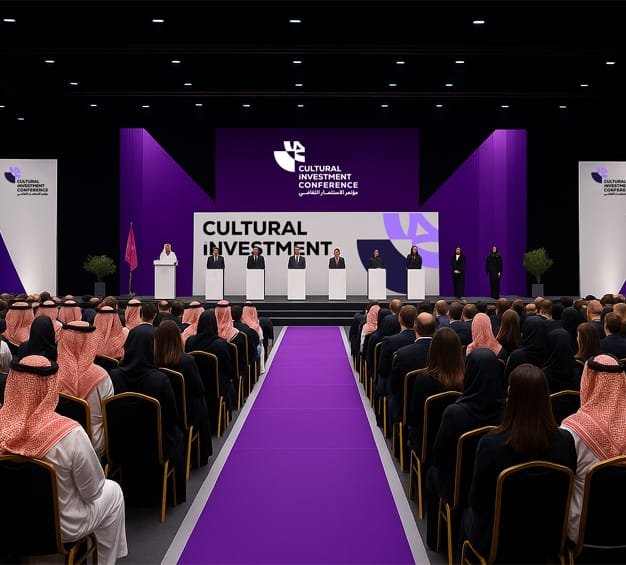
The Cultural Investment Conference in Riyadh—under the auspices of the Saudi Ministry of Culture—proceeded with its seventh plenary, under the title “Global Culture: Influence, Capital and Cohesive Power.” This session drew considerable attention, not only for its distinguished speakers, but for the broader symbolic weight it carried at a moment when Saudi Arabia is aggressively expanding its cultural diplomacy and seeking to embed culture at the heart of its economic transformation.
Jean-Yves Le Drian, presently serving as Chairman of the French Agency for AlUla Development (denoted as AFALULA), took center stage, in conversation with the French curator and writer Nicolas Bourriaud, who moderated. Le Drian’s remarks offered a clear articulation of how cultural localization has matured beyond incidental policy into a fundamental strategic tool for reinforcing national identity in a contemporary world in flux. In his view, culture need not be a passive reflection of heritage but can become an active instrument to project identity, both domestically and globally.
He insisted that in the Saudi context there lies enormous potential for the nation to emerge not only as a consumer of global culture but as a substantive contributor, provided that a foundational ecosystem of education, talent, and cultural infrastructure is cultivated.
Le Drian emphasized that a robust educational framework remains essential. He argued that schools and universities must not solely impart technical or disciplinary knowledge; they must also nurture creative instincts, self-learning habits, adaptability, and cross-disciplinary thinking.
He placed “culture, talent, education” as the three pillars of long-term success. Without inbuilt capacities for creative thinking, he cautioned, ambitious projects risk becoming superficial or reliant on imported expertise. But when the creative base is homegrown, cultural production becomes an engine of sustainable influence.
Drawing from the Saudi–French collaboration in AlUla, Le Drian presented this as a proof-point of how two countries with divergent histories and identities can cooperate while preserving the distinctiveness of each. He recalled how French artists and sculptors have already begun working alongside their Saudi counterparts under the AlUla framework, and how further such partnerships are slated in upcoming initiatives. This kind of exchange, he said, is not mere cultural tokenism, but a serious vehicle for mutual learning, transfer of skills, and trust building. He described the Saudi–French partnership as a “model” rather than a one-off case: a template for creative diplomacy rooted in respect, reciprocity, and patient investment.
He also cautioned that long-term commitments are indispensable. Culture cannot be “flipped on” like a switch; investments must persist through lean periods, and the rewards may appear only gradually. But over time, the ripple effects—on tourism, on place branding, on soft power—can compound in ways that transcend immediate returns.
Beyond the remarks of Le Drian, additional context from the broader conference and related developments help deepen the picture. The Cultural Investment Conference (CIC) is itself a relatively new but ambitious flagship initiative, held at the King Fahd Cultural Center in Riyadh across September 29–30. It is conceived as a global gathering for investors, cultural operators, policymakers, and creatives, intended to recast the cultural sector as an asset class and to map out pathways for sustainable financing.
According to official announcements, the program includes 38 panels and more than 100 speakers, engaging participants from every region in conversation about the role of culture in economic diversification, force multipliers of heritage, and new models of philanthropy and public-private cooperation.
In effect, the conference seeks to show that cultural investment does not merely sit on the margins of national strategies, but can be woven into them as a catalyst for growth, place making, identity, and global connectivity.
The Ministry of Culture, which under Crown Prince and Prime Minister Mohammed bin Salman is pushing a bold cultural agenda, sees CIC as one instrument among many in its broader program to convert cultural capital into sustainable industry.
The cultural calendar for 2025 already includes book fairs in multiple Saudi cities, national awards, and a host of festivals and activations.In parallel, the Saudi Cultural Development Fund (CDF) has been active in seeding innovation: in 2025 it launched “Nama’ Accelerators,” a multi-track support mechanism (starting first with handicrafts) to back cultural startups and enterprises with training, business development support, and financial incentives.
CDF also has a history of placing Saudi craftsmanship, media, performing arts, and creative industries on international stages, such as through cultural activations at Expo 2025 Osaka.Through such mechanisms, Riyadh is effectively building pipelines between creators, capital, and markets.
Returning to AlUla and the French role, it is helpful to recall that AFALULA is a France-funded agency established under a bilateral agreement to assist the Royal Commission for AlUla (RCU) in the development of the archaeological zone, heritage restoration, cultural programming, and tourism infrastructure.
Under Le Drian’s leadership (appointed in mid-2023), the agency has been undergoing an internal recalibration—sharpening governance, streamlining operations, and emphasizing coherence in its mission.
Le Drian has spoken publicly about the need to balance heritage preservation, local participation, and economic growth: for example, reviving sustainable agriculture, creating cultural residencies, and involving local inhabitants in social and economic uplift.
He has also navigated internal tensions between different consulting teams, including anglophone external advisors, and the RCU, as he seeks to assert a more integrated vision.
In multiple public forums, Le Drian has affirmed that French willingness to assist Saudi Arabia extends beyond the technical: France sees this as a stake in intercultural exchange, soft diplomacy, and the crafting of new narratives.
Indeed, in a recent seminar at the Saudi Embassy in France, Le Drian praised the “strong friendship and strategic alliance” between the two nations and expressed optimism about further cultural and institutional cooperation.
In the same spirit, Saudi and French officials have convened in Paris to review the AlUla joint committee’s roadmap, signaling that momentum is maintained at high diplomatic levels.
The Second Meeting of the Saudi-French Committee for AlUla, held in late 2024, reviewed ongoing and future projects spanning architecture, heritage, tourism, and cultural programming.Thus the cooperation is not limited to gestures, but has been institutionalized and bound into a long-term agenda.
In the CIC session, Le Drian’s argument about strategic localization resonates especially in Saudi Arabia’s pursuit of what might be called “culturally textured modernity.” The kingdom is not seeking to replicate other models of cultural modernism wholesale, but to build institutions and capacities rooted in Saudi identity, language, history, and aspirations.
Localization, in this sense, is not isolation; it is a selective integration of global ideas through local lenses. Through capacity building, education, artist residencies, museum programs, and cross-border exchange, Saudi Arabia seeks to push itself beyond being a mere patron or consumer of culture, toward generating original cultural exports.
What Le Drian delineated, in effect, is a paradigm of cultural sovereignty that coexists with global interdependence. The notion that strategic cultural investment can generate soft power is hardly novel, but in Saudi Arabia’s case it is unfolding in real time, with large financial resources, bold infrastructure (for instance, in AlUla), and high political will. The conference itself is part of that signaling—by bringing in global voices, the kingdom asserts that culture is not a peripheral or aesthetic concern but a pillar of its national transformation.
Taken together, yesterday’s session underscored more than intellectual posturing: it revealed a direction. Riyadh is inviting interlocutors—artists, investors, scholars—from around the world to engage its emerging cultural narrative. The presence of Le Drian and Bourriaud—and the tone of their exchange—suggests that Saudi Arabia sees in culture a two-way street: it wants to draw from global traditions while contributing its own perspective.
In closing, one may observe that in many countries, culture is often relegated to symbolic or touristic roles. In Saudi Arabia’s present moment, however, culture is being placed front and center in the architecture of national development.
The Kingdom is not merely funding festivals or monuments—it is seeking to forge a cultural economy, to train talent, to enable creative industries, to anchor identity, and to propel its global presence. Yesterday’s session, with Le Drian’s articulation of localization, long-term investment, and the seamless link between education and creativity, offers a revealing window into how Saudi Arabia hopes to scaffold that vision.