

Diplomatic momentum has once again shifted toward Cairo this Sunday, where Egypt is set to mediate another decisive round of talks aimed at securing a long-awaited ceasefire in Gaza.
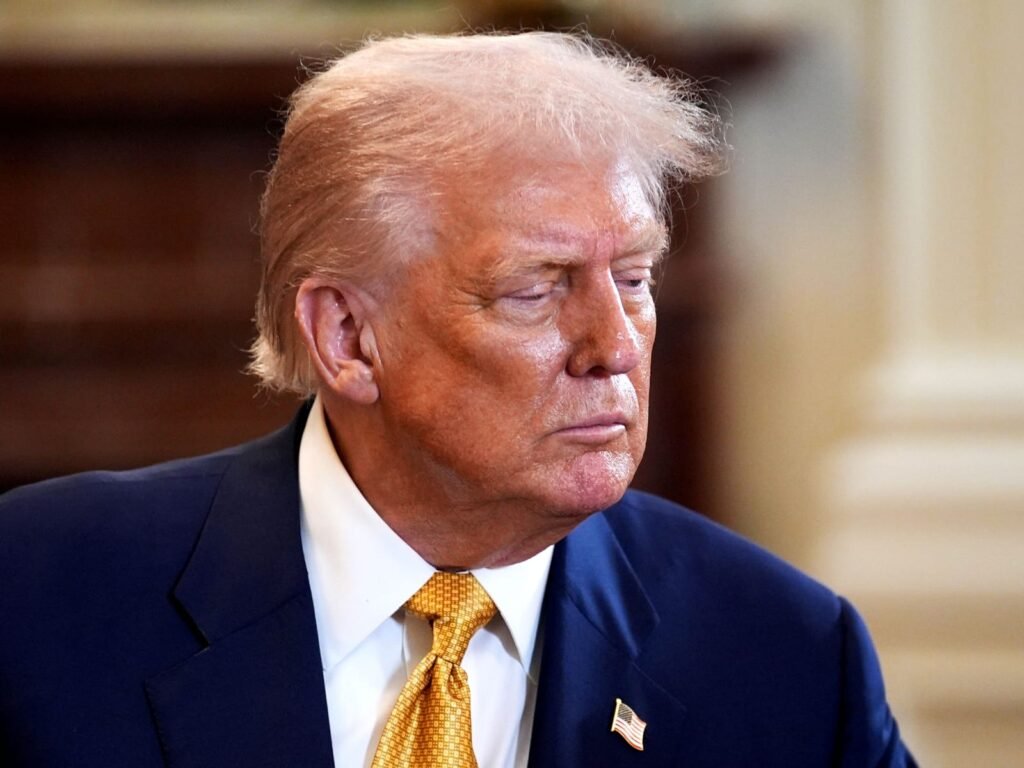
The renewed discussions come in the wake of an unexpected late-night statement by U.S. President Donald Trump, who announced that Israel has agreed to an “initial line of withdrawal” from the enclave — a potential breakthrough that could immediately bring hostilities to a halt if Hamas gives its approval.
Posting on his Truth Social platform, President Trump stated that the ceasefire could come into effect “instantly” once Hamas formally accepts the delineated boundary for the Israeli pullback. He explained that such an agreement would set into motion the exchange of hostages and prisoners and prepare the groundwork for what he called “subsequent stages of the peace process.” Alongside his remarks, the White House released a map illustrating Israel’s proposed movement out of northern Gaza.
The plan — presented without a specific timetable — outlines an early withdrawal route beginning at Beit Hanoun in the north and extending through Beit Lahia, Gaza City, Al-Bureij, Deir al-Balah, Khan Younis, and Khaza’a, finally reaching Rafah in the far south. According to Trump’s explanation, several areas such as Rafah, Beit Hanoun, and the Philadelphia Corridor would remain under Israeli supervision during the transition phase. The route essentially marks a gradual north-to-south retreat through Gaza’s most heavily populated zones.
Trump’s proposal, though ambitious, lacks key logistical details. It stipulates that Israeli forces will temporarily suspend all offensive operations while they reposition behind an agreed boundary and facilitate the release of captives. However, the pace and scope of withdrawal would depend on compliance from both sides and continuing verification by international observers.
Hours before Trump’s announcement, Israeli Prime Minister Benjamin Netanyahu confirmed that the Israel Defense Forces (IDF) would “redeploy” inside Gaza rather than completely pull out, maintaining control over “strategically vital sectors.” He stressed that Hamas must be disarmed either through diplomatic coordination under Washington’s mediation or, failing that, through sustained military action. Netanyahu’s remarks underlined Israel’s intention to secure its borders while still engaging in dialogue aimed at reducing violence.
Reports from Jerusalem suggest that Israel has already shared a preliminary security blueprint with Washington, proposing to retain a limited military presence within a so-called “buffer zone” along Gaza’s border.
While the exact boundaries of this zone remain unclear, sources indicate that it will include the Philadelphia axis and the elevated area of Tel al-Muntar (also known as Hill 70) near Shujaiya — a strategic vantage point offering visibility across northern Gaza, including Gaza City and the Jabalia refugee camp.
In parallel with these military adjustments, diplomatic teams are preparing for intensive sessions in Cairo. Netanyahu confirmed that an Israeli delegation is en route to Egypt to finalize technical aspects of the agreement.
He expressed hope that discussions would be completed “within days.” From the American side, Jared Kushner, President Trump’s son-in-law, and Steve Witkoff, the U.S. special envoy for the Middle East, have also departed for Egypt to focus on humanitarian coordination and prisoner release mechanisms.
Egyptian mediators have confirmed that indirect negotiations between Hamas and Israel are scheduled to run through Sunday and Monday.
Cairo’s foreign ministry emphasized that it is working “tirelessly to secure an immediate cessation of hostilities” and restore normal humanitarian operations in Gaza, where the destruction of infrastructure and the displacement of civilians have reached catastrophic levels.
Analysts say Trump’s announcement marks the most significant shift in the ceasefire narrative in months, introducing both political urgency and diplomatic complexity. Although the map outlines a clear starting point, it leaves open the most critical questions — how long Israel will remain in Gaza’s buffer areas, and under what conditions Hamas will accept disarmament or international oversight.
Reactions from within the region have been cautious. While some Hamas representatives have tentatively welcomed the prospect of an Israeli pullback tied to prisoner exchanges, they continue to reject any clause that might require the group’s complete disarmament.
Conversely, Israeli officials insist that the removal of heavy weapons and underground rocket systems is a “non-negotiable condition” before any final withdrawal.
For Gaza’s residents, the hope of a ceasefire offers a fragile glimmer of relief after nearly two years of relentless warfare. Bombardments have flattened neighborhoods, crippled power and water supplies, and pushed the enclave into a deep humanitarian crisis. Aid organizations warn that unless the ceasefire translates into unrestricted humanitarian access, conditions may remain dire even after the guns fall silent.
Regional observers believe that Cairo’s upcoming mediation efforts could determine whether Trump’s proposal becomes a milestone in the conflict’s de-escalation or simply another fleeting diplomatic gesture. The 48 hours ahead are seen as pivotal: Egypt’s balancing act between Israeli security guarantees and Hamas’ political survival will likely shape the next chapter of this protracted conflict.
In essence, the latest peace effort weaves together overlapping agendas — Israel’s quest for security, Hamas’ demand for sovereignty, Washington’s search for diplomatic victory, and Cairo’s ambition to reaffirm its regional influence. Whether this complex web leads to peace or merely pauses the bloodshed remains uncertain. Yet, the conversations unfolding in Egypt this week may well mark the most serious attempt in recent memory to draw a tangible boundary between war and peace in Gaza.