

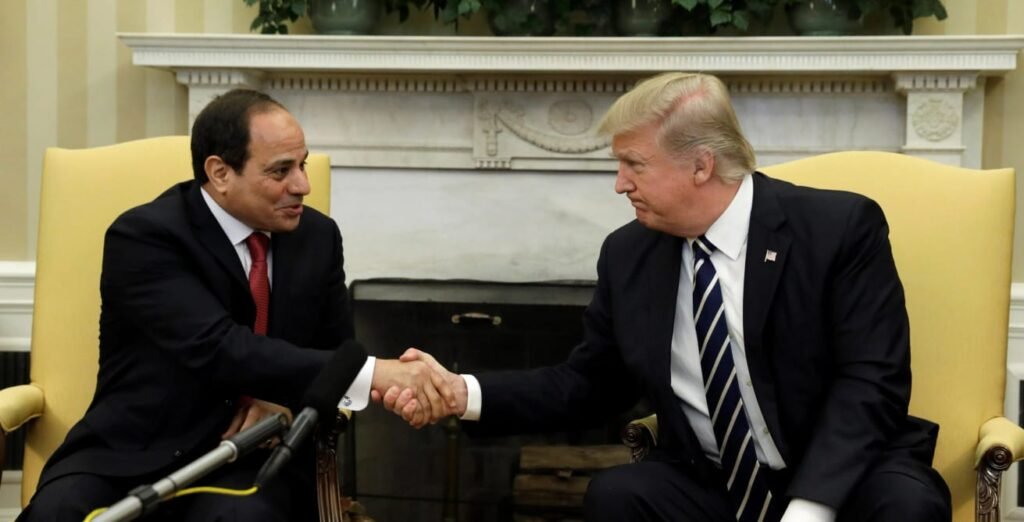
In a significant diplomatic gesture, Egyptian President Abdel Fattah el-Sisi has bestowed the “Order of the Nile” upon former U.S. President Donald Trump, recognizing his efforts in promoting peace and mediating ceasefires, particularly in the Gaza region. The distinction, considered Egypt’s highest national honor, is awarded only by the sitting head of state to those who have made extraordinary contributions to humanity or to Egypt’s international standing.
According to the official Egyptian presidential website, the “Order of the Nile” is accompanied by a formal certificate and, in the event of the recipient’s death, the individual is honored with full military recognition. The medal’s origins trace back to 1915 during the reign of Sultan Hussein Kamel, when it was first introduced as Egypt’s premier state decoration. Over time, it became a symbol of national gratitude and honor, with subsequent distinctions such as the “Order of the Republic” and “Nishan al-Nil” ranking lower in hierarchy.
The Egyptian law No. 12 of 1972, article 4, outlines that the Order of the Nile may be granted to heads of states, crown princes, vice presidents, or other eminent figures who have rendered remarkable services to the nation or humanity. Crafted from pure gold or golden silver, the medal’s intricate design reflects Egypt’s deep artistic and historical roots. It consists of three square panels linked by twin chains, adorned with miniature lotus buds—a motif symbolizing rebirth and purity in ancient Egyptian culture.
Each section of the medal carries its own symbolism. The first panel signifies the safeguarding of the nation from evil, the second represents prosperity brought by the River Nile, and the third embodies virtue and eternity. The individual squares are connected by circular floral elements encrusted with red and blue gemstones, culminating in a suspended pendant shaped like a lotus blossom. At its center lies a blue enamel emblem depicting the Nile, symbolizing the unity of Upper and Lower Egypt—represented by the papyrus and lotus respectively.
Throughout history, the Order of the Nile has been conferred upon a distinguished list of international leaders. Among its recipients are Saudi King Salman bin Abdulaziz, Queen Elizabeth II of the United Kingdom, Sultan Qaboos of Oman, Lebanon’s former President Émile Lahoud, Qatar’s former Emir Sheikh Hamad bin Khalifa, Yugoslav leader Josip Broz Tito, Mauritania’s President Mohamed Ould Abdel Aziz, South Africa’s Nelson Mandela, Japan’s Emperor Akihito, and Ethiopia’s Emperor Haile Selassie.
Within Egypt, the honor has also adorned the chests of prominent national leaders such as Gamal Abdel Nasser, Anwar Sadat, Mohamed Naguib, Hosni Mubarak, Adly Mansour, and President Abdel Fattah el-Sisi himself. Beyond political figures, the medal has been awarded to celebrated Egyptians whose contributions extended beyond national borders—individuals like Nobel laureate scientist Dr. Ahmed Zewail, renowned heart surgeon Dr. Magdi Yacoub, literary giant and Nobel Prize winner Naguib Mahfouz, and Dr. Mohamed ElBaradei, the former Vice President and Nobel Peace laureate.
Other notable awardees include Field Marshal Mohamed Hussein Tantawi, a former defense minister, and General Saad El-Shazly, a hero of the 1973 October War. Over the decades, this emblem of honor has come to represent not only personal achievement but also Egypt’s enduring appreciation for those who have contributed to the progress, peace, and dignity of humanity.
By awarding this distinguished medal to Donald Trump, Egypt has reaffirmed the historical significance of the Order of the Nile as a bridge of respect and recognition between nations. The act highlights Cairo’s tradition of honoring leaders who play a part in conflict resolution and peacebuilding across the world.