

ISLAMABAD: As tensions between Pakistan and Afghanistan intensified this week, a parallel battle unfolded online a coordinated misinformation campaign driven by Indian and Afghan social media networks, attempting to inflame public sentiment and distort facts.
Multiple fake news stories and doctored visuals surfaced on X (formerly twitter) and other platforms, many originating from Indian handles amplifying anti-Pakistan narratives.
Surprisingly, even official Afghan accounts, including that of Taliban spokesman Zabihullah Mujahid, became part of this digital disinformation drive.
In one viral post, Afghan social media users claimed that Afghan forces had captured a Pakistani tank, accompanied by images supposedly showing the spoils of war. However, open-source investigators quickly revealed that the tank in question was already in use by Afghan forces making the claim entirely fabricated.
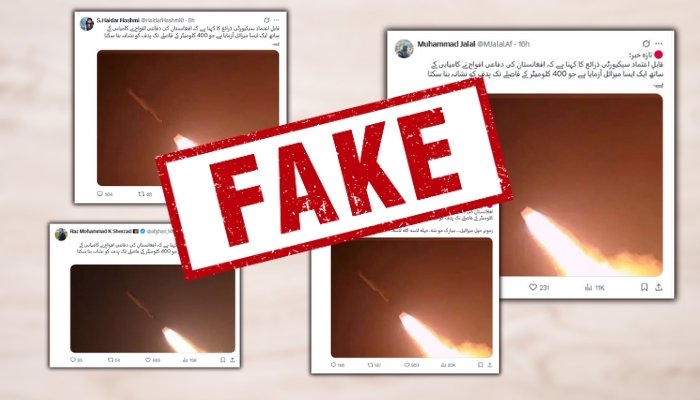
The deception did not end there. Another widely circulated post celebrated a successful Afghan missile test said to have a range of 400 kilometers. The image attached to the claim was soon identified as a 2023 North Korean missile launch photo, originally released by Pyongyang’s state news agency during a February 2023 military drill.
A reverse image search by Media verification team confirmed that the photo had been cropped and rebranded by Afghan social media accounts to portray it as a local achievement.
Even Al Jazeera’s February 2023 coverage of North Korea’s “Hwasal-2” cruise missile tests carried the same image.
Digital analysts in Islamabad say the episode reflects a broader information warfare strategy being waged across the region one in which false visuals, miscaptioned videos, and misleading claims are being used to manipulate narratives and discredit Pakistan internationally.
Fake news has become a new battlefield, one media expert told Daar news, and it’s aimed not at borders but at minds.