

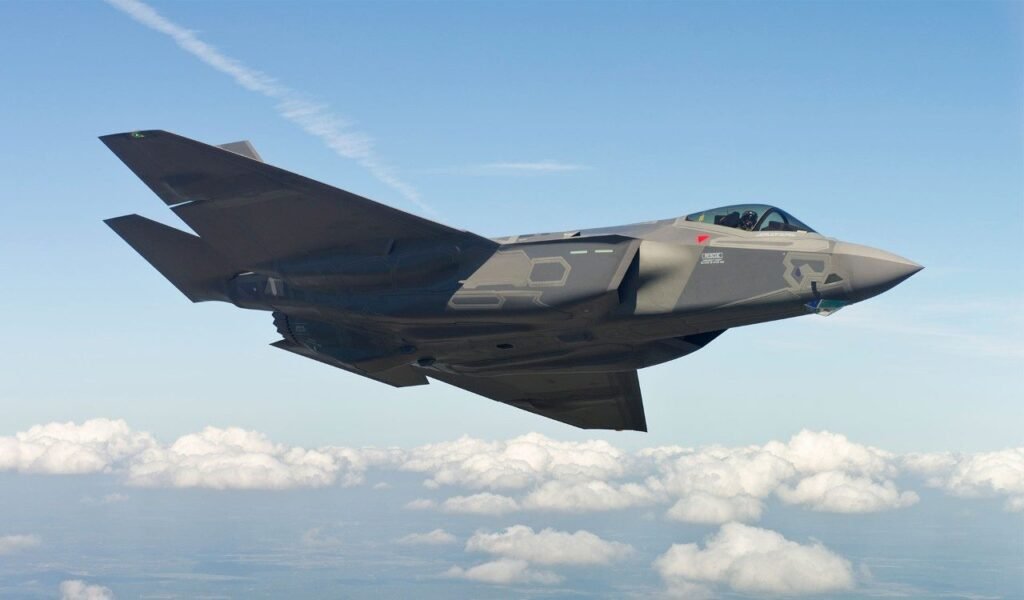
The Trump administration is currently weighing a significant defense proposal from Saudi Arabia that could reshape the geopolitical and military balance of the Middle East. The request concerns Riyadh’s intention to purchase 48 F-35 stealth fighter jets from the United States, a deal potentially worth tens of billions of dollars. According to multiple defense sources cited by Reuters, the proposal has already passed a crucial stage of internal Pentagon approval, signaling the seriousness with which Washington is considering the matter.
This development comes at a strategically important time, as Saudi Crown Prince Mohammed bin Salman prepares for an official visit to Washington, which could become the setting for deeper defense cooperation between the two allies.
If the sale materializes, it would represent one of the most consequential arms transactions in recent history and mark a significant policy shift for the United States. For decades, American administrations have carefully balanced military aid and sales across the Middle East to preserve what they call Israel’s “qualitative military edge,” meaning Israel must always retain superior military capability compared to its neighbors.
Granting Saudi Arabia access to the F-35, the most advanced fifth-generation fighter jet in the world, could therefore challenge a long-standing American doctrine. The sale would also highlight a growing willingness by Washington to accommodate its Gulf allies’ ambitions in light of shifting regional dynamics, ongoing tensions with Iran, and the global competition with China and Russia for defense influence.
The Saudi government has reportedly been seeking to acquire the F-35 since the early years of its production, and sources indicate that Riyadh made a direct appeal to President Trump earlier this year to advance the process. The Pentagon’s policy division has been studying the matter for several months, with the proposal now having reached the office of the Secretary of Defense for higher-level consideration. An American official familiar with the case noted that the Department of Defense is currently reviewing all strategic, legal, and congressional implications of such a sale before a final recommendation is made. Any formal approval would still require presidential endorsement and notification to Congress, which retains the authority to block or delay foreign arms sales.
While Lockheed Martin, the manufacturer of the F-35, has declined to comment directly on the potential transaction, the company confirmed that any deal of this magnitude must proceed through official government channels. The Pentagon, the White House, and the State Department have also refrained from public statements, reflecting the sensitivity of the issue.
Historically, U.S. arms transfers to the Middle East have been carefully structured to ensure that Israel maintains a technological advantage, which is why granting similar aircraft to another regional player has always been controversial. Israel has operated the F-35 since 2016, and it remains the only country in the Middle East with this stealth capability. The aircraft’s cutting-edge radar-evading design, intelligence-gathering systems, and advanced weapons integration make it one of the most powerful assets in modern aerial warfare.
For Saudi Arabia, gaining access to such technology would be a major leap forward. The kingdom’s air force currently operates a mix of Boeing F-15s, Eurofighter Typhoons, and Tornado aircraft — all powerful but belonging to older generations of fighter technology. The addition of F-35s would give Riyadh unprecedented stealth and precision capabilities, allowing it to respond more effectively to regional threats, particularly from Iran and its network of proxies.
The timing of this renewed request aligns with Crown Prince Mohammed bin Salman’s Vision 2030 initiative, an ambitious roadmap to modernize Saudi Arabia’s economy and military infrastructure. A key pillar of that plan is strengthening domestic defense industries and reducing reliance on foreign contractors, while still acquiring the most advanced platforms available on the global market.
The Trump administration has made defense cooperation with Saudi Arabia a cornerstone of its regional policy. In May 2025, Washington and Riyadh announced an estimated $142 billion arms package, described by the White House as the largest in U.S. history. That agreement covered a wide range of defense systems, including missile shields, armored vehicles, surveillance technology, and training programs. However, the F-35 jets were not part of that deal, likely due to concerns about technology transfer and political opposition in Congress.
The current request could therefore be seen as the next phase of that strategic partnership, aimed at elevating Saudi Arabia’s status as a major defense partner and regional power.
Still, the road to approval is far from guaranteed. Members of the U.S. Congress — particularly within the Senate Foreign Relations Committee — have historically expressed strong reservations about arms sales to Saudi Arabia, especially following the 2018 killing of journalist Jamal Khashoggi at the Saudi consulate in Istanbul. That incident severely strained Riyadh’s image in Washington and prompted calls for stricter oversight of U.S. military exports to the kingdom.
Several lawmakers remain concerned that advanced American technology could be misused or undermine U.S. leverage in regional diplomacy. Human-rights groups and defense analysts have also warned that providing F-35s to Riyadh without sufficient safeguards could inflame regional rivalries and lead to a new arms race across the Gulf.
The strategic implications extend beyond the immediate U.S.–Saudi relationship. The sale would likely force Washington to recalibrate its military aid policy toward Israel, which has long relied on American assurances that no other country in the region would receive systems more advanced than its own. Israel’s defense establishment has not yet made a formal statement, but security experts suggest that such a move could trigger demands for additional U.S. assistance to preserve its superiority.
At the same time, it could also reshape the defense calculus of other Gulf nations, including the United Arab Emirates and Qatar, both of which have shown interest in next-generation aircraft. The broader question for U.S. policymakers is whether expanding access to high-tech weaponry among Arab partners enhances regional stability or increases long-term volatility.
For Washington, the potential deal carries both risks and opportunities. On one hand, it could strengthen U.S. influence in the Gulf at a time when China and Russia are actively expanding their defense footprints through arms exports and security cooperation. On the other hand, it could complicate the delicate balance of power that the U.S. has maintained for decades.
The Biden administration had previously explored a scenario in which Saudi Arabia could receive F-35s if it normalized diplomatic relations with Israel — part of a broader framework inspired by the Abraham Accords — but those talks stalled. Trump’s renewed interest in the sale, therefore, represents both a diplomatic reset and a reaffirmation of his administration’s close ties with Riyadh.
From the Saudi perspective, the acquisition of the F-35 would not only serve military objectives but also symbolic and political ones. It would reinforce the image of the kingdom as a technologically advanced power capable of competing with regional rivals and participating in coalition operations with the West. It would also fit within Riyadh’s larger ambition of positioning itself as a central player in regional security arrangements extending from the Red Sea to the Gulf.
The kingdom’s efforts to expand its indigenous defense manufacturing sector, attract foreign partnerships, and enhance its cyber and aerospace capabilities all align with this trajectory. The possible purchase of 48 aircraft — enough to form two full squadrons — would be a dramatic step in that modernization process.
Analysts note that while the proposed sale remains in early stages, it represents a strong signal of Saudi Arabia’s determination to upgrade its air force with the most modern technology available. The Pentagon’s willingness to even consider the request suggests that Washington views the kingdom as a long-term strategic anchor in the Gulf, despite occasional policy disagreements.
If finalized, the deal could redefine the U.S.–Saudi defense partnership for decades to come and potentially alter the military dynamics of the Middle East. Yet the outcome will ultimately depend on domestic politics in Washington, the stance of the Israeli government, and the evolving security situation across the region.
For now, the F-35 proposal remains an open chapter in a broader story of changing alliances, regional ambitions, and technological competition. As the United States debates how to manage its security relationships amid a rapidly shifting global order, Saudi Arabia’s pursuit of the world’s most advanced fighter jet underscores the enduring importance of military power in shaping political influence. Whether this deal is approved or delayed, it has already signaled that the balance of power in the Middle East — both militarily and diplomatically — may be entering a new era.