

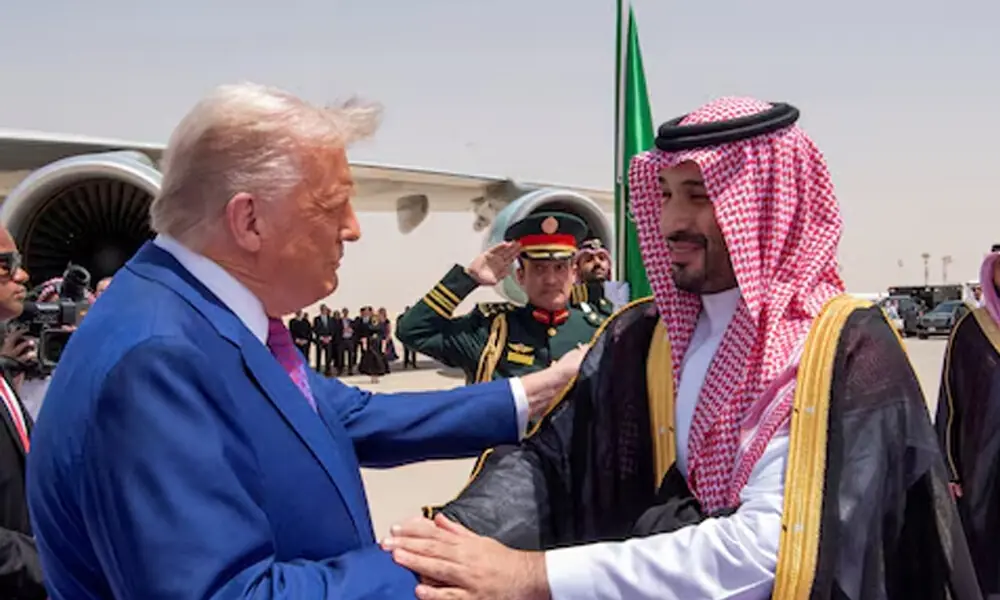
RIYADH/WASHINGTON: Saudi Crown Prince Mohammed bin Salman (MBS) is set to visit the White House on Tuesday for high-level talks with US President Donald Trump, marking a critical juncture in decades-long US-Saudi relations.
The visit, MBS’s first to the United States since the 2018 killing of journalist Jamal Khashoggi in Istanbul a case that sparked international condemnation and temporarily strained bilateral ties aims to expand cooperation beyond oil and regional security into emerging sectors such as artificial intelligence, civilian nuclear energy, and advanced technology. While the crown prince denied ordering Khashoggi’s assassination, he acknowledged responsibility as the kingdom’s de facto ruler, signaling a desire to move past the controversy and refocus on strategic priorities.
The agenda for the meeting is expected to cover a potential defense agreement, including the acquisition of F-35 fighter jets, following Trump’s $600 billion Saudi investment pledge during his May visit to the kingdom. Analysts note that while Washington may issue an executive order to formalize aspects of military cooperation, Riyadh is seeking a fully ratified defense pact that ensures long-term guarantees linking such agreements to broader regional commitments, including Israeli recognition of Palestinian statehood. Trump wants normalization; Saudi Arabia wants a full defense pact. Both sides will likely compromise, but the visit signals progress,” said a Western diplomat based in the Gulf.
Beyond defense, MBS is pressing for accelerated access to artificial intelligence technology and progress on a civilian nuclear programme, key pillars of Saudi Arabia’s Vision 2030 economic diversification plan. Achieving these goals would bolster Riyadh’s position relative to regional rivals such as the UAE and Iran, while ensuring the kingdom’s energy and technology sectors remain competitive on the global stage. U.S. former Middle East negotiator Dennis Ross noted that the visit may result in commitments ranging from missile defense deployments to naval cooperation, as well as potential agreements on nuclear energy that circumvent contentious restrictions on uranium enrichment, a long-standing hurdle in past negotiations.
Observers highlight the broader significance of the visit. It not only reaffirms Saudi Arabia’s centrality in Middle East geopolitics but also reflects its ambition to become a regional hub for innovation and energy, both conventional and nuclear. By securing partnerships in AI, technology, and defence, Riyadh aims to future-proof its economy while consolidating influence in an increasingly volatile region. Analysts also expect joint business forums to follow the high-level talks, where investment and commercial agreements may be signed, reinforcing the message of a multifaceted partnership between Washington and Riyadh.
While the shadow of Khashoggi’s killing still lingers in international discourse, experts believe the visit signals a pragmatic recalibration of US-Saudi relations. There is a page that has been turned, said Aziz Alghashian, a Saudi-based lecturer in international relations. Both nations are looking forward, balancing past controversies with present and future strategic needs. With defence, technology, AI, and nuclear energy at the core of discussions, MBS’s White House visit is being viewed as a historic step toward redefining one of the most consequential bilateral partnerships in the Middle East.