

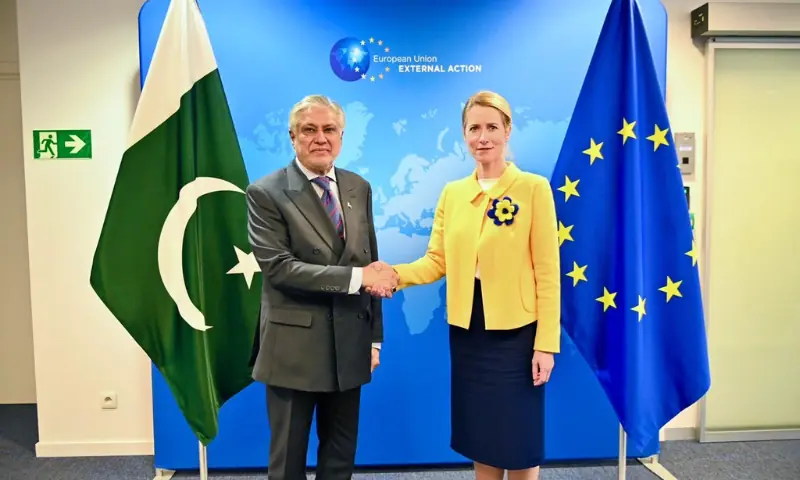
Brussels: Pakistan and the European Union (EU) have emphasized the need to further deepen trade and investment ties, leveraging the EU’s GSP+ scheme as a catalyst for sustainable growth, export diversification, job creation, and mutually beneficial economic opportunities. The announcement came during the 7th Strategic Dialogue between Pakistan and the EU, held in Brussels and co-chaired by Pakistan’s Deputy Prime Minister and Foreign Minister Ishaq Dar and EU’s chief diplomat Kaja Kallas.
The dialogue provided a comprehensive review of the full spectrum of Pakistan-EU relations, building on positive momentum from previous high-level engagements and institutional interactions, according to Pakistan’s Foreign Office. Both sides reaffirmed their commitment to a broad-based, multidimensional, and forward-looking partnership anchored in shared values, the UN Charter, multilateralism, and mutual respect.
The discussions also touched on regional and global developments, including South Asia, Afghanistan, the Middle East, and broader geopolitical issues. The parties underlined the importance of coordinated approaches to peace, stability, sustainable development, and addressing global challenges such as climate change and connectivity. Pakistan and the EU agreed to strengthen cooperation under the Strategic Engagement Plan, advance ongoing dialogues, and explore concrete avenues to expand collaboration in the coming years.
The GSP+ scheme allows Pakistan to export two-thirds of its tariff lines to the EU duty-free, provided it implements 27 international conventions covering human rights, labor rights, good governance, and environmental protection. EU Ambassador to Pakistan Raimundas Karoblis recently stressed that Pakistan must do more to fulfill its GSP+ commitments ahead of the next review.
During the dialogue, Deputy Prime Minister Ishaq Dar also highlighted critical maritime security challenges, calling them both multidimensional and transnational. He noted that Pakistan’s strategic location along the Arabian Sea a gateway linking Central Asia to global trade makes maritime security central to national defense, economic resilience, and food and energy security. Dar emphasized that piracy, terrorism, trafficking, cyber vulnerabilities, marine pollution, and climate-induced risks are pressing concerns requiring regional and international cooperation.
Dar stressed that maritime security and economic development are mutually reinforcing and outlined Pakistan’s efforts to strengthen its Joint Maritime Information Coordination Centre, integrating satellite monitoring and AI-enabled vessel tracking with support from Suparco. He called for global collaboration, technological partnerships, regulatory exchanges, and capacity-building to ensure oceans remain zones of peace, prosperity, and shared progress, warning against exclusionary or hegemonic approaches.
He concluded that connectivity, resilience, and sustainable maritime governance must be anchored in international law, transparency, and mutual trust, while disputes should be resolved peacefully, ensuring ocean resources remain a common heritage of humanity.