

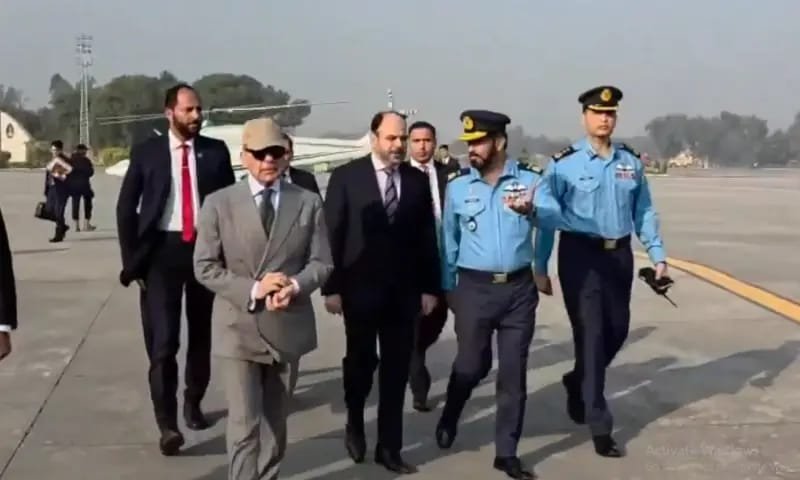
Prime Minister Shehbaz Sharif departed for Bahrain on Wednesday for an important two-day official visit that is expected to open a new chapter in Pakistan’s diplomatic and economic engagement with the Gulf kingdom. His departure was accompanied by a high-level delegation comprising Deputy Prime Minister Ishaq Dar, federal ministers, and senior officials who will assist in negotiations and policy-level discussions across various sectors. The composition of the delegation itself reflects the significance Pakistan is attaching to this visit.
The visit comes at a time when Pakistan and Bahrain have been steadily enhancing their bilateral contacts, setting the stage for deeper cooperation. Pakistani officials noted before the departure that the objective of the visit is not only to reinforce the historically warm ties between the two nations but also to explore fresh avenues for strategic collaboration. Talks during the visit are expected to revolve around scaling up investment, expanding bilateral trade, initiating joint ventures in the energy sector, enhancing technological cooperation, boosting skilled workforce training, and cultivating stronger educational and cultural exchanges.
During his stay, the Prime Minister will engage in extensive discussions with Bahrain’s leadership, including King Hamad bin Isa Al Khalifa, Crown Prince and Prime Minister Salman bin Hamad Al Khalifa, and Deputy Prime Minister Sheikh Khalid bin Abdullah Al Khalifa. These conversations are expected to cover issues of mutual interest, regional developments, and long-term strategic partnerships. Officials believe that these meetings will help lay the groundwork for future agreements and projects that will benefit both sides.
The groundwork for this visit had, in fact, been laid over the past several months through steady diplomatic engagement. Recently, the first meeting of the Pakistan–Bahrain Parliamentary Friendship Group produced a series of commitments aimed at deepening cooperation in multiple sectors. Both sides agreed to establish a joint working group to advance collaboration in counter-narcotics operations, counterterrorism measures, coastal security, border management, immigration reforms, and professional police training. Additionally, both countries had signaled their intent to finalize several memoranda of understanding related to extradition procedures, mutual legal assistance, and the training of specialized security units.
This diplomatic momentum was further strengthened during a separate meeting between Pakistan’s interior minister and his Bahraini counterpart earlier this year. Both sides agreed to enhance cooperation in counterterrorism, anti-narcotics operations, and immigration system reforms. This demonstrated a strong mutual desire not only to improve security coordination but also to establish long-term institutional linkages between their law-enforcement bodies.
Beyond the governmental level, the visit is also expected to positively impact the large Pakistani expatriate community living in Bahrain. Pakistani officials believe the discussions will help create new employment opportunities, expand skills-training initiatives, and improve services for overseas Pakistanis residing in the kingdom. Given the significant contribution of the Pakistani community to Bahrain’s workforce and economy, both governments see value in strengthening people-to-people ties and ensuring better socio-economic support systems.
Observers note that this visit holds particular importance within the wider regional and global context. Pakistan has been actively working to strengthen its economic diplomacy with Gulf nations, especially in areas such as investment, energy partnerships, infrastructure development, and technological exchange. Bahrain, due to its strategic economic position and growing interest in diversified partnerships, is considered a valuable ally for Pakistan in these pursuits. Analysts expect that discussions held during this trip will pave the way for new projects related to industrial cooperation, energy solutions, technology transfer, and enhanced financial collaboration.
In a broader sense, the visit represents an opportunity for both countries to elevate their relationship beyond traditional diplomatic ties and move towards a more result-oriented partnership. It may allow Pakistan and Bahrain to coordinate more closely on global issues, support each other in regional matters, and build frameworks for sustainable long-term cooperation across multiple sectors. With growing geopolitical shifts in the Gulf region, both sides appear keen to anchor their relationship in economic, strategic, and social foundations that will endure far into the future.
This two-day visit is being viewed as a significant step toward transforming Pakistan–Bahrain relations into a more dynamic, mutually beneficial, and comprehensive partnership—one that strengthens strategic cooperation, expands economic opportunities, and deepens the bonds between the peoples of both nations.