

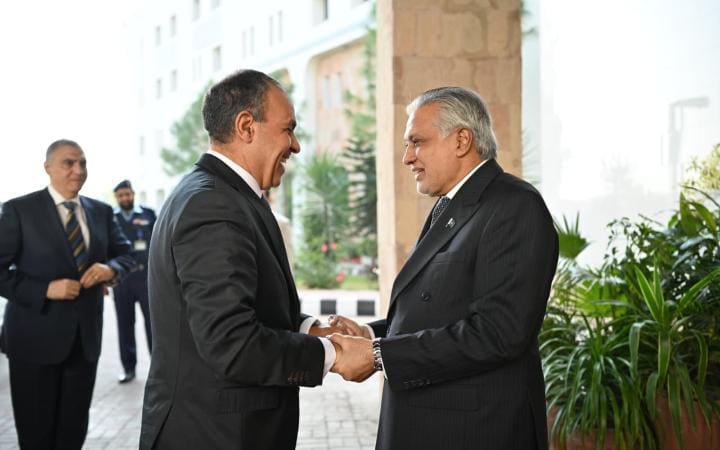
Egyptian Foreign Minister Badr Abdelatty arrived in Islamabad late on Saturday night for a two-day official visit, marking a significant step in the longstanding relations between Pakistan and Egypt. His visit, aimed at strengthening bilateral ties across multiple sectors, included high-level meetings with key Pakistani leaders, including President Asif Ali Zardari, Foreign Minister Ishaq Dar, and Chief of Army Staff Field Marshal Asim Munir.
Upon his arrival, Abdelatty first met with Field Marshal Munir at the General Headquarters in Rawalpindi. The discussions centered on a wide range of defence and security topics, including military cooperation, joint training programs, personnel exchanges, and regional stability. Both leaders reaffirmed their commitment to maintaining continuous high-level engagement between the armed forces of their respective countries, emphasizing the importance of strategic collaboration to address evolving security challenges in the region.
Following the meeting with the army chief, Abdelatty paid a courtesy call on President Zardari at Aiwan-i-Sadr. During their discussion, the president highlighted Pakistan’s long-standing relationship with Egypt, rooted in shared faith, mutual respect, and common interests.
Zardari expressed his desire to advance this partnership further through structured and forward-looking initiatives, covering areas such as trade, investment, cultural exchange, and people-to-people connections. He also conveyed warm regards to Egyptian President Abdel Fattah El-Sisi and noted that 2025 marks seventy-seven years of diplomatic relations between the two nations. He urged that both countries take active measures to reinvigorate cooperation, particularly in commerce and industry.
President Zardari encouraged Egyptian investors to explore emerging opportunities across multiple sectors of Pakistan’s economy, including energy, logistics, construction, agriculture, mining, and information technology. He emphasized that a strategic and coordinated approach could further enhance economic ties and generate mutual benefits for both countries. In response, Minister Abdelatty delivered a message from President El-Sisi, expressing Egypt’s keen interest in expanding collaboration with Pakistan in various fields, ranging from commerce and industry to education and cultural exchange.
A separate meeting with Foreign Minister Ishaq Dar preceded the president’s audience. The two ministers engaged in a focused dialogue about boosting business-to-business interactions between Pakistan and Egypt, aiming to elevate bilateral trade, which Dar described as not yet reflective of the countries’ potential. As a practical step, Pakistan will compile a list of 250 prominent business houses across key sectors, which will be shared with Egypt to facilitate and enhance commercial engagement. The list, curated by the Federation of Pakistan Chambers of Commerce & Industry (FPCCI) in coordination with other chambers, will undergo due diligence to ensure transparency and commitment from participating firms.
Dar explained that these companies would initially form a “white list” of trusted and active participants, with subsequent rounds expanding the list to 500 businesses to maximize economic cooperation. Furthermore, both countries agreed to establish a Pakistan-Egypt Business Council to institutionalize private-sector collaboration, promote bilateral trade, and facilitate mutually beneficial partnerships. The council will eventually lead to the creation of a Pakistan-Egypt Business Forum, co-chaired by the two foreign ministers, with its inaugural meeting scheduled in Cairo in the second quarter of 2026.
The discussions also addressed political and regional developments, including the ongoing humanitarian and security challenges in Gaza. Abdelatty reaffirmed Egypt’s role in facilitating peace and supporting the ceasefire, emphasizing its commitment to a just resolution of the Israeli-Palestinian conflict. Both ministers highlighted the necessity of respecting sovereignty, adhering to international law, and promoting peaceful conflict resolution.
Abdelatty further stressed the importance of a two-state solution based on pre-1967 borders, with East Jerusalem as the capital of a sovereign Palestinian state, as the only viable path to lasting regional stability. Pakistan’s consistent support for Egypt’s diplomatic efforts was acknowledged and appreciated during the meetings.
The Egyptian Foreign Minister also took the opportunity to express condolences over recent terrorist attacks in Islamabad and Peshawar, affirming Egypt’s solidarity with Pakistan in combating extremism and terrorism. He shared insights into Egypt’s holistic approach to countering terrorism, which integrates security measures with socio-economic interventions and religious guidance through institutions such as Al-Azhar University, Dar al-Ifta, and the Ministry of Waqf. Abdelatty highlighted the potential for Pakistan and Egypt to collaborate in promoting moderate religious discourse and countering extremist ideology by leveraging the intellectual and spiritual leadership of these institutions.
Security cooperation remained a key topic, with both sides agreeing to intensify coordination to counter cross-border terrorism and extremism. The meetings underscored the importance of mutual support, information sharing, and strategic alignment to enhance regional security. Beyond security, the ministers also discussed enhancing cultural, educational, and people-to-people exchanges, recognizing that such engagement strengthens mutual understanding and reinforces the bonds between the two nations.
Abdelatty described Pakistan as his “second home country,” reflecting the depth of the friendship between the two nations. He acknowledged the cordial relations shared at the governmental, military, and civil levels and highlighted shared challenges in political, economic, and security spheres. He emphasized that peace, stability, and development form the pillars of a strategic partnership, and expressed Egypt’s desire to elevate bilateral relations to a strategic level.
Both leaders assessed opportunities for institutionalizing dialogue through mechanisms like the Joint Ministerial Commission (JMC), which had not convened for several years. Plans were made to hold the next meeting of the JMC, with Pakistan and Egypt preparing a comprehensive agenda covering all aspects of cooperation, including political consultation, economic collaboration, trade, investment, security, religious and cultural affairs. A roadmap for sustained cooperation is expected to guide bilateral efforts in the years ahead.
During the interactions, the ministers also discussed Pakistan’s role in facilitating humanitarian and diplomatic initiatives, particularly in support of the Palestinian people. Egypt reaffirmed its commitment to close coordination with Pakistan to address challenges in Gaza, the West Bank, and the broader Middle East. Both sides stressed that joint diplomatic efforts, grounded in international law, are crucial for long-term peace and stability. Additionally, Egypt announced the doubling of scholarships for Pakistani students at Al-Azhar University, particularly in programs focused on countering extremism through moderate religious education.
Abdelatty and Dar reflected on multiple previous interactions throughout the year, noting that these engagements had reinforced trust and mutual understanding. They highlighted the importance of continued dialogue at multilateral forums, global conferences, and international summits to strengthen bilateral relations and address shared challenges. The discussions reiterated the importance of leveraging historical, cultural, and religious ties to deepen cooperation across multiple domains, including defence, trade, investment, education, and culture.
The meetings concluded with mutual assurances to further develop institutional mechanisms and implement practical measures to enhance bilateral trade, investment, and defence cooperation. Both Pakistan and Egypt affirmed their commitment to reinforcing friendship, promoting peace and stability in the region, and expanding avenues for practical collaboration in political, economic, security, and cultural spheres. Abdelatty underscored that “the sky is the limit” for cooperation, signaling Egypt’s readiness to explore all possibilities for partnership.
Overall, the visit reinforced the strategic friendship between Pakistan and Egypt, showcasing mutual commitment to strengthening defence ties, boosting economic engagement, and promoting regional stability. Both nations expressed optimism that the outcomes of this visit, including the establishment of business forums, scholarship programs, and institutionalized cooperation through the JMC, would pave the way for a new era of practical and sustainable collaboration.