

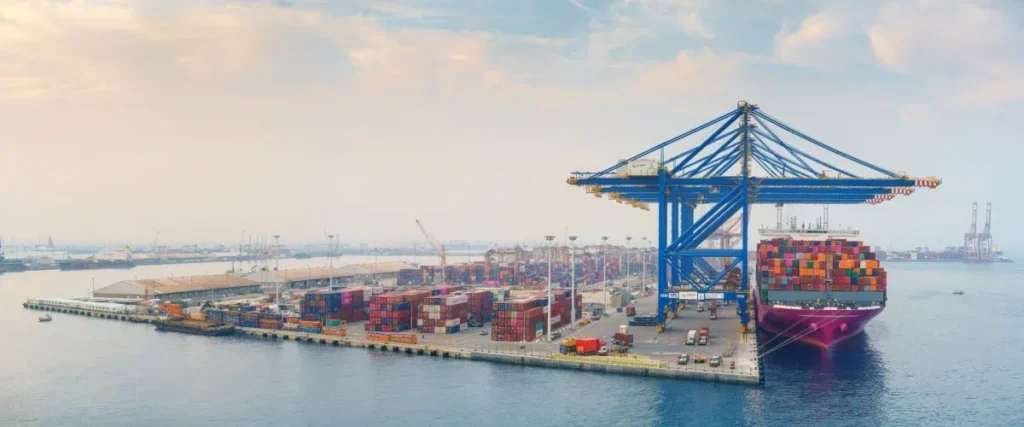
Saudi Arabia has taken a significant step toward strengthening its food-security system and modernizing its port-based logistics network by initiating a major development project at King Abdulaziz Port in Dammam. This effort is being carried out under a SR200 million agreement between the Saudi Ports Authority — widely known as Mawani — and the Arabian Agricultural Services Company, Arasco. The contract was formally signed by Mawani’s president, Suliman bin Khalid Al-Mazroua, and Arasco’s CEO, Ziyad A. Alsheikh, marking an important expansion in the Kingdom’s long-term logistical ambitions. The initiative directly supports Saudi Arabia’s National Transport and Logistics Strategy, which aims to position the Kingdom as a central bridge for trade between Asia, Africa, and Europe.
This partnership has drawn attention not merely because of its financial value but because of the broader vision behind it. For years, Saudi Arabia has been working to upgrade its ports so they align with global standards and rising international trade demands. Mawani emphasized that the new contract is more than just a construction project; it is a cornerstone of the Kingdom’s mission to enhance speed, accuracy, and resilience across national supply chains. The expansion at King Abdulaziz Port is expected to escalate the port’s efficiency to unprecedented levels, further strengthening its role as one of the Gulf region’s most important maritime gateways.
At the heart of this development lies a 40,000-square-meter integrated logistics facility, which will be equipped with modern technologies designed specifically for the swift handling, processing, and distribution of food-related cargo. Instead of serving as a simple storage area, the new facility will integrate advanced systems that support continuous movement of goods through the port. Incoming food shipments will be processed more quickly, categorized with precision, and connected seamlessly to transportation routes that extend across the Kingdom. This will enable faster flow of commodities, reduce operational bottlenecks, and ensure smoother national and regional distribution.
One of the most critical components of the project is the establishment of new grain storage silos that will greatly enhance the country’s reserve capabilities. These silos are engineered to safely store up to 100,000 metric tons of grain, a capacity that significantly reinforces Saudi Arabia’s strategic food-security infrastructure. Such storage capability is vital not only for emergency situations but also for meeting the country’s long-term nutritional and population growth needs. As global food markets face volatility and supply disruptions, this kind of storage enhancement provides the Kingdom with an important cushion of stability.
The development is not limited to storage alone. Cutting-edge equipment will be used to streamline port-side operations, including advanced ship-unloading mechanisms, high-speed conveyor belt systems, and specialized loading facilities for vehicles transporting goods inland. These systems will create a direct, highly efficient operational link between Berths 37 and 39, ensuring that ships can offload cargo quickly and with minimal downtime. The improved machinery will reduce vessel turnaround times — one of the most important performance metrics in global maritime operations — and help the port handle a consistently rising volume of cargo without congestion.
Beyond operational upgrades, the project carries strong socio-economic value. It is expected to generate over 3,000 direct and indirect jobs, opening doors for technicians, engineers, logistics specialists, and workers in related fields. As these new facilities become operational, the demand for training, skill-building, and technical expertise is likely to increase, fostering local workforce development in sectors such as food handling, maritime operations, machinery maintenance, and supply chain management. This plays directly into Saudi Arabia’s broader economic diversification goals and its plans to create new employment avenues for the local population.
Regionally, the new center is expected to become a major stabilizing force for the Gulf’s food-supply network. Saudi Arabia’s geographic position already makes it a crucial node in the movement of essential goods throughout the Middle East. By establishing a state-of-the-art food logistics hub at one of its most strategic ports, the Kingdom will be better equipped to support regional markets during times of increased demand or global uncertainty. As the world faces rising logistics costs, trade disruptions, and supply chain vulnerabilities, Saudi Arabia’s enhanced capacity will allow it to function as a buffer and support its neighbors with more reliable distribution capabilities.
King Abdulaziz Port itself stands as one of the most powerful maritime facilities in the region, with 43 fully operational berths and an annual capacity exceeding 105 million tons of cargo and containers. The port is a major linkage between Saudi Arabia’s Eastern Province and international markets, playing a central role in the movement of industrial, agricultural, and commercial goods. This new expansion is expected to elevate its global standing even further, making it more attractive to international logistics companies seeking strong regional partnerships and faster access to Gulf and Asian markets.
The project aligns closely with the core principles of Saudi Vision 2030, which promotes infrastructure modernization, institutional efficiency, and strong private-sector participation as pillars of national progress. The collaboration between Mawani and Arasco is a clear demonstration of the Kingdom’s commitment to involving private enterprises in transformative development initiatives. Such partnerships are seen as vital for accelerating innovation and expanding economic opportunities in a rapidly changing global trade environment.
In a broader sense, this development is not only about enhancing a port’s capacity — it represents a strategic move that strengthens Saudi Arabia’s long-term economic, logistical, and food-security architecture. As the facility becomes operational, it will contribute to a more reliable supply chain, stimulate commercial activity across the Kingdom, and support the wider regional economy. Analysts argue that the project could become a “game-changing” advancement in the Gulf’s logistics landscape, propelling Saudi Arabia into a leading position in global trade routes for decades to come.