

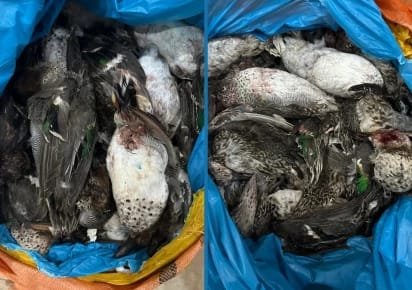
An illegal wildlife trafficking attempt was uncovered in central Punjab when authorities intercepted a passenger vehicle and discovered thousands of dead wild birds being transported across districts, exposing yet another instance of organized wildlife smuggling in the province. The incident took place in Khanewal, where officials from the Punjab Wildlife Department acted on prior intelligence and launched a targeted enforcement operation that led to the seizure of a massive consignment intended for onward delivery to Okara.
According to officials familiar with the operation, the action was initiated after the department received confidential information indicating that a large quantity of protected wild birds was being moved from Karachi toward Punjab through public transport. Acting swiftly on this tip-off, senior wildlife officials authorized a field operation and deployed a team to intercept the suspected vehicle before it could reach its destination. A temporary checkpoint was established on a key route used by intercity buses, allowing officers to closely monitor incoming traffic from Sindh.
The enforcement activity was carried out under the oversight of Deputy Chief Wildlife Ranger Multan, Dr. Sajjad Hussain, who coordinated the operation with local wildlife authorities. Assistant Chief Wildlife Ranger Khanewal, Munawar Hussain Najmi, led the on-ground team responsible for stopping and inspecting the suspected bus. Wildlife personnel conducted a detailed search of the vehicle upon its arrival from Karachi, carefully examining luggage compartments and cargo sections commonly used to conceal illegal consignments.
During the inspection, officials uncovered multiple packages containing dead wild birds, tightly packed and prepared for transport. Upon counting and identification, the seized consignment was found to include an alarmingly large number of birds belonging to several species commonly targeted in illegal wildlife trade. The recovery included thousands of sparrows, a significant number of mynas and bulbuls, as well as ducks and a pair of partridges. Authorities confirmed that none of the birds were alive at the time of seizure, indicating that they had likely died due to inhumane handling, suffocation, or prolonged transport under harsh conditions.
In total, wildlife officials recovered 7,702 dead birds from the bus. This included 4,304 sparrows, approximately 3,200 mynas and bulbuls combined, 196 ducks, and two partridges. The scale of the seizure immediately raised serious concerns within the department, as such numbers point toward a well-organized supply chain rather than an isolated act of poaching. Officials noted that sparrows and mynas are often captured in large quantities due to high demand in illegal markets, while ducks and partridges are typically trafficked for consumption or sale in specialty markets.
Further investigation revealed that the consignment had been formally booked for transport under the name of an individual identified as Rafiq, who is reported to be a resident of Okara. Wildlife authorities believe the birds were being shipped to Punjab for illegal sale, possibly to traders or intermediaries involved in black-market wildlife dealings. Officials stated that documentation used to book the consignment was being examined, and efforts were ongoing to trace the full network involved in capturing, transporting, and intended distribution of the birds.
Following the seizure, the Punjab Wildlife Department initiated legal proceedings under the relevant wildlife protection laws. Officials confirmed that steps were being taken to locate and arrest the individual named in the booking records, along with any accomplices who may have facilitated the transportation. The department also indicated that coordination with other law enforcement agencies may be required to investigate whether similar consignments have previously passed through the same route undetected.
Senior wildlife officials described the operation as a critical success, emphasizing that such enforcement actions are essential to curbing the illegal exploitation of wildlife. They pointed out that the smuggling of wild birds not only violates conservation laws but also poses ecological risks by disrupting natural populations and biodiversity. Many of the species recovered play an important role in local ecosystems, including pest control and seed dispersal, and their large-scale removal from the wild can have long-term environmental consequences.
Authorities also expressed concern over the cruelty involved in such trafficking. Transporting live birds in cramped and unsuitable conditions often results in high mortality rates, while the recovery of thousands of dead birds highlights the severe suffering inflicted during capture and transit. Wildlife officials stressed that public transport vehicles are frequently misused for illegal trade due to their accessibility and the assumption that routine checks will be minimal, making intelligence-led operations crucial in detecting such crimes.
The Punjab Wildlife Department reiterated its commitment to strengthening surveillance and enforcement across the province, particularly along major transit routes used by smugglers. Officials stated that similar operations would continue in coordination with district administrations to deter wildlife crimes and send a clear message that violations will be met with strict legal action. They also urged the public and transport operators to remain vigilant and report any suspicious activity related to wildlife trafficking.
This incident has once again drawn attention to the ongoing challenges faced by wildlife protection agencies in Pakistan, where illegal hunting and trade continue despite existing laws. Officials emphasized that effective enforcement, combined with public awareness and inter-provincial cooperation, is essential to protecting wildlife and preserving ecological balance. As investigations continue, authorities hope that the arrests stemming from this case will help dismantle broader networks involved in the illegal trade of wild birds and prevent similar incidents in the future.